ARTISTS


At close quarters
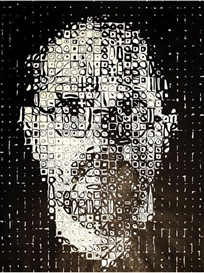
To see a portrait painting by Chuck Close as a portait, you cannot look at it. You must notice it, glancingly. I have a personal edge in this regard
Peter Schjeldahl / Village Voice
09 Jan, 1996

To see a portrait painting by Chuck Close as a portait, you cannot look at it. You must notice it, glancingly. I have a personal edge in this regard because the years have fuzzed my unaided eyesight. When I take off my glasses in the presence of a Close, the painting`s image jumps toward clarity. It doesn`t arrive there, of course. You would need to be halfblind in semidarkness to reduce the squiggled grid of a Close portrait to something like the speaking photograph from which it was derived.
It is fun at PaceWildenstein to watch viewers do the old how-to-look-at-Impressionism dance, walking backward in hopeful antipation ofan illusionistic voila] They should forget about it or ride bicycles, checking back over their shoulders now and then. (About the length of a football field might do it.) These wonderful paintings are not about familiar pleasures of paint resolving into images but about rare joys of swimming in baroque fields of representation-in-action. They evoke the Eros of gazing at someone you love, whose face fills your vision even from across a room. You don`t actually see that person more clearly than if you were kissing her or him, which in your mind you are.
We can all fit into the big-tent erotic field of Chuck Close`s art if we want to. This almost spookily triumphant show, which has been extended an extra week, confirms Close`s standing as New YorKs virtual artist laureate. We never had an artist laureate before. (Willem de Kooning and Jasper Johns were too lofty, and Andy Warhol too, well, rampant.) Close`s work and persona precipitate a community of serious art workings and the city`s pancultural elite (roughly, those whose tickets are stamped in the Times and/or The New Yorker). He thereby squares social circles that normally fear and frequently disdain each other.
So mighty is the Close bandwagon that its one apparent recent setback, the artist`s cancellation of a retrospective scheduled for 1997 at the Met over his unhappiness with the rooms offered for it, has impressed most observers as a loss to the museum, not the artist. Maybe only Close could effectively expose, as, finally, an embarrassment, the Met`s cluelessly arrogant attitudes toward contemporary art. Someone else might be dismissed as an ingrate, but Close has too much credit. People sense that it is not a matter of ego with him, but of doing a thing properly or not at all.
Artistically, Close`s achievement is a grand synthesis of disparate American aesthetics, including Photo Realist rendering and Postminimalist process, on a chassis of Abstract Expressionism. His work distills New York painting tradition in ways that commune with all manner of past masters. I fancy that Close splits differences between Roy Lichtenstein and Philip Guston, say, and among Warhol, Alex Katz, and Elizabeth Murray. The most collegial of artists, he seems held in a radiating web of respect, ageeing alike with those who treat painting as a deadpan expedient and with those for whom it is alchemy.
The optimum beholding distance for a Close, once you`ve relaxed your struggle to wrest a face from it, is midrange, where you can best take in both whole and parts. Each grid square or diamond is a painting in itself, a luscious little tone poem (in pictures that are black and white, with whispers of umber and blue) or color cadenza (sometimes echoing sensual pink-green-yellow chords of classic de Kooning). The effect is orderly anarchy, like a mass marching drill of jazz dancers. Let yourself be tossed around in and by it until pleasantly tired.
As a poet of social relations, Close deems languishing liberal fantasies of another oxymoron, democratic aristocracy. He used to paint strictly family and friends, as jealously intimate in his selection of subjects as he was professionally taciturn in picturing them. Recently, he has opted to portray esteemed fellow artists whose identities appear to flesh out a communitarian ideal. In anybody else`s hands, the gesture might be tokenish, but when Close presents a fine old-time homosexual, Paul Cadmus, and a brilliant young black woman, Lorna Simpson, the choices exude mainly gratitude--less affirmative action than affirming humility, noblesse oblige as a two-way street. Close projects a world where kindness is a privilege, given and received, that attests to all one`s values.
Speaking of so-called minorities, it is well known that Close is almost totally quadriplegic, having been devastated by a freakish blood clot in his upper spine while on a dais at Gracie Mansion in 1988. His nearly fatal ordeal and grueling recovery are detailed in a new book by John Guare, Chuck Close: Life and Work 1998-1995 (Thames and Hudson), that limns a sparkling word portrait of the man. There is no point in pretending that personal charm laced with a disarming refusal of pity doesn`t inform Close`s popularity, as he himself is aware. He assesses his own naturally obliging personality with cool candor, noting to Guare that for anyone in so dependent a physical condition, "If you`re not a cooperator, you`re shit out of luck."
In art terms, the book is a cheerful shaggydog story. It naces the author`s inquiry into the effects of Close`s disability on his painting, only to conclude that there are hardly any. Close was already tending toward coarser mark-making in 1988. Having to paint with brushes Velcro-strapped to the back of his hand (on canvases he moves up and down by activating hydraulic machinery) simply sped up the development, whose results--the best work by far in a never less than first-rate career--speak for themselves. Such are the perverse interactions of human sympathy and dread that I suppose someone (myself in a certain state) could respond negatively to the very guilt-absolving reassurance that Close grants: how dare he let me off the hook of harrowing compassion that thank God he lets me off the hook of] It can`t be much fun to confront the squirminess of those who are known in the wheelchair set, Close tells Guare with a smile, as the "temporarily abled." To be neither a victim nor a poster child of his misfortune is Close`s moral determination and feat.
Close`s life and art mesh. Their common terms are ethical commitment to reality (what is the case on every level, in all ways) and a preference for grade. He takes stony truths head-on while declining to be doleful or angry about them. The tumbling, streaming visual facts that inundate us int eh field of his art instruct without pedantry and please without pandering. They do so on a palatial sort of scale, the traditionally heroic mode of New York painting turned opulent and sociable. A taste for Close advertises courtly maturity among New York culturati. You got a problem with that?
COPYRIGHT: Copyright Village Voice Jan 9, 1996. Provided by Proquest- CSA, LLC. All Rights Reserved. Only fair use as provided by the United States copyright law is permitted.
PROQUEST-CSA, LLC- MAKES NO WARRANTY REGARDING THE ACCURACY, COMPLETENESS, OR TIMELINESS OF THE LICENSED MATERIALS OR ANY WARRANTY, EXPRESS OR IMPLIED.
It is fun at PaceWildenstein to watch viewers do the old how-to-look-at-Impressionism dance, walking backward in hopeful antipation ofan illusionistic voila] They should forget about it or ride bicycles, checking back over their shoulders now and then. (About the length of a football field might do it.) These wonderful paintings are not about familiar pleasures of paint resolving into images but about rare joys of swimming in baroque fields of representation-in-action. They evoke the Eros of gazing at someone you love, whose face fills your vision even from across a room. You don`t actually see that person more clearly than if you were kissing her or him, which in your mind you are.
We can all fit into the big-tent erotic field of Chuck Close`s art if we want to. This almost spookily triumphant show, which has been extended an extra week, confirms Close`s standing as New YorKs virtual artist laureate. We never had an artist laureate before. (Willem de Kooning and Jasper Johns were too lofty, and Andy Warhol too, well, rampant.) Close`s work and persona precipitate a community of serious art workings and the city`s pancultural elite (roughly, those whose tickets are stamped in the Times and/or The New Yorker). He thereby squares social circles that normally fear and frequently disdain each other.
So mighty is the Close bandwagon that its one apparent recent setback, the artist`s cancellation of a retrospective scheduled for 1997 at the Met over his unhappiness with the rooms offered for it, has impressed most observers as a loss to the museum, not the artist. Maybe only Close could effectively expose, as, finally, an embarrassment, the Met`s cluelessly arrogant attitudes toward contemporary art. Someone else might be dismissed as an ingrate, but Close has too much credit. People sense that it is not a matter of ego with him, but of doing a thing properly or not at all.
Artistically, Close`s achievement is a grand synthesis of disparate American aesthetics, including Photo Realist rendering and Postminimalist process, on a chassis of Abstract Expressionism. His work distills New York painting tradition in ways that commune with all manner of past masters. I fancy that Close splits differences between Roy Lichtenstein and Philip Guston, say, and among Warhol, Alex Katz, and Elizabeth Murray. The most collegial of artists, he seems held in a radiating web of respect, ageeing alike with those who treat painting as a deadpan expedient and with those for whom it is alchemy.
The optimum beholding distance for a Close, once you`ve relaxed your struggle to wrest a face from it, is midrange, where you can best take in both whole and parts. Each grid square or diamond is a painting in itself, a luscious little tone poem (in pictures that are black and white, with whispers of umber and blue) or color cadenza (sometimes echoing sensual pink-green-yellow chords of classic de Kooning). The effect is orderly anarchy, like a mass marching drill of jazz dancers. Let yourself be tossed around in and by it until pleasantly tired.
As a poet of social relations, Close deems languishing liberal fantasies of another oxymoron, democratic aristocracy. He used to paint strictly family and friends, as jealously intimate in his selection of subjects as he was professionally taciturn in picturing them. Recently, he has opted to portray esteemed fellow artists whose identities appear to flesh out a communitarian ideal. In anybody else`s hands, the gesture might be tokenish, but when Close presents a fine old-time homosexual, Paul Cadmus, and a brilliant young black woman, Lorna Simpson, the choices exude mainly gratitude--less affirmative action than affirming humility, noblesse oblige as a two-way street. Close projects a world where kindness is a privilege, given and received, that attests to all one`s values.
Speaking of so-called minorities, it is well known that Close is almost totally quadriplegic, having been devastated by a freakish blood clot in his upper spine while on a dais at Gracie Mansion in 1988. His nearly fatal ordeal and grueling recovery are detailed in a new book by John Guare, Chuck Close: Life and Work 1998-1995 (Thames and Hudson), that limns a sparkling word portrait of the man. There is no point in pretending that personal charm laced with a disarming refusal of pity doesn`t inform Close`s popularity, as he himself is aware. He assesses his own naturally obliging personality with cool candor, noting to Guare that for anyone in so dependent a physical condition, "If you`re not a cooperator, you`re shit out of luck."
In art terms, the book is a cheerful shaggydog story. It naces the author`s inquiry into the effects of Close`s disability on his painting, only to conclude that there are hardly any. Close was already tending toward coarser mark-making in 1988. Having to paint with brushes Velcro-strapped to the back of his hand (on canvases he moves up and down by activating hydraulic machinery) simply sped up the development, whose results--the best work by far in a never less than first-rate career--speak for themselves. Such are the perverse interactions of human sympathy and dread that I suppose someone (myself in a certain state) could respond negatively to the very guilt-absolving reassurance that Close grants: how dare he let me off the hook of harrowing compassion that thank God he lets me off the hook of] It can`t be much fun to confront the squirminess of those who are known in the wheelchair set, Close tells Guare with a smile, as the "temporarily abled." To be neither a victim nor a poster child of his misfortune is Close`s moral determination and feat.
Close`s life and art mesh. Their common terms are ethical commitment to reality (what is the case on every level, in all ways) and a preference for grade. He takes stony truths head-on while declining to be doleful or angry about them. The tumbling, streaming visual facts that inundate us int eh field of his art instruct without pedantry and please without pandering. They do so on a palatial sort of scale, the traditionally heroic mode of New York painting turned opulent and sociable. A taste for Close advertises courtly maturity among New York culturati. You got a problem with that?
COPYRIGHT: Copyright Village Voice Jan 9, 1996. Provided by Proquest- CSA, LLC. All Rights Reserved. Only fair use as provided by the United States copyright law is permitted.
PROQUEST-CSA, LLC- MAKES NO WARRANTY REGARDING THE ACCURACY, COMPLETENESS, OR TIMELINESS OF THE LICENSED MATERIALS OR ANY WARRANTY, EXPRESS OR IMPLIED.