BUY ART

Eric Green: On the Spectrum of Reality
Contemporary surrealist artist Eric Green's work invites viewers into otherworldly landscapes and dreamlike compositions that challenge the boundaries of reality
Michael Pearce / MutualArt
16 Jul, 2024
Is the red of the rose you see the same red as the color caressing the eyes of your beloved or do they witness it as the color you call purple? Does the same rich fragrant tone of the bloom drift to them in scented air, or have they learned the notes of another smell? In each generation messengers emerge from the studios and salons of bohemian spaces with art that mystifies, perplexes, and inspires attentive audiences to re-evaluate their perception of sensual reality. Sometimes their work is far ahead of our capacity to understand, and decades pass before they land in the time prepared for them. Eric Green is a messenger of other dimensions. Around the radiant edges of his objects, he sees the spectral glow of prismatic light, he sees the world like a man who fell to earth.
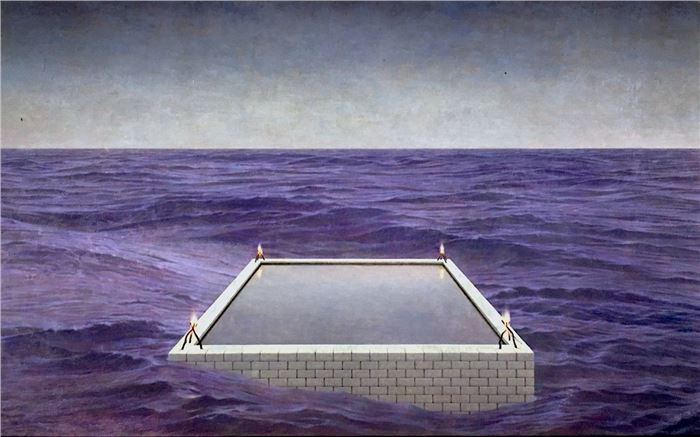 Eric Green, Pool, 1995, oil on canvas, 40" x 65"
He said, “My early work was influenced by Andrew Wyeth, Edward Hopper, Chardin, and different people that I was looking at, because that was my education. I worked hard since I was eleven, and all I did was paint and draw. I never finished high school. I got into the Rhode Island School of Design on a full four-year scholarship at sixteen years old and I didn’t really assimilate well, I left after a week.” Green abandoned a future of formal training, preferring a free and sometimes frightening life hitch-hiking thousands of miles on the open roads of America, then riding the rails of the vast network carrying freight across the continent. Still obsessed with image-making, he wanted his art to mirror the rawness and intensity of his experiences, which carried him through the extremes of life on the trains, living true stories of drugs, drunks, and death. He likened his early paintings to haiku poetry, “…where the moment of living or ‘seeing’ the poem is more important than the craft of the writing.” His superb landscape Passage VI captures that sense of anonymous freedom in the split of road and rail rising and falling through a rural landscape somewhere, anywhere, lost in the American heartland.
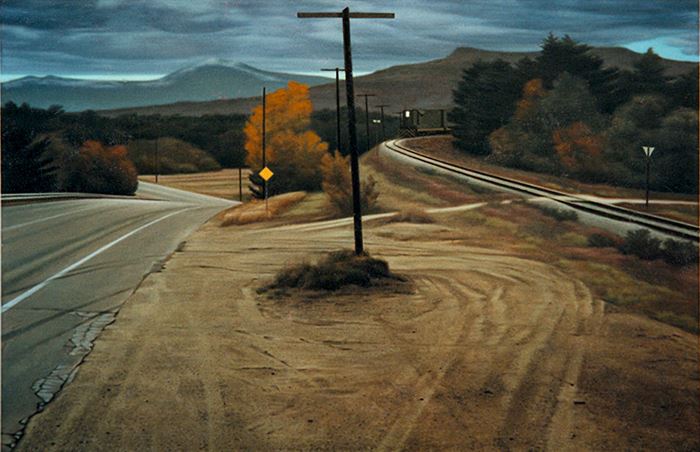 Eric Green, Passage VI, 1980, Acrylic on ungessoed Masonite panel, 32" x 48"
Hobo life on the freights was rough, but it was an improvement upon Green’s horrible childhood. Between nine and seventeen years old he was repeatedly assaulted by homosexual rapists. His parents were alcoholics. His promiscuous mother had no qualms about having sex in front of her son. His father tried to kill him in a drunken rage when he was fifteen, and he ran from his home in his underwear. Riding the trains was a relief.
It was amazing, because I saw the West, which you dream about as a kid, and I saw it for the first time from an open boxcar door by myself. I can remember every day. I almost froze to death, I almost starved to death. I was peeing absolute sienna brown urine, that’s when it’s towards the end. It was so worth it, because I also learned what I was capable of, where my limits were. I remember jumping between two cement cars at seventy miles an hour. I was terrified, because I knew it was a very difficult jump, a very long jump, and I knew if I didn’t make it, I’d be dead. And I wanted to see if I could overcome my fear and do it.
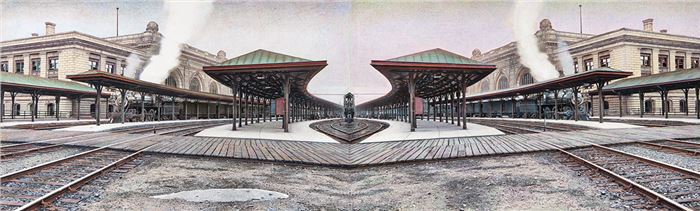 Eric Green, Mirrored Landscape for O. Winston Link, 2017, Graphite, colored pencil and acrylic with UV varnish on panel, 11" × 36"
He already understood the hobos' hunt for booze and the buzz, and their willingness to suffer through the spaces between. He saw violence and suicide on the rails and met the philosophers of the boxcars who rejected society like barreled Diogenes.
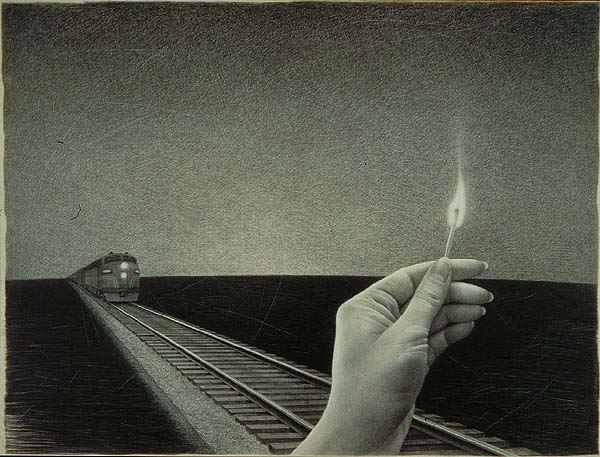
Eric Green, Train, 1997, Pencil on paper, 38" x 50"
Trains were already his obsession. Green had become fascinated by them when he was a toddler, excited to witness the clatter and rhythm of whirling wheels over weld and jointed steel, the wild whistle and the wind. Roaring locomotives and rolling stock became a lifelong fascination. He explained, “Anything trains, I just adore it. I love riding trains, I like looking at trains, I like modelling trains, and I’ve been that way since I was two years old, and I have a theory why. A train track by its very nature cannot go up steep climbs or around steep curves and must be smooth and level. And I think because my life has been so tempestuous, so turbulent, that I seek that out. I need something calming, and trains give you that.”
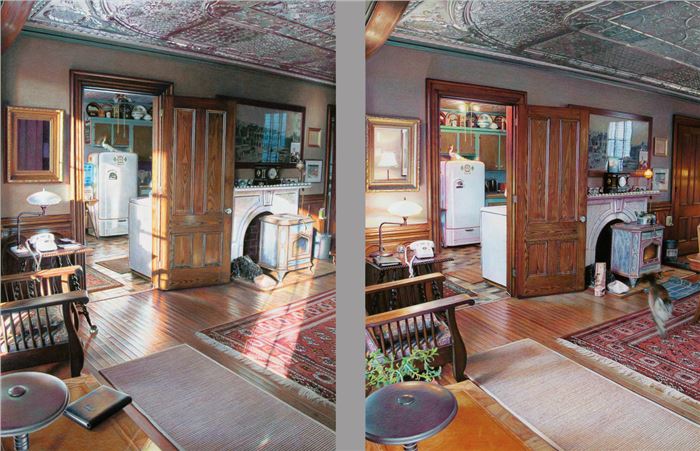
Eric Green, Peacock, 2014, coloured pencil on pencil grisaille, 16" x 25"
Green doesn’t see the world like others. He is Dave Bowman watching the floor-lit mansion set in another time, in another space. Dave Bowman, after entering the wormhole and warp of the black megalith. Green’s drawings are rainbows of color blended with layers born of intense patience, his hand building shimmering sheets created with the persistence and obsession of scrutiny – he doesn’t look at his subjects as much as he watches the way things appear, waiting for the thing itself to emerge from his watching. He is an obsessed observer of reality, visiting it from another plane. His earliest pictures show him stretching his technical ability to the limit – like his spectacularly detailed barn with plank walls broken by a thousand splits where sunlight streams though the hardened space – in his later drawings he has relaxed into the arms of Mihaly Csikszentmihalyi’s flow state, comfortable in his patient virtuosity and willing to embrace the strange places encountered on the thresholds of imagination.
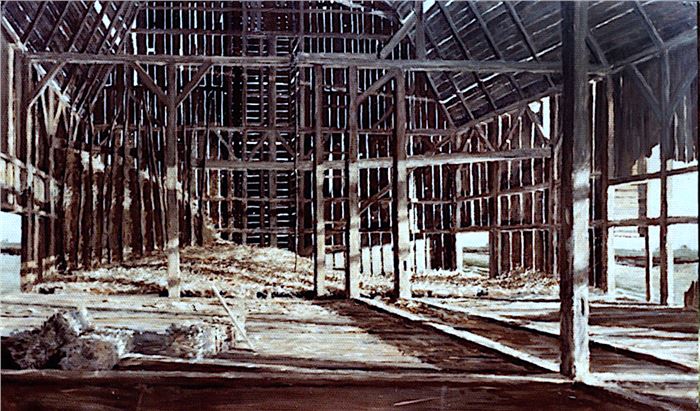 Eric Green, Barn, 1972, acrylic on panel, 32" x 50"
As a child, Green was fascinated with imagining the world upside-down, and he began drawing doubled pictures of the ceilings of his 19th century home. “I spent seventeen years restoring this house,” he said, “and that’s what I’m drawing. I already care about every detail. For me it’s like a theatre set. This is me, every color, every fabric. I installed those tin ceilings, I put in all the floors. I made the image by hand, and then I stood back and said, ‘Okay, I’m going to draw it now.’” The split drawings emphasize the depth and personality of the place, spinning the viewer’s perception to reconsider ceilings as floors, a wonderland inversion of normality making the calm drawings of benign spaces uncanny. But his fascination with perception went still deeper. He began considering the nature of time, juxtaposing two drawings of the same room, before and after endless time had wrought changes of furniture, decoration, and light. Green created the first of his time diptychs after considering how to improve upon Richard Estes’ painting Broadway, a beautifully rendered subway inlet in New York, which he greatly admired. He had a sudden revelation that by painting a second version of an image a few days – or months – after the first, he could force viewers into considering the passage of time as they looked at the drawings. He witnessed an unusual response: “You watch people look at them and they’re flashing back and forth between the two images, looking for change, and they amalgamate them in their brain, and that becomes the work of art. So, the art can only exist inside the viewer’s brain in that instant. Everything has changed, there’s not one thing that’s the same. Unlike cubism, which was trying to work its way around the object to see it, in this case from comparing two things you really see it.” The drawings are magnets for observant eyes.
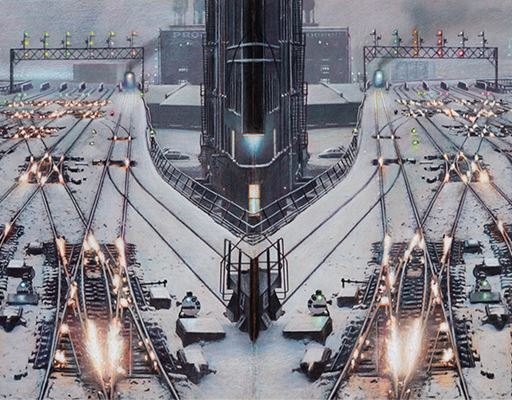
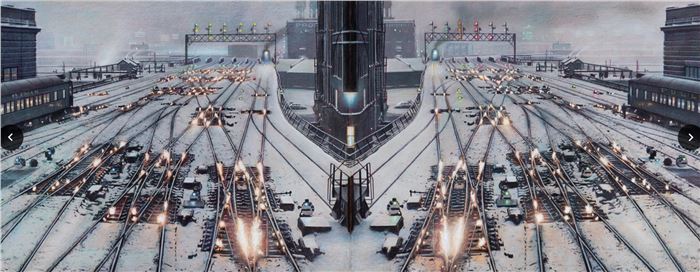 Eric Green, Mirrored Landscape with Smudge Pots, 2024, pencil on paper, 14" x 36"
He continued with the diptych format, working with mirrored images, again offering two paths into the picture and presenting a variable vision of the same world from the same position. In Mirrored Landscape with Smudge Pots, his most recent serious and significant piece, he drew the flicker and radiance of a twilight Chicago rail yard, emphasizing the intense lights of kerosene smudge-pot fires burning the ice from the frozen manifolds of complex switching points as transcendent glowing orbs, like illuminations and enlightenment, and mirrored the image to create new worlds of visionary pathways, offering a choice of journeys into alternate planes, questioning reality, questioning the nature of normal perception, questioning what it means to see. A rose is a rose is a rose, until it’s a Green.
For more on auctions, exhibitions, and current trends, visit our Magazine Page