.Jpeg\")
 Many other masterpieces have sustained harm over the past century, like Pablo Picasso’s Guernica, 1937, Claude Monet's Argenteuil Basin with a Single Sailboat, 1874, and da Vinci's The Virgin and Child with St Anne and St John the Baptist – in the name of art, to protest the government, or voice frustration of a perceived wrong. Has there ever been even a slightly positive consequence from art vandalism of any kind and for any cause? Probably not. Have the perpetrators ever profited from the act? Yes, on many occasions. In this latest version, which showed remarkably little creativity and coherence, a Frenchman dressed as a woman, pretended to be disabled and proclaimed his concern for the planet, while strangely calling on artists to heed him. Besides making a mockery of the disabled, the man achieved little with this stunt, certainly not what he claimed to be his motive –climate change awareness. There are a myriad of ways in which that issue is being tackled and awareness spread. That man did nothing to advance the cause. Instead, the only coherent parallel between act and cause that can be drawn here is the cowardice with which the act was carried out and the cowardice by which the true motive – to gain a moment in a spotlight – was hidden behind a good cause.
 BUY ART






How and Why Do Vandals Attack Art?
The Mona Lisa remained unscathed after a feebly attempted caking. Why does art continue to become the target of vandalism?
MutualArt
31 May, 2022
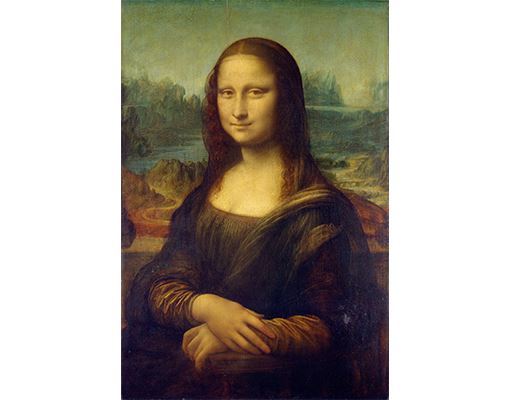
The Mona Lisa has once again become the subject of attempted art vandalism this week, when a man, wearing a wig and pretending to be disabled, rose from his wheelchair and threw a cake at the protective glass behind which the timeless face smilingly gazes back at millions of curious pairs of eyes every year. As the man was, in a curiously delicate manner, escorted out by security, he yelled in French, “Think of the Earth. There are people who are destroying the Earth. All artists, think of the Earth.” Nothing is known about the identity of the perpetrator bar that he was arrested and admitted to psychiatric care – and that the act was carried out in the noble name of climate change. What the Mona Lisa, cake, and climate change have in common remains a mystery – likely because the answer is nothing.
The Mona Lisa is of course a popular target for both art vandalism and theft. It was attacked at least three times over the last 70 years, on one occasion getting slightly damaged. In 1911 it was even successfully stolen in one of the greatest art heists of all time, the story of which you can read up on in our column here. The reasons for art vandalism vary, in the case of the Mona Lisa and of other artworks: from political and social causes to personal grievances and mental instability, some of the greatest pieces of art have at times been irreparably damaged by thoughtless and ineffectual protests of this kind.
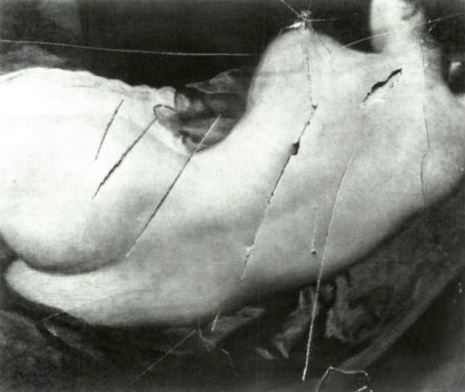
The slashes inflicted upon Diego Velasquez’ Rokeby Venus
The most famous incidence of art vandalism in the name of a social cause goes back to 1914, when Mary Richardson, a radical suffragette, attacked Diego Velasquez’ Rokeby Venus, 1651, with a meat cleaver. The 17th-century painting from the Spanish Golden Age was slashed several times, although conservators managed to fully restore the work and put it back on view. Richardson acted in response to the arrest of fellow suffragette Emmeline Pankhurst the day before (some reports suggested that the attack had been planned in advance) and later maintained it was a symbolic act, the destruction of the “most beautiful woman in mythological history,” being the result of “the Government … destroying Mrs. Pankhurst, who is the most beautiful character in modern history.” At least there’s something poetic about that.
Auguste Rodin’s The Thinker, too, was attacked in the name of “justice.” The Cleveland Museum of Art’s original cast, one of the last of its kind, wasn’t as lucky as Velasquez’ Venus. An explosion in 1970, believed to be set off by three sticks of dynamite, blew off the famous statue’s lower legs and part of the base the pensive poet sat on. No one ever was ever arrested for the act, yet it was believed that the radical left wing militant organization Weather Underground was responsible, probably protesting the US’ military action in Vietnam or the elitism of the American government. The statue was beyond repair, and after deliberations it was decided to return it on its pedestal in its damaged state.
.Jpeg)
The Thinker at the Cleveland Museum of Art. Credit: Erik Drost/Wikimedia Commons
However, most famous acts of art vandalism stem from personal grievances or mental instability. Rembrandt van Rijn’s The Night Watch, 1642, was attacked on three different occasions in the 20th century, each time by mentally ill individuals. On the second occasion, in 1975, Wilhelmus de Rijk, a former schoolteacher, slashed the monumental painting with a bread knife, claiming he was ordered to do so, “for the Lord.” He did such extensive damage that it took years to restore the work, with some remainders of the slashes still visible from up close.
Three years before, in 1972, a similar megalomaniac cost Michelangelo’s Pietà her arm, nose, and a piece of her eyelid. Hungarian-born Australian Laszlo Toth, a geologist, took to the marble statue with a hammer, getting in 15 blows while shouting “I am Jesus Christ; I have risen from the dead!” before being forcibly removed. To reconstruct the sculpture, conservators had to remove some blocks from its back, and Pietà now resides behind a bulletproof acrylic glass panel.
Then there are vandals whose act actually concerns the object of their crime. In 1986, Barnett Newman’s Who’s Afraid of Red, Yellow, and Blue III, 1967, baffled Dutch museum visitors with its huge, almost entirely red surface – so much so that Gerard Jan van Bladeren attacked it with a knife. While he was arrested and sentenced to five months in prison, many museumgoers voiced their support for the attack, believing the painting unworthy of being called art. To make matters worse, the attempted restoration only damaged the painting more, leading to another scandal. Van Bladeren returned to the Stedelijk Museum in 1997 and damaged another Newman after not finding the original object of his wrath.
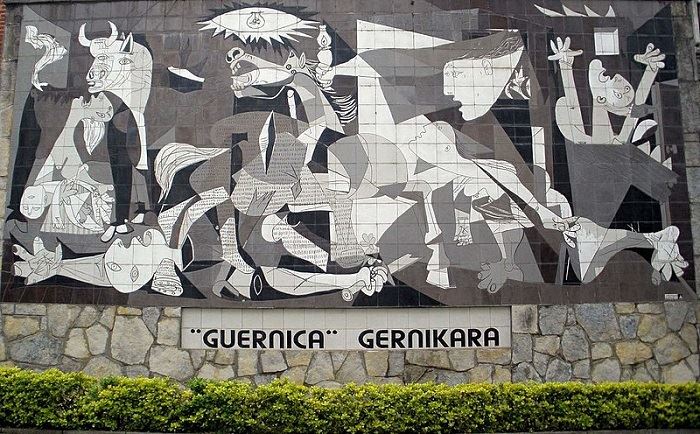 Many other masterpieces have sustained harm over the past century, like Pablo Picasso’s Guernica, 1937, Claude Monet's Argenteuil Basin with a Single Sailboat, 1874, and da Vinci's The Virgin and Child with St Anne and St John the Baptist – in the name of art, to protest the government, or voice frustration of a perceived wrong. Has there ever been even a slightly positive consequence from art vandalism of any kind and for any cause? Probably not. Have the perpetrators ever profited from the act? Yes, on many occasions. In this latest version, which showed remarkably little creativity and coherence, a Frenchman dressed as a woman, pretended to be disabled and proclaimed his concern for the planet, while strangely calling on artists to heed him. Besides making a mockery of the disabled, the man achieved little with this stunt, certainly not what he claimed to be his motive –climate change awareness. There are a myriad of ways in which that issue is being tackled and awareness spread. That man did nothing to advance the cause. Instead, the only coherent parallel between act and cause that can be drawn here is the cowardice with which the act was carried out and the cowardice by which the true motive – to gain a moment in a spotlight – was hidden behind a good cause.
For more on auctions, exhibitions, and current trends, visit our Magazine Page