ARTISTS

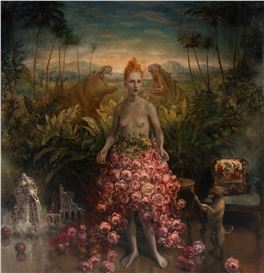
Julie Heffernan’s Fountainhead, Her Annihilation, Her Eve, Her Eden
Many of the surrealists left the mysterious landscape of the imagination largely uncharted, barely penetrating the frontiers of the subconscious. Not so Heffernan
Michael Pearce / MutualArt
Jul 29, 2020
Many of the surrealists left the mysterious landscape of the imagination largely uncharted, barely penetrating the frontiers of the subconscious. Not so Heffernan.
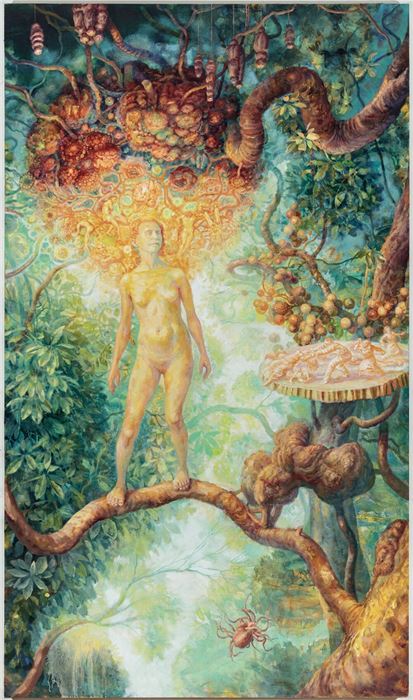
Julie Heffernan, Fountainhead, Oil on Canvas, 96x 56
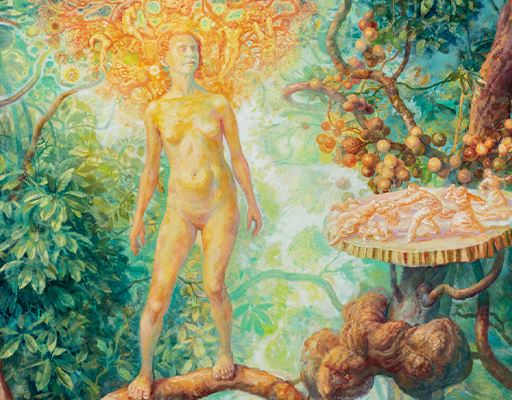
She has painted herself naked, poised high on the branch of a tall tree in a primordial forest, meditatively focused and intently inward despite the threat of a tumorous and parasitic growth clinging beside her like a deformed and gigantic ant, and beneath her a malformed arachnid mutant octopus floating mid-air, but her eyes are closed and these monstrous distractions make no impact upon her, for she is as brahman-balanced as the fruit of her organic imagination, which erupts from her head as a sphere of golden light, a visual hypotaxis of rapidly evolving forms, a transmuting ball of cells, swiftly dividing, glowing and transcendent, like an active nuclear drama of splitting atoms, expanding vivid clusters of swollen berries which erupt as fertile balls, potent and wonderful, but some cancerous, for among the images birthed early in this fecund and awe-inspiring outpouring of ideas are poisonous fragments of scenes of dismembered bodies hanging in trees, victims remembered from Goya’s Disasters of War, and beneath the spherical swellings of ripened and luscious fruit a sliced tree trunk provides the platform for the performance of a violent vision of a mother torn from her child by a man, who is about to be stabbed by a vengeful woman, thrusting her blade as she stands akimbo over the dead who lie scattered about the brutal stage – perhaps this scene of the destruction of innocence is the source of the toxins that gestate in the cocoons above – and as the widening sphere of imagination surges from Heffernan’s head, these cellular fragments of ideas, both the infected and the innocent, cling to the twisting snakelike branch of the primeval tree, hardening and taking solid form as, beyond her control, they multiply on their own, their own life emerging, and their genetic reconfigurations maturing into pupae suspended in the canopy of fertile leaves, but they are in the world now, and soon new creatures will emerge fully-formed from these chrysalides to effect its future, and she, the goddess demiurge of this forest, will move on to create new images fresh-formed from the stream channeled from her mind to her hand.
Intensely autobiographical, Julie Heffernan’s Fountainhead is a map of her explosively fertile imagination.
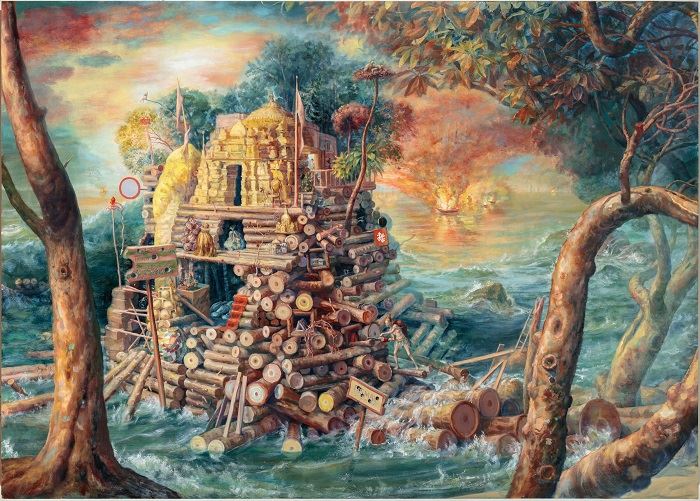
Julie Heffernan, Hiveminder, Oil on Canvas, 60x84
She works in the woodlands of Woodstock, surrounded by the trees of the forests of the American Northeast. Her studio space there is austere and monastic. A visual parataxis. It’s a workplace without adjectives, a place stripped down for craftsmanship. Two unfinished canvases hang on a white wall, one leans against it, facing inward. Bare nails wait for new works. A strip-light hangs vertically, throwing sidelight onto the work wall. A small bed is tucked against a desk. Both are pushed against a large window, and the glass door is blocked. The exterior world is barricaded – to be looked at but not allowed in. Perhaps it’s too alive, too rich and too overwhelming outside. Sometimes black bears are out there. The glass-covered image of the vivid woodland presses into the room where she paints. In here, in this small and quiet space, she releases the overwhelming imagery boiling in her head and pours it onto her canvases. From this flood she has shaped a peculiar Eden, but hers is not the old Eden of the Genesis myth of the ancient past. This is a novel and feminine vision that reveals the effect the present has upon her.
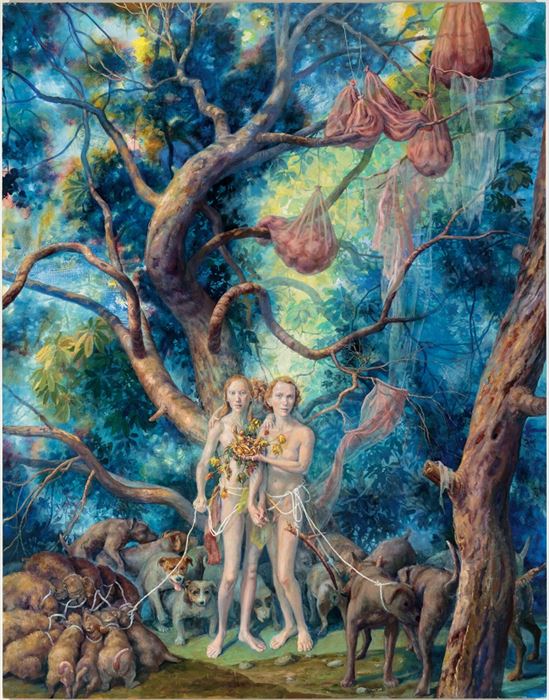
Julie Heffernan, Self-Portrait with Laoccon, Oil on Canvas, 96 x 78
Heffernan’s paintings are the charts of her mind, a visit to the tapestry of memories, of visual cues and half-formed knowledge that spills out of her. Fountainhead is evidence into how she sees her imagination at work. She’s an explorer, a mapmaker for the otherworld. “It feels really necessary to include the poetry that has come out of others’ responses to the messed up world,” she says, “It’s also to play the Freudian stream of consciousness game, so while my hand is doing Goya, it’s prompting my imagination to see some counterpart or alias to the Goya that’s of my own making. It’s a phantasmagoria of the quotes and prompts and associations, and that’s what keeps me running to the studio every day. I guess it’s the post-modern impulse. I love to quote. I love to have the painting like a big dinner party where there’s as many voices as possible and my hand is the moderator, or the conductor.”
The autobiography of Fountainhead is the story of the infection of her imagination by the wickedness outside. “I listen to National Public Radio all day when I’m painting,” she says, “and of course it’s full of stories that will make your hair curl. But I fail at the screed aspect of what I’m trying to do. I’d love to be Sue Coe and be able to really mount the screed in a loud way. But I’m not inherently a critic, or an ironist or a parodist. As I follow the promise of the painting it becomes a response to what we can pull off in the face of these calamities we’re confronting, you know, how to turn a landscape full of sodden mattresses into a treehouse or something. And so it becomes a constructive act. The act of making begets a world that is constructive, not destructive. My attempts at dystopia get reformulated to potential for discovery or invention. I’m not a natural negativist. That’s what comes of painting for my whole life.”
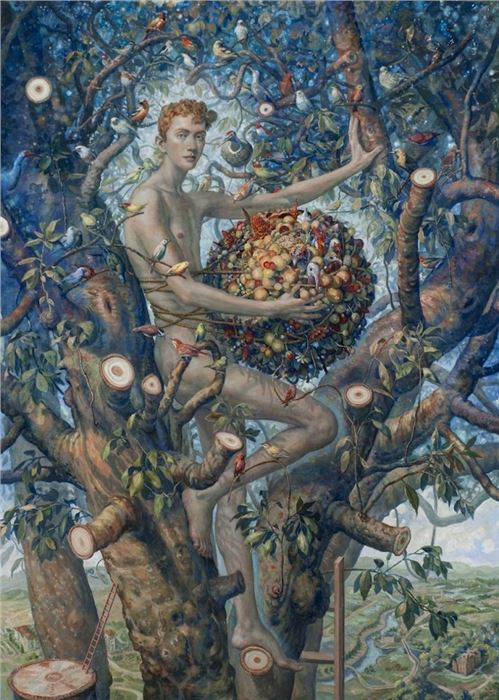
Julie Heffernan, Budding Boy, Oil on Canvas, 78 x 56
Her work reveals the mapping of a strange new world, in which the old patriarchy is destroyed, and a new feminine world is born. There is no Adam here, and with the exception of some beautiful pictures of her son, women – embodied as herself – dominate her body of work. Most of her extravagant outpouring of paintings are self-portraits.
Heffernan’s feminine new world surely helped to inspire “the shimmer” in the brilliantly vivid movie Annihilation, starring Natalie Portman, who enters a weird zone of uninhibited and fast-paced genetic evolution after an alien life lands on earth. Heffernan’s painted shimmer is the home of extravagant novelty, where possibilities are unconstrained in their conception, and a new kind of surrealism is allowed to flourish.
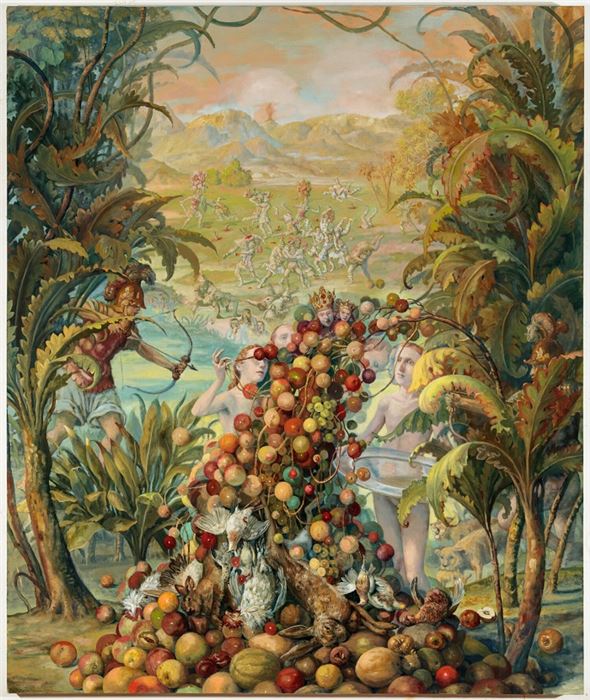
Julie Heffernan, Self-Portrait as Two-Headed Princess, Oil on Canvas, 68”x57''
Like a contemporary Leonora Carrington, Heffernan takes the cartography of her imagination seriously. But many of the surrealists left the mysterious landscape of the imagination largely uncharted, barely penetrating the frontiers of the subconscious, playing with dreams, and offering random imagery to trigger surprise and curiosity, but not blazing trails into what lay beyond. Compared to Heffernan’s richly detailed depictions of her new Eden, these arbitrary and deliberately bizarre juxtapositions seem superficial, even dishonest. They made explorations of the borderlands of the mind while claiming to have entered its heart. Huge landscapes were left open. But intrepid Heffernan goes deep into the new world. “I deeply believe that imagination is our most powerful faculty, but it’s so abused, and it was disastrously abused by surrealism. It’s the modernist path that was left unexplored,” she says.
Heffernan has painted herself naked, and vulnerable, but she is protected by the strength of pranic self-knowledge and stands secure in the embrace of the shimmer. She is a powerful pioneer of the imagination.
Julie Heffernan’s exhibit Hotheads is at Catharine Clark Gallery, San Francisco April 18th – September 5th, 2020.
Catharine Clark Gallery
248 Utah Street
San Francisco, CA 94103
For more on auctions, exhibitions, and current trends, visit our Magazine Page