BUY ART
Laurie Lipton: Drawings from the Darkness
The American artist likes drawing more than anything else in the world and uses it to create dystopian scenes combining past and present to deal with the insanity going on around us
Michael Pearce / MutualArt
Jul 22, 2020
The American artist likes drawing more than anything else in the world and uses it to create dystopian scenes combining past and present to deal with the insanity going on around us.
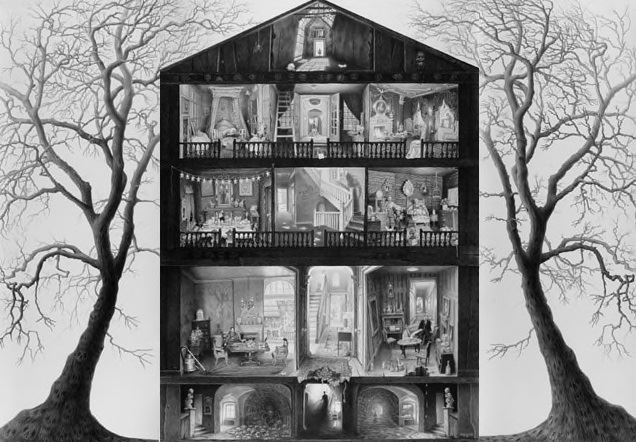
Laurie Lipton, Haunted Doll's House, 54 1/2 x 79 Charcoal and Graphite on Paper, Courtesy of the Artist
Like the endless and poisonous stream of disgruntled complaints and insidious lies that presently flood contemporary culture through the backed up and diseased sewers of social media, the paranoid visions obsessively drawn by Laurie Lipton into her massive graphite compositions infect the imagination long after they have been seen.
Lipton’s early work, made during her stay in England, was darkly gothic. Her Haunted Dollhouse is a compartmentalized view into her head. It’s an altarpiece, with folding panels that cover the interior of the eponymous building, and like the late gothic religious paintings its form is derived from, it needs careful inspection to grasp the narratives and symbols that fill it. Lipton was kidnapped as a girl, and this trauma took away her innocence and gave her a unique understanding of the pretenses of childhood, of the failures of parental protection, of the darkness that exists in the world. Her doll’s house is full of fearful imagery: downstairs a child sits friendless and frightened at a birthday-party table laden with uneaten ice cream sundaes and frosted cakes – in the mirror on the mantle a reflected man approaches the draped window, casting a dark shadow on the curtains. Something lurks outside. But on the stairs inside, another shadow, that of the vampire Nosferatu, already climbs upstairs, where in another room a skeleton rests against plump pillows in a luxurious four-poster bed while a grotesque, swollen-headed and overgrown baby twists in a perambulator at its foot, and a macabre nanny mannequin is propped powerless and ineffective beside them, wooden headed and useless.
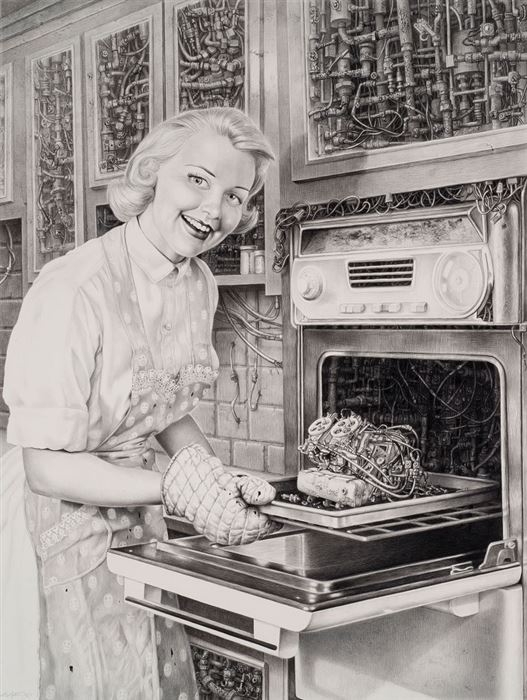
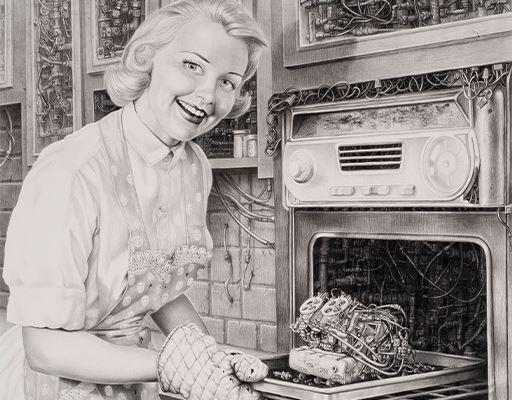
Laurie Lipton, Cooked, Charcoal & Graphite on paper, 47″ x 35″, 2015, Courtesy of the Artist
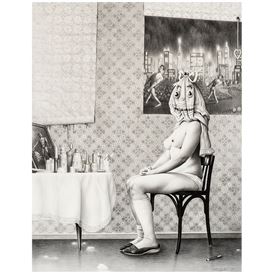
Raised in the 1950s and ‘60s, when mothers smiled their way through the threat of nuclear holocaust and schoolchildren ducked and covered under their desks in terrifying drills, Lipton loves to contrast her dystopian and unhappy vision of the paranoid and increasingly authoritarian present world with the vanished ideal of the archetypal nineteen-fifties housewife, the clinched embodiment of the American dream. She cooks in her period-perfect Betty Crocker kitchen, prim and pastel-pretty, properly trimmed and aproned, oblivious to the electronic invasion of the knotted wires and twisted cables of postmodern interconnection that entangle her proudly clean big-box appliances. The science fiction nightmare of Orwell’s surveillance state has invaded the suburban fantasy of the post-war nuclear age.
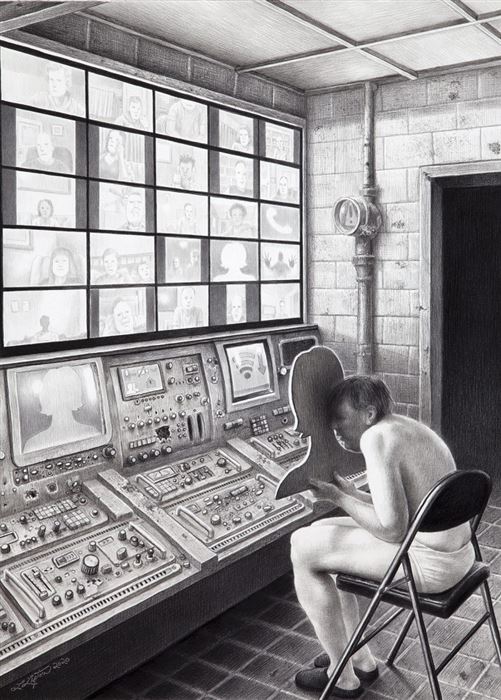
Laurie Lipton, Meeting, charcoal and Graphite on Paper 2020, 26 x 18.75 Courtesy of the artist
In other drawings Lipton focuses on television and mass communication, imagining excessive retro-machines that provide access to the stream of propaganda. She draws pictures that regard the mendacious paradoxes of social media self-exposure, of an addicted people obsessing over the twisted revelations our shining screens bring and the lies they tell, while we disassembling and dependent users simultaneously conceal our true selves from those that in turn are watching us.
A man participating in a multi-screened Zoom meeting sits naked but for shabby Walter White skivvies before a basement bunker bank of computer consoles, which resembles a nuclear age missile control room. He holds a cut-out image of the self he chooses to reveal to the faces shining out of the twenty-five monitors looming over him, each in turn projecting the edited image of its participant. These false selves, which have become a habitual and normalized feature of our virtual life, make a superficial new kind of public self-imaging explicitly clear. Humans are accustomed to presenting their best selves, and hiding behind social masks of cars, clothing and hairstyles, but now we do it with a new level of complicity with our friends and colleagues – they know that we are faking it, and we know they are, too. We all have well-stocked but digitally-rendered bookshelves behind us now, but the gaussian shimmering about our heads betrays the world of deceit.

Laurie Lipton, Alone in a Room, Socializing, 2018, Charcoal and Graphite on Paper, 29 x 31, Courtesy of the Artist
Recently, her subject has become the disquieting and real presence of the pervasive network of computerized surveillance devices, which is used to observe our movements, our faces, our purchases, and our language – the multiplying sneaky, spying network of cameras, which permanently watches our streets and stores; the algorithms cleverly programmed into super-computers, silently listening for trigger words in a billion telephone conversations; the on-line trackers used to refine personalized and carefully pinpointed advertising and to exploit our digital addiction to purchasing processed pleasures – these seeping violations excused by functionary servants of the state with bland utilitarian apologies as the expediencies of the war on terror, the war on drugs, or the war on Covid-19; these infectious intrusions, justified by manipulating our fear of violence, of harm to our families, of sickness and death. “My work evolves,” Lipton says, “but has always been about the world I live in. Like Goya, I am reacting, in a symbolic way, to the insanity around me. What do I think should be done about it? Make more drawings.”
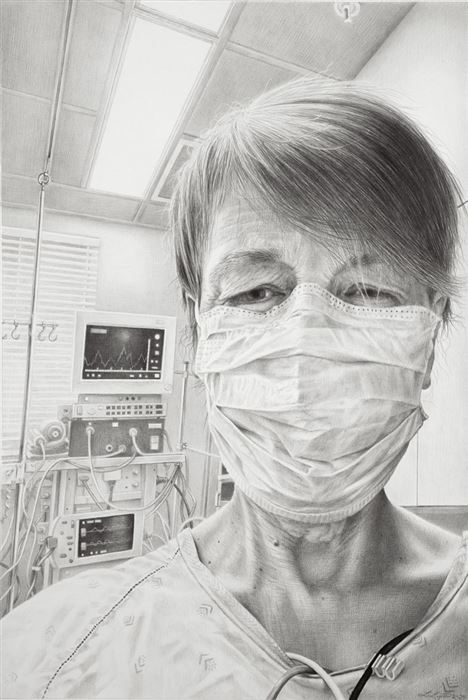
Laurie Lipton, Selfie 2020, charcoal and Graphite on Paper 2020, Courtesy of the artist
Lipton works with neurotic discipline, religious in its repetitive and meditative observance. Like a solitary medieval monk, she follows a strict regime of drawing in the isolation of her studio, which is in her home in suburban Los Angeles. “The ‘devotion’ to my work comes through joy,” she says, “I adore drawing. I like doing it more than anything else on earth, which is why I’m so good at it.”
But what species of joy is this? The scale of the drawings, and the fanatical dedication she takes in producing them, with millions of strokes of graphite to paper, are these the marks of obsession, a religious observation, like the joy of self-inflicted penitence for the sins of the world? Christian icons share the same quality of self-sacrifice. When asked about her religious thoughts, she replies dismissively, “What do I think about spirituality today? If anyone finds any, good for them.” And although conceived with the fidelity and self-mortifying dedication of an aesthetic stylite, her drawings offer no expiation for our collective guilt for allowing culture to become what it has become, and they lack the appeal that the iconographers made for forgiveness, for they make no connection to the numinous.
She has a fanatical following of collectors, including Terry Gilliam, whose brilliantly imaginative, bizarre and funny movies 12 Monkeys, and Brazil, share the same obsessive observation of a society infected with bureaucratic evil. Lipton met the great director and former Python in London through a mutual friend. “We also mutually adore each other’s work & have kept in touch,” she says. Unlike Gilliam’s films, in which we are released from the darkness by laughter and the truth of human affection, there’s little comedic redemption in Lipton’s work, which bleakly peers into the void as a grim affirmation of the tragic failure of modern communication. Her cacotopic drawings linger in the imagination like a dark patch on an x-ray, like the undead shadow on the staircase, like an eclipse.
For more on auctions, exhibitions, and current trends, visit our Magazine Page