BUY ART


Photo-essay: A self-taught art
As we continue to explore leading exhibitions around the globe, in the spotlight today is ‘Approaching Abstraction’ at the American Folk Art Museum in New York (through September 5th, 2010), which features works by self-taught artists, among them Purvis Young, Aloïse Corbaz and James Castle.
MutualArt
Jun 02, 2010

As we continue to explore exhibitions around the globe, in the spotlight today is Approaching Abstraction at the American Folk Art Museum in New York (through September 5th, 2010). This photo-essay includes a short introduction followed by images of selected artworks, accompanied by explanations, as described by the exhibition's curator Brooke Davis Anderson. (click here to view last week's photo-essay Poetry and Prayer: Islamic Manuscripts at the Walters).
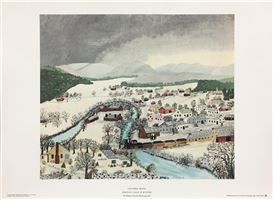
"There are many assumptions about self-taught artists: they work in isolation, they live in rural settings, they have no connection to community or culture, and their artwork is representational, often based on storytelling and personal memories. The popularity of memory painters such as Anna Mary Robertson “Grandma” Moses, perhaps one of the best-known artists in this discourse, helped place the emphasis on narrative, leading many to believe that untrained artists do not experiment with a plurality of creative outcomes. As the field of self-taught artists and their work matures and expands, however, scholarship is beginning to dispute these stereotypes. Many vernacular artists enjoy deep community ties and claim rich cultural influences in their artwork; some even seek out and appreciate an audience. Contemporary autodidacts are as likely to hail from New York City or Chicago as from Alabama or Mississippi. And while realistic renderings do dominate in the work of visionary artists, abstraction and expressionism are explored just as vigorously.
Approaching Abstraction comprises works from the American Folk Art Museum’s collection that illustrate the diversity of aesthetic choices made by artists with no formal art training who display tendencies that range from highly expressionistic to fully nonobjective... Repetition, exaggeration, and distortion are put to work in these paintings, drawings, sculptures, and mixed-media objects, and realistic renditions are sacrificed. By accepting the primacy of the material, the artist experiments, and unexpected results lead to a freewheeling approach toward abstraction."
— Brooke Davis Anderson, Director and Curator, The Contemporary Center

James Castle (1899-1977)
Soot and saliva on found board
Because his parents’ home served as the post office and general store for their small Idaho community, James Castle had a wealth of material for his artmaking. But while he recycled envelopes and other paper goods, he chose to use not pens or pencils but sharpened twigs and sticks for styluses and a homemade medium of stove soot mixed with spit. If paste was needed, Castle made his own with flour and water. With this assortment of materials, he set upon the task of documenting his life and community. Through practice and daily application, he understood the properties of perspective and mastered the rigors of sophisticated composition.

Gregory "Mr. Imagination" Warmack (born 1948)
Wood and cement with buttons, bottle caps and nails
The understructure of Button Tree is a tree limb that Gregory Warmack, also known as Mr. Imagination, rescued from the street and set in a base festooned with bottle caps. Dismayed that the tree had been uprooted for urban renewal and development, he resolved “to save part of it.” Warmack worked on this sculpture a little at a time, nailing buttons into the wood one by one in a laborious process that took years to complete. Wire strands of buttons radiate from the branches, creating a lively, jubilant presence. Because each button is nailed to the tree, one cannot help but think of the Central African nkisi tradition of covering the surface of wooden sculptures with hundreds of nails, each representing a prayer, pounded in by a village full of believers. While the result may be different, the act is the same. Warmack has created an American nkisi, willing the dead tree to linger in life still, now as a work of art.

Aloïse Corbaz (1886-1964)
Crayon, colored pencil, geranium flower juice and thread on paper
Aloïse Corbaz was institutionalized in 1918 for schizophrenia; two years later, she made her first drawings. Corbaz utilized what was available to her in the confined setting and enriched her colorful works with an assortment of found materials, such as paper packaging, magazine pages, and yarn; as well as toothpaste and the juice pressed from flower petals. With these humble materials she created a fanciful world inhabited by kings, queens, dukes, and duchesses.
Nenuphars/Paix Christi translates into “Waterlillies/Peace Christ.” The double-sided work is composed of three ?paper sheets stitched together to increase its scale. Lush and romantic flowers, leaves, and other decorative motifs crowd embracing couples. Figures and flowers are so closely intertwined they morph into one entity. On one side of this work, a woman is lifted off her feet to reach her joyous lover’s lips and, while a substantial figure, appears to float upward off the page. Her décolleté of roses was applied with a stain of geranium-flower juice.

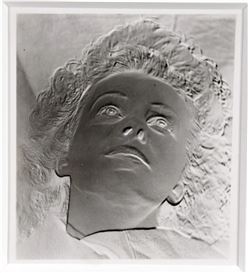
Eugene Von Bruenchenhein (1910-1983)
Mixed media on Masonite
Eugene Von Bruenchenhein worked as a florist and a baker before devoting the last forty years of his life to making art. The son of a sign painter and stepson of a Sunday painter who believed in reincarnation, Von Bruenchenhein was exposed to creative trades and nonconformist ideas from an early age. It was a fortunate foundation for an artist who eventually found his voice in a wide range of expressions: poetry, photography, painting, ceramics, and sculpture. “Create and be recognized” commanded a sign hanging in the artist’s basement studio, and he attempted to do just that: his home was utterly transformed by his unrelenting outpouring of expression.

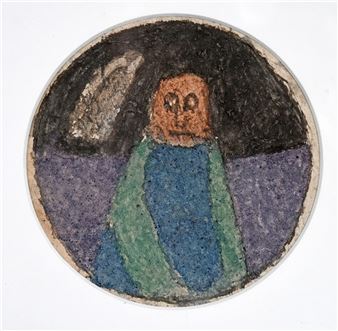
Leroy Person (1907/08–1985)
Crayon on wood

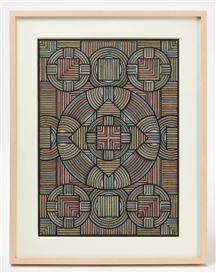
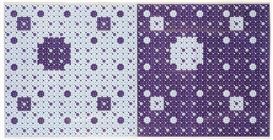
Martin Thompson (born 1956)
Ink on graph paper
New Zealand artist Martin Thompson uses graph paper and ball-point pens to draw perfectly designed diptychs that are as exacting in execution as they are mesmerizing in design. Thompson’s other tools are a handsaw (used as a straightedge), a small scalpel, and Scotch tape. A self-taught artist and a mathematician, he explores the visual patterns of mathematical rhythms and sequences; each of the markings in his works relates to a mathematical equation, and each formula is based on multiples of ten. After memorizing a formula or sequence, he develops a hard-edged pattern on a line of squares on graph paper scaled in millimeters and then creates a mirror image using the sequence in the opposite manner on a second sheet of graph paper.

Painted wood with beads

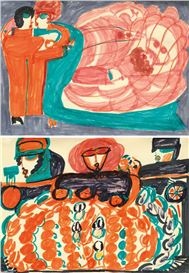
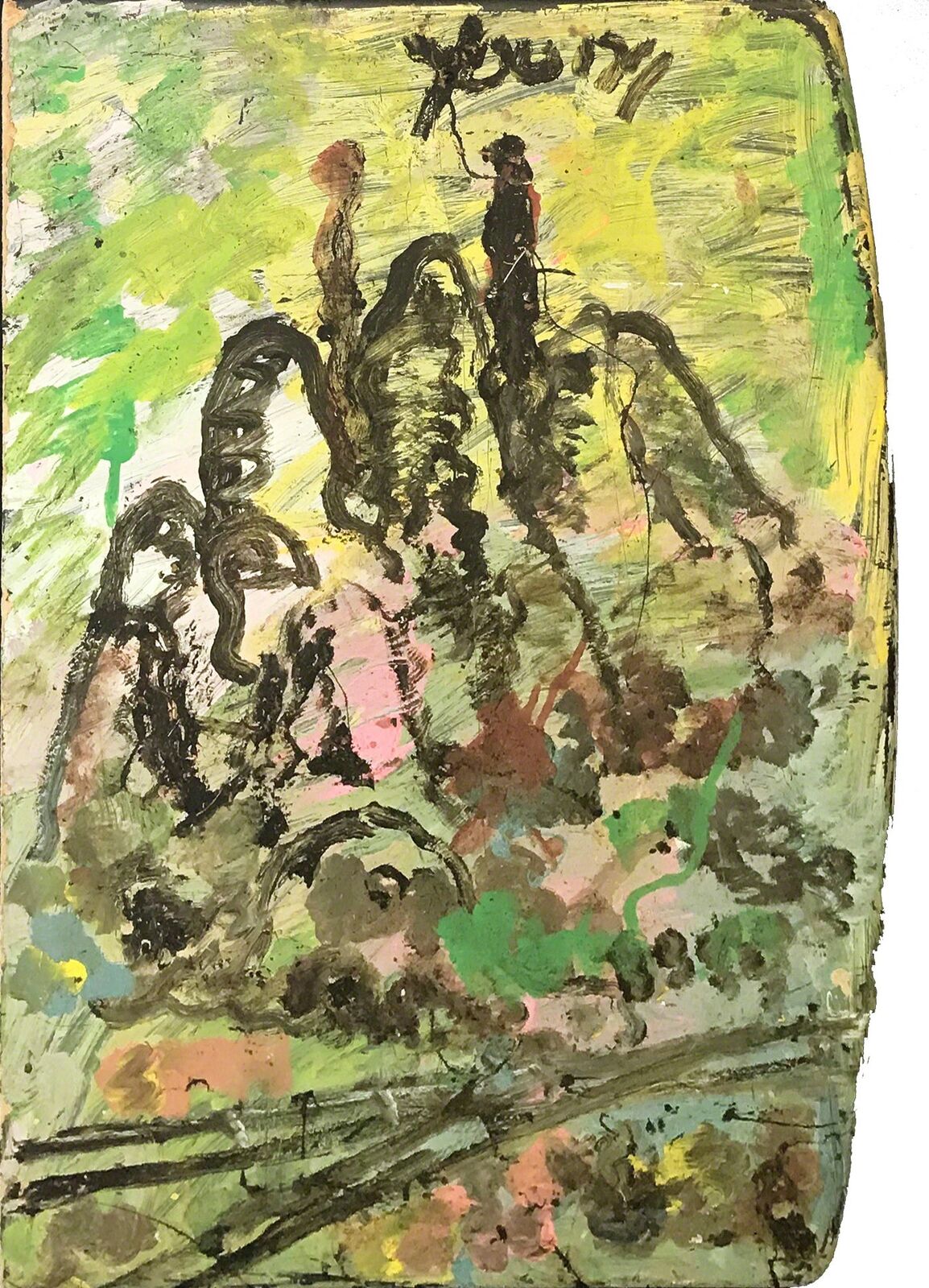
Purvis Young (1943 - 2010)
Paint on paper mounted on cardboard
Highly prolific, Purvis Young has filled his vast studio in a warehouse building with stacks of artworks, all covered with his trademark motifs— writhing crowds of people with arms upraised, powerful horses, commanding pregnant women, armies of trucks, and clusters of city buildings. A short stint in prison opened up the world of art to Young. While serving time for armed robbery, he studied the mural-painting tradition, particularly urban murals from the 1960s and 1970s, such as Chicago’s Wall of Respect. He also admired canonized masters, including El Greco, Rembrandt, and van Gogh. The artist distills all of these influences into his paintings, assemblages, and books. His quick, gestural lines and washes of color show that Young works rapidly and in an assured manner.

Eugene Andolsek (1921- 2008)
India ink on graph paper
In 1950, Eugene Andolsek started a ritual of nightly drawing sessions at the kitchen table in the home he shared with his mother. Using graph paper, he would begin each composition by applying black outlines—what Andolsek called the “designs”—with a straightedge and a compass and then fill them in with color. The artist described his process as methodical and orderly but also trancelike, in that the drawings just “came out” of him. He sometimes did not even remember putting stylus to paper. His recollection of?“waking up sometimes and a drawing were there and I didn’t even know how it got there” points to the transcendent, meditative quality artmaking can be for the artist.

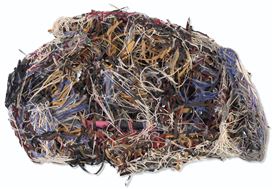
Judith Scott (1943–2005)
Yarn and fabric with unidentified armature
Images courtesy of the American Folk Art Museum