BUY ART


Taylor Schultek: Command and Control
Taylor Schultek’s futuristic genre paintings not only imagine the growing role of technology in our lives, but also their dangers – which have already entrenched themselves in our reality
Michael Pearce / MutualArt
Jun 07, 2023
Taylor Schultek is a stealthy citizen of skunky tunnels and freshly tagged rooftops, acid-lit research facilities and neon ruins. The best of his recent pictures continue to satisfy our curiosity about the overlap between life in the contemporary world and the digital metaverse, while blending smoothly with his concurrent project of painting scenes from his urban explorations, which, while less open to imaginative interpretation, are also deeply embedded within the realm of contemporary issues that concern the future of global civilization – Schultek paints a futurist realism.
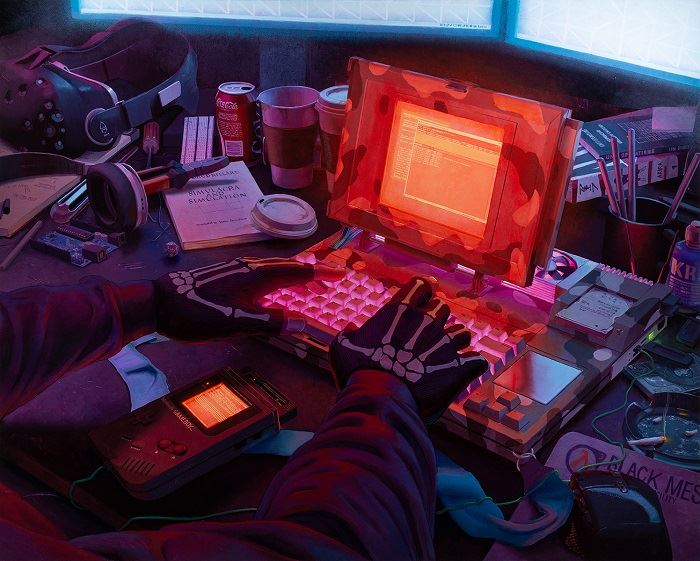
Taylor Schultek, Command and Control, oil on birch panel, 60 x 48, 2023
He inhabits the borderlands of the real and unreal. He leaves clues to help his audience understand his work. His Command and Control is an over the shoulder shot of a caffeinated coder’s skeleton-gloved hands working a keyboard which is clad in acidic paramilitary camo, with vivid pink and orange light staining the conventional patterns of concealment with bright color and emphasizing the synthetic character of the digital world. A copy of Baudrillard’s Simulacra and Simulation is within reach beside a coke and two coffee cups, a virtual reality headset and headphones – the caffeinated necessities of a digital life. Baudrillard famously explored the idea of human experience as a simulation of reality, and said that the distinction between reality and imagination, between the real world and the metaverse, had become blurred. Tucked behind the screen, and less strategically positioned to attract attention there is a copy of Ian Bogost’s Unit Operations: An Approach to Videogame Criticism, which proposed a theory for analyzing creativity within computational worlds. Schultek is asking for literary critiques of his metaverse.
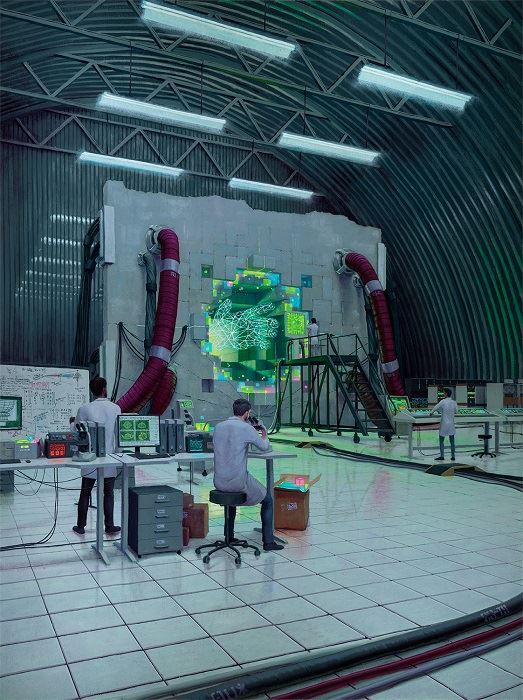
Taylor Schultek, Research and Development, oil on birch panel, 48 x 36, 2023
Few artists are so precisely positioned at the liminal intersection of the present and the future as Schultek. His Research and Development imagines an emblematic scene of technological advancement where the boundaries between the metaverse and reality are being crossed by machine intelligence represented as a glowing hand formed by a network of pathways and linkages. Complex computer systems resembling artificial intelligence may one day imitate consciousness so closely that they can make decisions and take self-determined action in the real world. When this singular moment occurs, humans may become obsolete. Transhumanists believe that technology provides a path to utopia and will allow humans to shape an ideal world, to modify their bodies and minds with enhanced senses and improved longevity, and even open the doors to immortality.
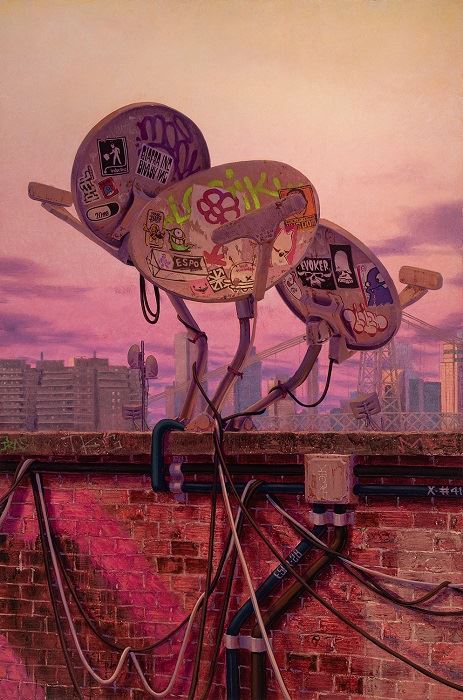
Taylor Schultek, Fruiting Body, oil on birch panel, 36 x 24, 2023
While Research and Development sees the allegorical hand of technological consciousness reaching out from the depth of the machine to touch the material world, Fruiting Body is a metaphor for the messy difference between the ugliness of what we do and the elegance of what we wish, with tags and slaps covering the reflecting dishes of rooftop satellite dishes. A hot sky dawns over sagging cables and rotting bricks. It’s a condemnation of the promised perfection of technological convergence, this ruination of the dish – the ancient disc of the sky made modern, a perfect defaced and faceless symbol for the shabby electric Eden – this dish of digital prayer which communicates with the heavens, replacing the masked shaman as a new intermediary between god and man with its hard and plastic efficiency.
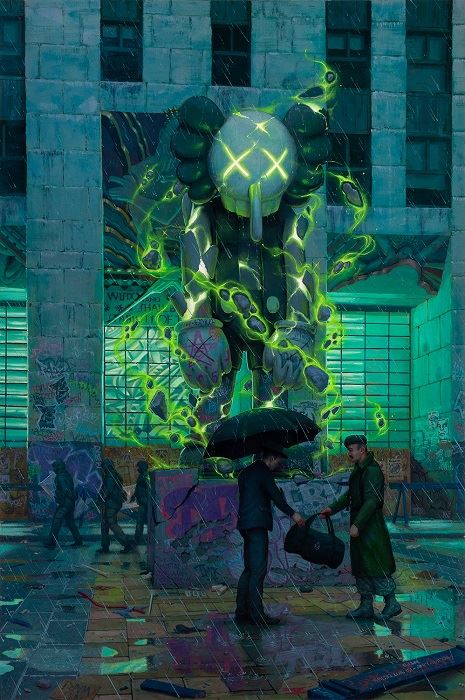
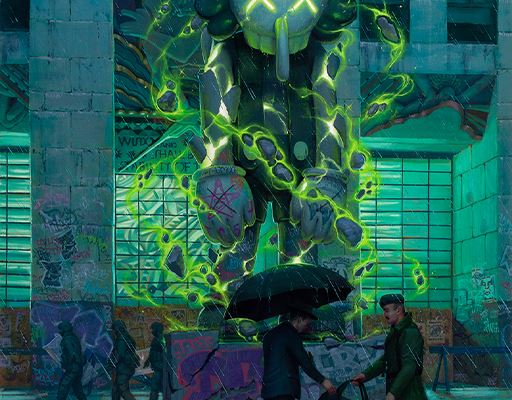
Taylor Schultek, The Corporation, oil on birch panel, 36 x 24, 2023
Another mask occupies the death-eyed face of KAWS’ gigantic and vinyl sculpture of his ‘Companion’ in Schultek’s The Corporation, which imagines the iconic character as a plasmatic Frankenstein’s monster – the graffitied icon of existential despair is electrified, and neon light breaks and bursts as a new being of supremacy emerges from within its chrysalis shell, transfigured like a nuclear super-villain transformed by raw power accidentally unleashed by the clandestine overreach of super-villain agencies, or by government research run awry. A conspiratorial satchel is exchanged between representatives of the military and the money.
KAWS’ miserable cartoon character has become an icon of the cynical comedy of the past decade, a memento mori designed to remind us of the failure of capitalism. The mutating sculpture obscures a sign abbreviating a biblical quote from Isaiah 33:6, “…wisdom and knowledge shall be the stability of thy times, and strength of salvation: the fear of the LORD is his treasure,” but the exponential digital proliferation of accessible knowledge which arrived with the computer age was not matched with a commensurate expansion of wisdom, and ignoring this biblical advice has birthed ruin, and the trash-strewn street is walked by anonymous and grey paramilitary figures with cast-down gazes. Although the painting is vivid, and within the aesthetic frame of children’s entertainment, the grim and critical message seems to be that without the salvation of wisdom, we are lost. The Corporation and Fruiting Body each make the same skeptical promise. The weird, ambiguous violence of techtopia is coming, and the death’s-head of KAWS’ nihilist capitalism promises a bleak future under the regime of this incoming energy, regulated by machines. Schultek seems to warn that we should be skeptical of the arrival of techtopia. The elements of dystopia found in the real world inevitably emerge in the digital world, too.
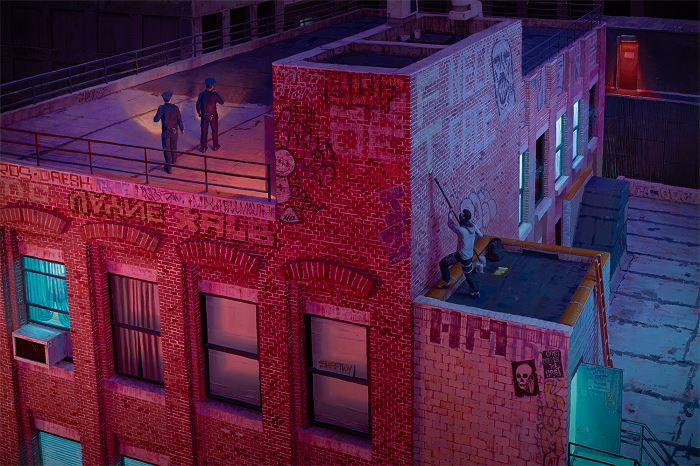
Taylor Schultek, Opposing Force, Oil on linen, 72 x 48, 2023
Schultek’s rotten cities are trapped in a permanent cycle of decay and gentrification, and while these things are representations of reality, they are also allegories. The inadequacy and futility of the police, who represent governmental control, to control graffiti, to control the chaotic and evolving metaverse, is expressed in Schultek’s Opposing Force, where a daring tagger continues painting even while two flashlight cops patrol the adjacent rooftop. Sophisticated systems of surveillance would make his capture easy, but broad constitutional protections regulating personal privacy also protect the privacy of criminals. The policing of antisocial elements of the population cannot exist efficiently in America, for the same safeguards that were placed to protect the pursuit of happiness include protection for individuals to pursue the pleasures of indifference, sloth, and greed, and their inevitable consequences. The anarchy of the metaverse cannot be regulated, and it infects reality.
The nocturnal cities Schultek wanders and captures in the abrasive and vibrant colors of his imagined world are graffitied and ruined precisely because the urban blights of graffiti and decay and addiction cannot be effectively regulated in a free society, either in the digital anarchy of the metaverse or in the reality of the American Republic – in Schultek’s paintings, urban explorers and taggers and their graffiti are signs and symbols of liberty, for they are the direct consequence of individuality, and freedom of speech, and choice, and these key values are at the anarchic hacker heart of coding as much as they are at the heart of the West.
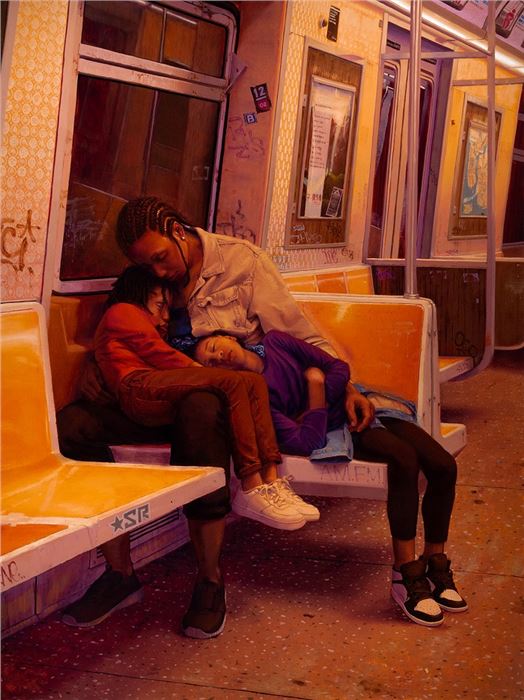
Taylor Schultek, Madonna, oil on birch panel, 48 x 36, 2023
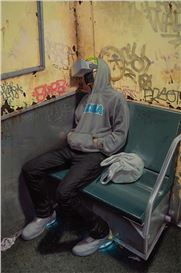
There is a price. The sentiment of Schultek’s memorable Madonna belongs in the context and history of American social realism, but when considered within the acidic quinacridone and phthalo and orange world of his metaverse, the narratives of his social commentary are not the same as the narratives of contemporary social justice which are entangled in the issues of the past. Instead, Schultek addresses the frightening narratives of alienation and class division which are knotted to the approaching transhumanist future, belying the naivete of the techtopia. Schultek’s futurist realism suggests some of us will be left behind.
For more on auctions, exhibitions, and current trends, visit our Magazine Page