 BUY ART


The Art of Propaganda: The Banality of Nazi Paintings
Ahead of Holocaust Remembrance Day, Michael Pearce launches a new column for MutualArt, exploring the use of the arts in furthering the interests of regimes or cultural groups.
Michael Pearce / MutualArt
Jan 22, 2021

Ahead of Holocaust Remembrance Day, Michael Pearce launches a new column for MutualArt, exploring the use of the arts in furthering the interests of regimes or cultural groups.
Richard Spitz, Nazi Vision of Greatness
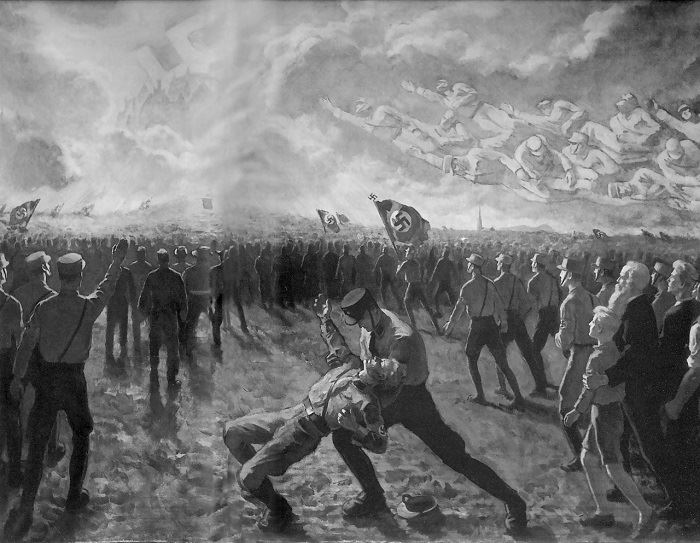
Within ten days of his appointment as the National Socialist Chancellor of Germany on January 30, 1933, Adolf Hitler made his intentions for the arts clear, declaring that his party wanted “to burn out the symptoms of decomposition in literature, in the theatre, in the press – in a word in our whole culture; we want to burn out this whole poison which during these fourteen years has followed into our life.”
By the end of the year, the Nazis had completed the removal of Jews from Germany’s entire educational and cultural system. By 1935, all artists, musicians, architects and creative workers who were not certified Aryan members of the Reich Chamber of Culture could expect to be unemployed and persecuted, forbidden from making art, and subjected to surprise visits from the Gestapo. The arts weren’t only to be cleansed of Jewish, Communist and non-doctrinaire ideas and influences, they were also to be specifically aimed at providing a romanticized ideal of what German life under the Nazis should be like. Hitler and Goebbels’ intention was to encourage art as propaganda, imprinting the ideas of racial purity, the German Homeland (Lebensraum) and the sacredness of German blood and German earth (Blut und Boden) in the minds of the people. The status of artists who did not make such work was explicitly clear – they were criminals. When Hitler laid the cornerstone to the new Congress Hall of the Reich Party Congresses in Nuremberg, he described modern artists as murderers who wanted “to kill the soul of the Volk.”
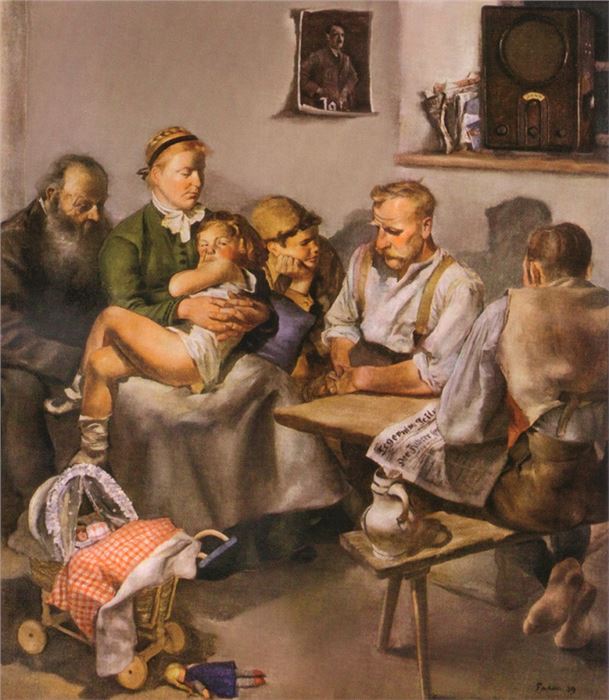
Hitler understood that propaganda was most effective when the same message comes to people repeatedly through a variety of media, saying “The receptive powers of the masses are very restricted, and their power of understanding is slight. On the other hand, they quickly forget. Such being the case, all effective propaganda must be confined to a few bare essentials, and these must be expressed as far as possible in stereotyped formulas. These slogans should be persistently repeated until the very last individual has come to grasp the idea that has been put forward. If this principle be forgotten, and an attempt be made to be abstract and general, the propaganda will turn out ineffective, for the public will not be able to digest or retain what is offered to them in this way.” This understanding was repeated by the Nazi aesthetician Alfred Rosenberg, who wrote “Propaganda does not need to be intellectual; it must be effective. It should express our worldview in a way that can be understood by the masses.”
Paul Matthias Padua, The Fuhrer Speaks
In the first issue of a magazine produced by his propaganda ministry, Goebbels encouraged his network of artists, journalists and editors to be vigilantly consistent, for “in the long run, propaganda will reach the broad masses of the people only if at every stage it is uniform. Nothing confuses the people more than lack of clarity or aimlessness. The goal is not to present the common man with as many varied and contradictory theories as possible. The essence of propaganda is not in variety, but rather the forcefulness and persistence with which one selects ideas from the larger pool and hammers them into the masses using the most varied methods.”
All publicists know that getting people to pay any attention to an event, or book, or person requires putting exciting materials that describe it in front of the public over and over again, and this is why the themes found in National Socialist artworks, literature, poster designs, films, theater productions, magazines, and spectacles are repetitive – because all together it was effective propaganda produced to impress Nazi ideas upon the consciousness of the German people.
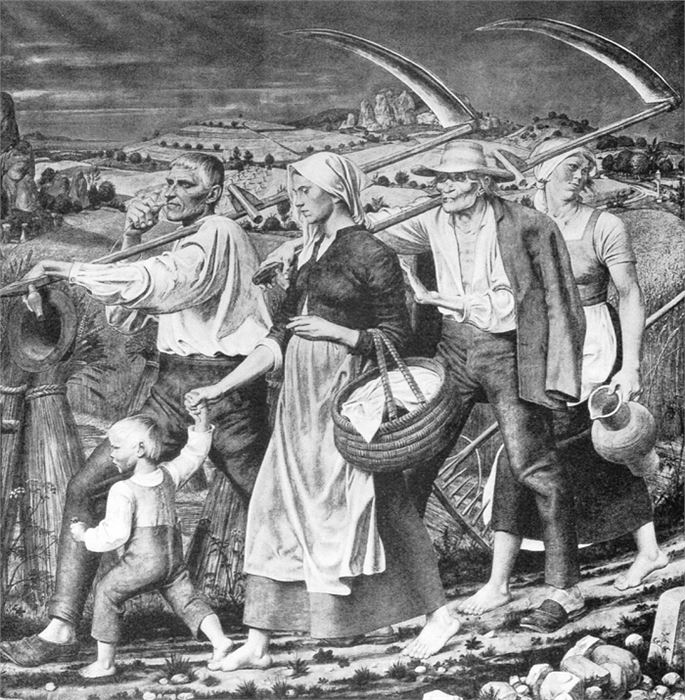
Therefore, Nazi paintings repeatedly emphasized the roles the German people were expected to fill as members of the Volk. Artists followed party dogma and made paintings that would affirm and reaffirm these narratives. They made images of physically perfect Aryan men and women – the subjects of their works were tall, handsome and blonde, with well-muscled physiques. They crafted genre pictures of healthy family groups (always with several children, for good Germans were encouraged to out-breed the inferior races which were over-running the country), of babies suckling at their mother’s breast, of the old man looking with satisfaction over a hard day’s work in the fields, of burly farmers ploughing the good, productive earth. In the official “Great German Art” exhibits ordered by Hitler in his House of German Art museum in Munich, we see endless numbers of paintings of childbearing mothers, of hard-working German farmers working the land to produce food for Germany; of heroic soldiers struggling in their manly duty to protect the fatherland; of assertive male and female nudes in perfect physical condition. Artists who failed to fulfil these expectations were exiled, murdered or censored – even if they were party members like Emil Nolde.
Oskar Martin-Amorbach, Harvest
Disconcertingly, no antisemitic paintings were accepted into Hitler’s exhibits. National Socialist painting was part of Hitler and Goebbels’ broader propaganda plan designed to guide the Volk in their belief in German superiority and the purity of the Aryan race, but it was a subtler and more sophisticated tool than their brash poster and film campaigns. No antisemitic paintings were admitted because he perceived them as shows of art for the ages, not for the present. With hideous logic, he reasoned that antisemitism would one day be a thing of the past because the Jewish subject of Nazi hatred would be completely eradicated, leaving only an unpleasant memory of a dark necessity. Hostile propaganda directed against Jews was therefore reserved for temporary paper posters, and for the fleeting and fashionable imagery of motion pictures, quickly discarded and considered as amusements. Destined to be eradicated, Jews were not to be made immortal by becoming the subjects of the art of the thousand-year Reich, instead they were simply to be omitted from National Socialist art.
Hitler claimed “a vast flowering of cultural and artistic life” would be the result of his purification of the arts, but reviewing the paintings exhibited in Hitler’s art museum is an exercise in tedium, for they are almost entirely clichéd – the banality of evil was as evident in the galleries as it was in the bureaucracy. Individualism was all but impossible in Nazi painting, and perhaps this is among the lessons to be learned from it – where we find liberty there is always free speech, and where we find free speech there is always individualism, and where we find individualism there is always creativity. The banality of Nazi paintings warns us to be on guard whenever we see the erosion of liberty in the arts, whenever subject matter becomes prescribed, and whenever artists are prevented from expressing themselves, for the discomfort of being offended is nothing compared to the creeping evil of tyranny which follows in the shadow of censorship.
For more on auctions, exhibitions, and current trends, visit our Magazine Page