
 ARTISTS
American Still Life: Treasures from the Parrish Art Museum
Oct 10, 2010 - Nov 28, 2010
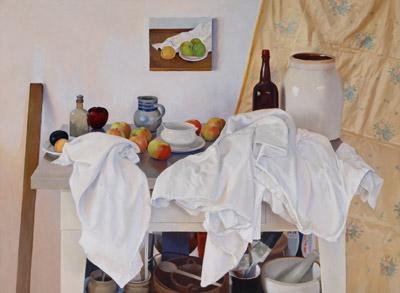
American Still Life: Treasures from The Parrish Art Museum wiwll include more than forty paintings, sculptures, and works on paper dating from 1871 to the present. American Still Life, the third in a series of exhibitions drawn exclusively from the Museum’s permanent collection, explores the many ways in which generations of American artists have approached the subject of still life painting.
“Still life painting has traditionally been regarded as a ‘lesser art’ when compared to the loftier subjects of religious and history painting, landscape, and portraiture,” according to Alicia Longwell. It was not until the sixteenth century in Holland that the trappings of everyday life became seen as worthy subjects for artists, and the resulting paintings became valued objects.
The still life became an important feature in American colonial painting. In 1871, a youthful William Merritt Chase chose a still life subject to demonstrate his prodigious technique. Still Life with Fruit (1871) acknowledges European models but has “a rustic simplicity that is purely American,” according to Longwell. Still Life with Cockatoo was painted ten years later and reflects Chase’s study at Munich’s Royal Academy and exposure to the virtuoso brushwork of European Old Masters.
The exhibition includes, in addition to the artists mentioned above, Barbara Bloom, Warren Brandt, John Button, Nicolai Cikovsky, Michael Combs, George Constant, William Glackens, Robert Kulicke, Robert Lazzarini, Li-lan, Sheridan Lord, Henry Muhrman, Larry Rivers, Casimir Rutkowski, Raphael Soyer, William Aiken Walker, Fred Wilson, and Jane Wilson.
“Still life painting has traditionally been regarded as a ‘lesser art’ when compared to the loftier subjects of religious and history painting, landscape, and portraiture,” according to Alicia Longwell. It was not until the sixteenth century in Holland that the trappings of everyday life became seen as worthy subjects for artists, and the resulting paintings became valued objects.
The still life became an important feature in American colonial painting. In 1871, a youthful William Merritt Chase chose a still life subject to demonstrate his prodigious technique. Still Life with Fruit (1871) acknowledges European models but has “a rustic simplicity that is purely American,” according to Longwell. Still Life with Cockatoo was painted ten years later and reflects Chase’s study at Munich’s Royal Academy and exposure to the virtuoso brushwork of European Old Masters.
The exhibition includes, in addition to the artists mentioned above, Barbara Bloom, Warren Brandt, John Button, Nicolai Cikovsky, Michael Combs, George Constant, William Glackens, Robert Kulicke, Robert Lazzarini, Li-lan, Sheridan Lord, Henry Muhrman, Larry Rivers, Casimir Rutkowski, Raphael Soyer, William Aiken Walker, Fred Wilson, and Jane Wilson.
Recommended for you

Jul 07, 2017
- Jun 05, 2027

Mar 31, 2023
- Mar 29, 2026

Jul 07, 2024
- May 10, 2026
Feb 10, 2024
- Jan 11, 2026
American Still Life: Treasures from The Parrish Art Museum wiwll include more than forty paintings, sculptures, and works on paper dating from 1871 to the present. American Still Life, the third in a series of exhibitions drawn exclusively from the Museum’s permanent collection, explores the many ways in which generations of American artists have approached the subject of still life painting.
“Still life painting has traditionally been regarded as a ‘lesser art’ when compared to the loftier subjects of religious and history painting, landscape, and portraiture,” according to Alicia Longwell. It was not until the sixteenth century in Holland that the trappings of everyday life became seen as worthy subjects for artists, and the resulting paintings became valued objects.
The still life became an important feature in American colonial painting. In 1871, a youthful William Merritt Chase chose a still life subject to demonstrate his prodigious technique. Still Life with Fruit (1871) acknowledges European models but has “a rustic simplicity that is purely American,” according to Longwell. Still Life with Cockatoo was painted ten years later and reflects Chase’s study at Munich’s Royal Academy and exposure to the virtuoso brushwork of European Old Masters.
The exhibition includes, in addition to the artists mentioned above, Barbara Bloom, Warren Brandt, John Button, Nicolai Cikovsky, Michael Combs, George Constant, William Glackens, Robert Kulicke, Robert Lazzarini, Li-lan, Sheridan Lord, Henry Muhrman, Larry Rivers, Casimir Rutkowski, Raphael Soyer, William Aiken Walker, Fred Wilson, and Jane Wilson.
“Still life painting has traditionally been regarded as a ‘lesser art’ when compared to the loftier subjects of religious and history painting, landscape, and portraiture,” according to Alicia Longwell. It was not until the sixteenth century in Holland that the trappings of everyday life became seen as worthy subjects for artists, and the resulting paintings became valued objects.
The still life became an important feature in American colonial painting. In 1871, a youthful William Merritt Chase chose a still life subject to demonstrate his prodigious technique. Still Life with Fruit (1871) acknowledges European models but has “a rustic simplicity that is purely American,” according to Longwell. Still Life with Cockatoo was painted ten years later and reflects Chase’s study at Munich’s Royal Academy and exposure to the virtuoso brushwork of European Old Masters.
The exhibition includes, in addition to the artists mentioned above, Barbara Bloom, Warren Brandt, John Button, Nicolai Cikovsky, Michael Combs, George Constant, William Glackens, Robert Kulicke, Robert Lazzarini, Li-lan, Sheridan Lord, Henry Muhrman, Larry Rivers, Casimir Rutkowski, Raphael Soyer, William Aiken Walker, Fred Wilson, and Jane Wilson.
Artists on show
- Barbara Bloom
- Dan Rizzie
- Donald Sultan
- Fairfield Porter
- George Zachary Constant
- James Rosenquist
- Jane Freilicher
- Jane Wilson
- Jim Dine
- Joe Zucker
- John Button
- Larry Rivers
- Michael Combs
- Nell Blaine
- Nicolai Cikovsky
- Philip Guston
- Raphael Soyer
- Robert Kulicke
- Robert Lazzarini
- Robert Rauschenberg
- Roy Lichtenstein
- Warren Brandt
- William Aiken Walker
- William Glackens
- William Merritt Chase

What's on nearby
Oct 09, 2025
- Feb 02, 2026
Sep 14, 2025
- Feb 08, 2026
Sep 14, 2025
- Feb 08, 2026
