ARTISTS
Art Revolutionaries
The Mayoral art gallery presents “Art revolutionaires”, a museum quality artistic project featuring works by Pablo Picasso, Joan Miró, Alexander Calder and Julio González in Barcelona.
“We were consulting a book on the Pavilion of the Spanish Republic for the International Exposition held in Paris in 1937, where artists such as Julio González, Pablo Picasso, Joan Miró, Alexander Calder, and many others, got involved in the defence of democracy and freedom. Filled with curiosity, we kept looking at the publication, attentive, with increasing emotion; because holding in your hands art and culture books makes your heart beat faster and it fills your soul…”
Jordi and Eduard Mayoral, rediscovered this chapter in the history of art and remembered El Segador —Miró’s mural painting, which disappeared when the pavilion was dismantled— and, while browsing through the pages, they grew more and more convinced that this was a great project they could make possible. In their own words: “As Catalans, we are very conscious of the importance of the Spanish Civil War, of the fight for the ideals of freedom; as art lovers and professionals, we know that the works created by our artists then are still part of our collective memory and that they represented a turning point.”
“Art Revolutionaries” is an exhibition whose main protagonists are liberty and oppression, hope and despair. A crucial moment in which everything was at stake and in which, finally, these artists lost a cruel war that forced them into exile, disrupting forever the course of a whole generation of incomparably talented creators.
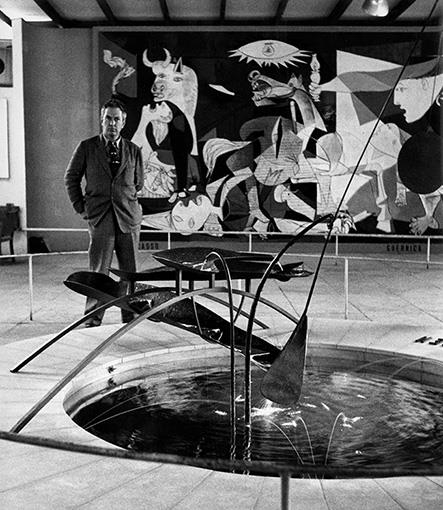
The exhibition will inaugurate the commemoration of the 80th anniversary of the Exposition Internationale des Arts et des Techniques appliquées à la Vie Moderne, in 1937 in Paris, with the aim of paying homage to the artists who took place in it. The curator of the show, Juan Manuel Bonet, current director of the Instituto Cervantes in Paris, and former director of the Museo Nacional Centro de Arte Reina Sofía in Madrid, explains: “Everyday there is an increasing awareness that the International Exposition was an exceptional event”. The Spanish Pavilion for the Universal Exposition of Paris, 1937, was created in a period of great turbulence, as Spain was in the midst of a Civil War. For this reason, the Pavilion presented by the Spanish Republican Government became a strategic platform to vindicate the tragic situation the country was going through. The architects who designed the building were Josep Lluís Sert and Luis Lacasa, and José Gaos was the curator of the exhibition. José Gaos counted on the participation of many Spanish artists. The main artists: Picasso (Guernica), Miró (El Segador), Calder (Mercury Fountain) and González (Montserrat) created some of the most relevant pieces in art history. In this regard, Picasso commented: “Maybe, later on, some art historian will prove that my painting has changed because of the war. I myself don’t know”. According to Joan Miró’s grandson Joan Punyet Miró: “The Reaper and the Guernica seemed political propaganda posters of monumental dimensions. Nobody chose a solid and durable support, because they knew in advance that those works were ephemeral, just to make an impact, and that they would finally disappear together with the pavilion.”
This a historically accurate project featuring paintings, drawings and sculptures by Pablo Picasso, Joan Miró, Alexander Calder and Julio González. The exhibition has been the result of a year-long research and document gathering; intense work has been carried out, full of interesting findings and discoveries, that enables us to show and evoke the Spanish Pavilion in a most accurate and faithful way. The pieces that will be displayed share a very close link with those presented by the republican artists in 1937. Furthermore, a reconstruction of El Segador —approved by Successió Miró— will be shown.
Recommended for you


The Mayoral art gallery presents “Art revolutionaires”, a museum quality artistic project featuring works by Pablo Picasso, Joan Miró, Alexander Calder and Julio González in Barcelona.
“We were consulting a book on the Pavilion of the Spanish Republic for the International Exposition held in Paris in 1937, where artists such as Julio González, Pablo Picasso, Joan Miró, Alexander Calder, and many others, got involved in the defence of democracy and freedom. Filled with curiosity, we kept looking at the publication, attentive, with increasing emotion; because holding in your hands art and culture books makes your heart beat faster and it fills your soul…”
Jordi and Eduard Mayoral, rediscovered this chapter in the history of art and remembered El Segador —Miró’s mural painting, which disappeared when the pavilion was dismantled— and, while browsing through the pages, they grew more and more convinced that this was a great project they could make possible. In their own words: “As Catalans, we are very conscious of the importance of the Spanish Civil War, of the fight for the ideals of freedom; as art lovers and professionals, we know that the works created by our artists then are still part of our collective memory and that they represented a turning point.”
“Art Revolutionaries” is an exhibition whose main protagonists are liberty and oppression, hope and despair. A crucial moment in which everything was at stake and in which, finally, these artists lost a cruel war that forced them into exile, disrupting forever the course of a whole generation of incomparably talented creators.
The exhibition will inaugurate the commemoration of the 80th anniversary of the Exposition Internationale des Arts et des Techniques appliquées à la Vie Moderne, in 1937 in Paris, with the aim of paying homage to the artists who took place in it. The curator of the show, Juan Manuel Bonet, current director of the Instituto Cervantes in Paris, and former director of the Museo Nacional Centro de Arte Reina Sofía in Madrid, explains: “Everyday there is an increasing awareness that the International Exposition was an exceptional event”. The Spanish Pavilion for the Universal Exposition of Paris, 1937, was created in a period of great turbulence, as Spain was in the midst of a Civil War. For this reason, the Pavilion presented by the Spanish Republican Government became a strategic platform to vindicate the tragic situation the country was going through. The architects who designed the building were Josep Lluís Sert and Luis Lacasa, and José Gaos was the curator of the exhibition. José Gaos counted on the participation of many Spanish artists. The main artists: Picasso (Guernica), Miró (El Segador), Calder (Mercury Fountain) and González (Montserrat) created some of the most relevant pieces in art history. In this regard, Picasso commented: “Maybe, later on, some art historian will prove that my painting has changed because of the war. I myself don’t know”. According to Joan Miró’s grandson Joan Punyet Miró: “The Reaper and the Guernica seemed political propaganda posters of monumental dimensions. Nobody chose a solid and durable support, because they knew in advance that those works were ephemeral, just to make an impact, and that they would finally disappear together with the pavilion.”
This a historically accurate project featuring paintings, drawings and sculptures by Pablo Picasso, Joan Miró, Alexander Calder and Julio González. The exhibition has been the result of a year-long research and document gathering; intense work has been carried out, full of interesting findings and discoveries, that enables us to show and evoke the Spanish Pavilion in a most accurate and faithful way. The pieces that will be displayed share a very close link with those presented by the republican artists in 1937. Furthermore, a reconstruction of El Segador —approved by Successió Miró— will be shown.
Artists on show
Contact details

What's on nearby