ARTISTS


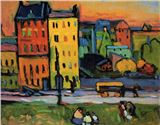

Avant - gardes '20 | '60
Jun 26, 2009 - Aug 23, 2009
This exhibition tells the story of the two most tempestuous decades in the history of twentieth century art – the Twenties and the Sixties – and of a shift in global cultural power relations.
The Twenties
During the Twenties the avant-garde still operated almost exclusively in Europe. Paris remained the epicentre of artistic innovation that it had always been thanks to the late Cubism of Picasso and Surrealism. But Germany and the Netherlands, too, saw the flourishing of a radically new concept of art spearheaded by the Bauhaus and De Stijl movements, among others. And much further to the East, in Moscow and Leningrad, revolutionary new movements emerged that became known as Russian Constructivism. Picasso, Mondriaan, Van Doesburg, Schwitters and Malevich were among the key representatives of the avant-garde of this period.
The Sixties
Forty years later key developments within the avant-garde also emerged in the United States, particularly in New York and Los Angeles. The land of unlimited opportunities gave birth to pop art, minimal art and conceptual art, with artists such as Warhol, Andre and Nauman. In western Europe, Paris remained an important centre with representatives of the nouveau réalisme, while cities such as Düsseldorf, Cologne and Amsterdam came to the fore.
Stedelijk Museum's role
After the Second World War Amsterdam functioned as a transatlantic bridge, with many US artists staging their first museum presentations in the Dutch capital, thereby gaining a foothold in Europe. In this process Amsterdam’s Stedelijk Museum often played a unifying role, and so built up a leading collection.
This overview of more than 60 works showcases not only the exceptional quality of the Stedelijk Museum’s collection but also relates – from a western European perspective – the story of the shift from east to west.
Recommended for you

Jul 07, 2017
- Jun 05, 2027


This exhibition tells the story of the two most tempestuous decades in the history of twentieth century art – the Twenties and the Sixties – and of a shift in global cultural power relations.
The Twenties
During the Twenties the avant-garde still operated almost exclusively in Europe. Paris remained the epicentre of artistic innovation that it had always been thanks to the late Cubism of Picasso and Surrealism. But Germany and the Netherlands, too, saw the flourishing of a radically new concept of art spearheaded by the Bauhaus and De Stijl movements, among others. And much further to the East, in Moscow and Leningrad, revolutionary new movements emerged that became known as Russian Constructivism. Picasso, Mondriaan, Van Doesburg, Schwitters and Malevich were among the key representatives of the avant-garde of this period.
The Sixties
Forty years later key developments within the avant-garde also emerged in the United States, particularly in New York and Los Angeles. The land of unlimited opportunities gave birth to pop art, minimal art and conceptual art, with artists such as Warhol, Andre and Nauman. In western Europe, Paris remained an important centre with representatives of the nouveau réalisme, while cities such as Düsseldorf, Cologne and Amsterdam came to the fore.
Stedelijk Museum's role
After the Second World War Amsterdam functioned as a transatlantic bridge, with many US artists staging their first museum presentations in the Dutch capital, thereby gaining a foothold in Europe. In this process Amsterdam’s Stedelijk Museum often played a unifying role, and so built up a leading collection.
This overview of more than 60 works showcases not only the exceptional quality of the Stedelijk Museum’s collection but also relates – from a western European perspective – the story of the shift from east to west.
Artists on show
Contact details
Sunday - Thursday
10:00 AM - 6:00 PM
Friday
10:00 AM - 10:00 PM
Saturday
10:00 AM - 6:00 PM
Paulus Potterstraat 7 Amsterdam, Netherlands 1007 CX

What's on nearby
Oct 03, 2025
- Jan 11, 2026
Oct 17, 2025
- Jan 11, 2026