ARTISTS



Eight and a Half Weeks: The Earliest Works of the German School
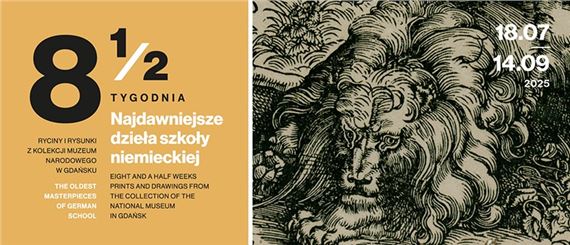
They are fragile, delicate, and rarely exhibited. Yet they tell stories from five hundred years ago with extraordinary precision and expressive power. True treasures of early German art—including works by Cranach, Holbein, and the Little Masters—will soon be on display in Gdańsk. Immerse yourself in an era when every detail mattered!
The oldest engravings and drawings in the collection of the National Museum in Gdańsk date back to the early 16th century, a period when German art entered its modern phase. Artists then drew on Italian Renaissance patterns, familiar from graphic works, and a few from their own travels to Italy (Albrecht Dürer, Hans Burgkmair, Hans Holbein the Younger). The process of adopting new stylistic patterns, however, was complex and coincided with the propagation of Reformation ideas, which found fertile ground in the German states. Germany's political fragmentation fostered the emergence of regional artistic centers. At the beginning of the 16th century, one of the most important was Franconia, with Nuremberg, where, in addition to Albrecht Dürer and his teacher Michael Wolgemut, the so-called Little Masters stood out. Other important centers were Augsburg, the seat of the court of Emperor Maximilian I, and Wittenberg, where Lucas Cranach St. maintained his workshop. The work of the representatives of the so-called Danube School became a separate stylistic phenomenon.
In the early 16th century, the flourishing of graphic art left a particularly strong mark on German art, often serving as a means of religious propaganda, but above all, reaching a wide audience. Engravings were even more popular when created by unparalleled masters of this technique – Dürer and his students, or Lucas Cranach St. Hans Burgkmair and Hans Baldung Grien – created book illustrations. Younger masters, in turn, excelled in copperplate engravings with diverse themes, but also disseminated new forms from Italy and the Low Countries as models for artistic craftsmanship. Representatives of the so-called Danubian School, on the other hand, contributed to the development of landscape as an independent art form through their insightful observation of nature – in their paintings and prints, it was an equal motif to the scene depicted, often dominating the entire composition. A separate issue was the elevation of the status of drawing from a utilitarian role to the rank of an independent field of art, which resulted in the creation of such works as autonomous works, as in the case of Virgil Solis or Urs Graf.
The presented objects come almost entirely from the 19th-century collection of the Gdańsk merchant Jakob Kabrun. They constitute a small but representative portion of the entire collection of the earliest works of the German School. The most valuable works, of international renown, are the drawings by Wolfgang Beurer and Hans Holbein the Elder, presented to the Gdańsk public for the first time in decades.
Recommended for you


They are fragile, delicate, and rarely exhibited. Yet they tell stories from five hundred years ago with extraordinary precision and expressive power. True treasures of early German art—including works by Cranach, Holbein, and the Little Masters—will soon be on display in Gdańsk. Immerse yourself in an era when every detail mattered!
The oldest engravings and drawings in the collection of the National Museum in Gdańsk date back to the early 16th century, a period when German art entered its modern phase. Artists then drew on Italian Renaissance patterns, familiar from graphic works, and a few from their own travels to Italy (Albrecht Dürer, Hans Burgkmair, Hans Holbein the Younger). The process of adopting new stylistic patterns, however, was complex and coincided with the propagation of Reformation ideas, which found fertile ground in the German states. Germany's political fragmentation fostered the emergence of regional artistic centers. At the beginning of the 16th century, one of the most important was Franconia, with Nuremberg, where, in addition to Albrecht Dürer and his teacher Michael Wolgemut, the so-called Little Masters stood out. Other important centers were Augsburg, the seat of the court of Emperor Maximilian I, and Wittenberg, where Lucas Cranach St. maintained his workshop. The work of the representatives of the so-called Danube School became a separate stylistic phenomenon.
In the early 16th century, the flourishing of graphic art left a particularly strong mark on German art, often serving as a means of religious propaganda, but above all, reaching a wide audience. Engravings were even more popular when created by unparalleled masters of this technique – Dürer and his students, or Lucas Cranach St. Hans Burgkmair and Hans Baldung Grien – created book illustrations. Younger masters, in turn, excelled in copperplate engravings with diverse themes, but also disseminated new forms from Italy and the Low Countries as models for artistic craftsmanship. Representatives of the so-called Danubian School, on the other hand, contributed to the development of landscape as an independent art form through their insightful observation of nature – in their paintings and prints, it was an equal motif to the scene depicted, often dominating the entire composition. A separate issue was the elevation of the status of drawing from a utilitarian role to the rank of an independent field of art, which resulted in the creation of such works as autonomous works, as in the case of Virgil Solis or Urs Graf.
The presented objects come almost entirely from the 19th-century collection of the Gdańsk merchant Jakob Kabrun. They constitute a small but representative portion of the entire collection of the earliest works of the German School. The most valuable works, of international renown, are the drawings by Wolfgang Beurer and Hans Holbein the Elder, presented to the Gdańsk public for the first time in decades.
Contact details

What's on nearby