ARTISTS

Fu Yao: Interplaying
Tang Contemporary Art is pleased to announce the opening of Fu Yao: Interplaying on July 18 at 4:00 PM at its Beijing 2nd Space. This solo exhibition by artist Fu Yao marks an important presentation jointly organized by Fu Yao and Tang Contemporary Art.
Fu Yao: Interplaying centres on the artist’s new eponymous Interplaying series, presented alongside selected works from the Scenario series, offering a systematic account of her evolving pictorial language and methodological trajectory over the past three years. Where Scenario constructed a theatrical image-world—an orchestration and consolidation of visual narrative—Interplaying signals a shift from construction toward reflexivity, from narrative toward openness.
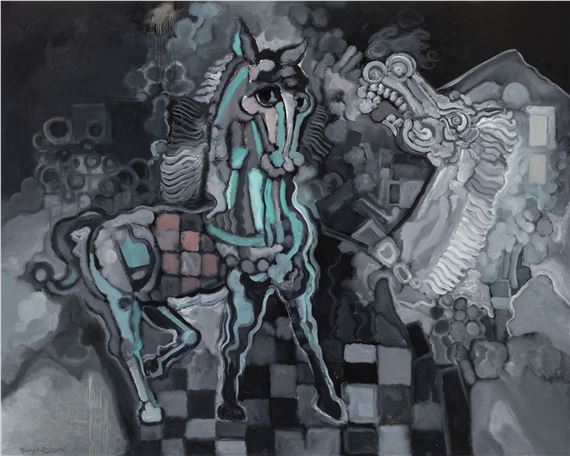
Looking back at the Scenario series, its canvases are populated by recurring motifs—warhorses, masked knights, exotic merchants, ancient nomadic figures—gathering, confronting, clashing, or gazing at one another in mutual suspension. The artist has a gift for seizing decisive moments, constructing from them a narrative architecture within the picture plane, deploying established conventions of composition and chromatic relationships. Tracing further back to earlier works such as The Great Escape and Cloud Wanderings, one finds the seeds of rupture already latent within the very orderliness of Scenario: background spaces gradually shed their scenographic function, reconstituting the pictorial hierarchy through an abstract vocabulary; colour broke free from its obligation to mimetic description, becoming an autonomous force within the canvas. The Interplaying series on view here extends this trajectory still further.
In Interplaying, the narrative charge carried by the human figure is preserved, yet no longer occupies the centre of the pictorial field. Chess pieces, grids, boundaries, and expanses of unexplained colour now inhabit the space once reserved for figuration. Bodies that were formerly whole and symbolically legible are dismembered, fragmented, and inserted into the logic of the game board. Black and red, the dominant hues, cease to serve spatial modelling; instead, they reorganise the painting’s internal relations through layering, collision, and arrest. At the same time, the canvas begins to accommodate what could never be premeditated: a wayward brushstroke, a chromatic imbalance, an unresolved tension between forms—all are retained as generative moments, openings through which the painting might continue its unfoldings.
For this reason, yi—the game—does not, for Fu Yao, denote an image of chess play, nor does it aspire to be a metaphor for victory and defeat. It is, rather, a mode of working. This does not mean that the text or narrative preceding the act of painting has vanished; rather, it means that the outcome of the picture is no longer determined in advance. Earlier experience is not abandoned but repositioned through continual overlay, judgment, and correction. What emerges, then, in the Interplaying series is an autonomy proper to painting itself. The act of creation becomes an unfinished match: each stroke a response to and revision of accumulated experience; each pause an expectant probing of the unknown canvas. The work no longer advances toward a predetermined terminus; instead, it finds its own rhythm through an ongoing process of deliberation and revision, sustaining an endless inner contest between experience and the unknown, control and chance, order and transformation.
Perhaps what truly matters is not what the painting finally presents, but how it perpetually remakes itself—how it becomes a work, how it keeps the act of creation in motion. The traces buried beneath subsequent layers, the unresolved relational tensions, the judgments that veer off course: these constitute the work’s genuine structure. They are neither errors nor provisional stages awaiting correction, but the very conditions that allow painting to go on living. In this sense, yi is not about what the chessboard points toward; it is about painting itself. The aim is not to arrive at a final image, but with each brushstroke, to open the field to yet another possibility.
Tang Contemporary Art is pleased to announce the opening of Fu Yao: Interplaying on July 18 at 4:00 PM at its Beijing 2nd Space. This solo exhibition by artist Fu Yao marks an important presentation jointly organized by Fu Yao and Tang Contemporary Art.
Fu Yao: Interplaying centres on the artist’s new eponymous Interplaying series, presented alongside selected works from the Scenario series, offering a systematic account of her evolving pictorial language and methodological trajectory over the past three years. Where Scenario constructed a theatrical image-world—an orchestration and consolidation of visual narrative—Interplaying signals a shift from construction toward reflexivity, from narrative toward openness.
Looking back at the Scenario series, its canvases are populated by recurring motifs—warhorses, masked knights, exotic merchants, ancient nomadic figures—gathering, confronting, clashing, or gazing at one another in mutual suspension. The artist has a gift for seizing decisive moments, constructing from them a narrative architecture within the picture plane, deploying established conventions of composition and chromatic relationships. Tracing further back to earlier works such as The Great Escape and Cloud Wanderings, one finds the seeds of rupture already latent within the very orderliness of Scenario: background spaces gradually shed their scenographic function, reconstituting the pictorial hierarchy through an abstract vocabulary; colour broke free from its obligation to mimetic description, becoming an autonomous force within the canvas. The Interplaying series on view here extends this trajectory still further.
In Interplaying, the narrative charge carried by the human figure is preserved, yet no longer occupies the centre of the pictorial field. Chess pieces, grids, boundaries, and expanses of unexplained colour now inhabit the space once reserved for figuration. Bodies that were formerly whole and symbolically legible are dismembered, fragmented, and inserted into the logic of the game board. Black and red, the dominant hues, cease to serve spatial modelling; instead, they reorganise the painting’s internal relations through layering, collision, and arrest. At the same time, the canvas begins to accommodate what could never be premeditated: a wayward brushstroke, a chromatic imbalance, an unresolved tension between forms—all are retained as generative moments, openings through which the painting might continue its unfoldings.
For this reason, yi—the game—does not, for Fu Yao, denote an image of chess play, nor does it aspire to be a metaphor for victory and defeat. It is, rather, a mode of working. This does not mean that the text or narrative preceding the act of painting has vanished; rather, it means that the outcome of the picture is no longer determined in advance. Earlier experience is not abandoned but repositioned through continual overlay, judgment, and correction. What emerges, then, in the Interplaying series is an autonomy proper to painting itself. The act of creation becomes an unfinished match: each stroke a response to and revision of accumulated experience; each pause an expectant probing of the unknown canvas. The work no longer advances toward a predetermined terminus; instead, it finds its own rhythm through an ongoing process of deliberation and revision, sustaining an endless inner contest between experience and the unknown, control and chance, order and transformation.
Perhaps what truly matters is not what the painting finally presents, but how it perpetually remakes itself—how it becomes a work, how it keeps the act of creation in motion. The traces buried beneath subsequent layers, the unresolved relational tensions, the judgments that veer off course: these constitute the work’s genuine structure. They are neither errors nor provisional stages awaiting correction, but the very conditions that allow painting to go on living. In this sense, yi is not about what the chessboard points toward; it is about painting itself. The aim is not to arrive at a final image, but with each brushstroke, to open the field to yet another possibility.
Artists on show
Contact details
What's on nearby