
 ARTISTS
Going with the Grain: Woodcuts from Houston Collections
Jan 31, 2009 - Apr 19, 2009
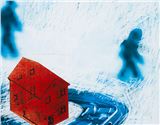
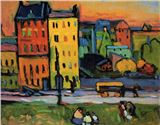
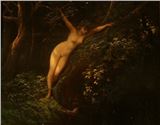
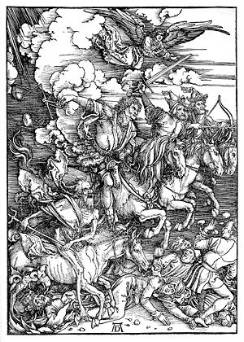
Going with the Grain: Woodcuts from Houston Collections illustrates the unique and expressive character of wood through the print medium. An artist makes a woodcut by drawing or tracing an image in reverse onto a planed piece of wood. Afterward, using gouges, chisels, and knives one cuts away negative areas from the block´s surface. This process results in a relief carving, whose image is transferred by applying ink to its surface, and then the printer presses paper to it by hand or runs it through a press. This exhibition traces the history of the woodcut, the oldest printmaking medium in Western art, and explains the relief printing process. Woodcuts first appeared in China in the ninth century and were originally used to stamp designs onto fabrics and textiles. Their popularity rose with the development of paper, which spread from China in 900 CE, arriving via Italy to Germany by the late fourteenth century. Western artists have made woodcut prints for hundreds of years. The sixteenth century marked a high point for the woodcut in Europe. After the production in 1455 of the Gutenberg Bible—the first book printed with movable type—presses proliferated throughout Europe, and the woodcut became the most effective means of illustrating a printed text. Other printmaking techniques, such as engraving, etching, and lithography, eclipsed the woodcut in the following centuries, mainly because they were more commercially viable. A resurgence in the medium occurred in the late nineteenth and early twentieth centuries when artists promoted the woodcut as a medium for original artistic expression. Going with the Grain is divided into four sections: the European development of the woodcut, from the fifteenth through eighteenth centuries; its artistic revival in Europe in the nineteenth and early twentieth centuries; the revitalized tradition in the United States and Mexico; and the recent employment of the medium by contemporary artists. The show demonstrates the communicative function and aesthetic potential of the woodcut that has captivated artists for centuries and honors the skill of master cutters. These artists include the sixteenth-century printmaker Albrecht Dürer who raised the artistic level and status of the woodcut. His masterworks, made 500 years ago, are heralded for their technical virtuosity and stylistic innovations, as in his famed The Apocalypse of Saint John series from 1498. Later, the independent nature and organic quality of the woodcut lured the German Expressionist, Emil Nolde (1867-1956), to the technique. This exhibition also includes the related media of wood engraving, promoted by the celebrated nineteenth-century American artist, Winslow Homer, and of the linoleum cut, revolutionized by Pablo Picasso in the twentieth century. A host of contemporary artists embraced the woodcut medium including Terry Winters and Helen Frankenthaler, who made the natural grain of the wood an essential aspect of their work. The graphic quality, achieved by intricate linework or heavy gouging, along with an easy accessibility to the raw materials, continues to make the woodcut an enduring choice of expression.
Recommended for you


Jul 07, 2017
- Jun 05, 2027


May 01, 2022
- Jun 01, 2050
Going with the Grain: Woodcuts from Houston Collections illustrates the unique and expressive character of wood through the print medium. An artist makes a woodcut by drawing or tracing an image in reverse onto a planed piece of wood. Afterward, using gouges, chisels, and knives one cuts away negative areas from the block´s surface. This process results in a relief carving, whose image is transferred by applying ink to its surface, and then the printer presses paper to it by hand or runs it through a press. This exhibition traces the history of the woodcut, the oldest printmaking medium in Western art, and explains the relief printing process. Woodcuts first appeared in China in the ninth century and were originally used to stamp designs onto fabrics and textiles. Their popularity rose with the development of paper, which spread from China in 900 CE, arriving via Italy to Germany by the late fourteenth century. Western artists have made woodcut prints for hundreds of years. The sixteenth century marked a high point for the woodcut in Europe. After the production in 1455 of the Gutenberg Bible—the first book printed with movable type—presses proliferated throughout Europe, and the woodcut became the most effective means of illustrating a printed text. Other printmaking techniques, such as engraving, etching, and lithography, eclipsed the woodcut in the following centuries, mainly because they were more commercially viable. A resurgence in the medium occurred in the late nineteenth and early twentieth centuries when artists promoted the woodcut as a medium for original artistic expression. Going with the Grain is divided into four sections: the European development of the woodcut, from the fifteenth through eighteenth centuries; its artistic revival in Europe in the nineteenth and early twentieth centuries; the revitalized tradition in the United States and Mexico; and the recent employment of the medium by contemporary artists. The show demonstrates the communicative function and aesthetic potential of the woodcut that has captivated artists for centuries and honors the skill of master cutters. These artists include the sixteenth-century printmaker Albrecht Dürer who raised the artistic level and status of the woodcut. His masterworks, made 500 years ago, are heralded for their technical virtuosity and stylistic innovations, as in his famed The Apocalypse of Saint John series from 1498. Later, the independent nature and organic quality of the woodcut lured the German Expressionist, Emil Nolde (1867-1956), to the technique. This exhibition also includes the related media of wood engraving, promoted by the celebrated nineteenth-century American artist, Winslow Homer, and of the linoleum cut, revolutionized by Pablo Picasso in the twentieth century. A host of contemporary artists embraced the woodcut medium including Terry Winters and Helen Frankenthaler, who made the natural grain of the wood an essential aspect of their work. The graphic quality, achieved by intricate linework or heavy gouging, along with an easy accessibility to the raw materials, continues to make the woodcut an enduring choice of expression.
Artists on show
Contact details
Sunday
12:15 - 7:00 PM
Tuesday - Wednesday
10:00 AM - 5:00 PM
Thursday
10:00 AM - 9:00 PM
Friday - Saturday
10:00 AM - 7:00 PM
1001 Bissonnet Street River Oaks - Houston, TX, USA 77005

