ARTISTS
Good Vibrations: The Prints of Victor Vasarely
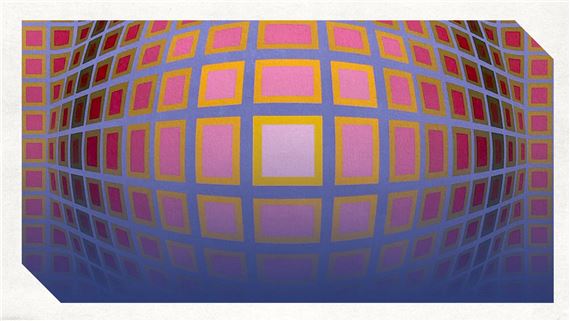
Just one year before The Beach Boys scored a hit with their 1966 song “Good Vibrations,” Victor Vasarely (1906-1997) was generating his own “good vibrations” in the groundbreaking Op (short for optical) art exhibition at the Museum of Modern Art, The Responsive Eye. As a result of the exhibition, Vasarely became widely celebrated, and he experienced enormous success as a printmaker.
Because prints are more affordable and widely available than paintings, Vasarely saw the medium as a vehicle for the democratization of art. Prints were also key to his vision of integrating his visual vocabulary into all aspects of living. This aligned Vasarely with the early Modern abstract artists who sought a universal visual language that could bring order to a chaotic world.
In 1955, Vasarely published his Yellow Manifesto, which emphasized the importance of the viewer in activating the illusion of movement in a static composition. In 1959, Vasarely obtained a patent for what he termed “plastic unity,” which took the form of a “plastic alphabet,” a modular system of combining two contrasting geometric forms and variable colors that could yield infinite compositional possibilities.
Those possibilities are in full bloom in this exhibition through the range of dynamic variations that the artist produced over 25 years. As you view each work, experience the optical sensations that Vasarely considered to be pathways to a more joyful life and towards a better world.
Recommended for you


Just one year before The Beach Boys scored a hit with their 1966 song “Good Vibrations,” Victor Vasarely (1906-1997) was generating his own “good vibrations” in the groundbreaking Op (short for optical) art exhibition at the Museum of Modern Art, The Responsive Eye. As a result of the exhibition, Vasarely became widely celebrated, and he experienced enormous success as a printmaker.
Because prints are more affordable and widely available than paintings, Vasarely saw the medium as a vehicle for the democratization of art. Prints were also key to his vision of integrating his visual vocabulary into all aspects of living. This aligned Vasarely with the early Modern abstract artists who sought a universal visual language that could bring order to a chaotic world.
In 1955, Vasarely published his Yellow Manifesto, which emphasized the importance of the viewer in activating the illusion of movement in a static composition. In 1959, Vasarely obtained a patent for what he termed “plastic unity,” which took the form of a “plastic alphabet,” a modular system of combining two contrasting geometric forms and variable colors that could yield infinite compositional possibilities.
Those possibilities are in full bloom in this exhibition through the range of dynamic variations that the artist produced over 25 years. As you view each work, experience the optical sensations that Vasarely considered to be pathways to a more joyful life and towards a better world.
Artists on show
Contact details

What's on nearby