
 ARTISTS

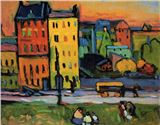

Group Exhibit
Aug 15, 2009 - Oct 16, 2009
Drawn from Deutsche Bank’s extensive collection of works on paper, this exhibition takes its
inspiration, and its title, from Wilhelm Worringer’s seminal 1907 book Abstraction and Empathy. In this
text, Worringer identifies two opposing tendencies pervading the history of art from ancient times
through the Enlightenment. He claims that in societies experiencing periods of anxiety and intense
spirituality, such as those of ancient Egypt and the Middle Ages, artistic production tends toward a flat,
crystalline “abstraction,” while cultures that are oriented toward science and the physical world, like
ancient Greece and Renaissance Italy, are dominated by more naturalistic, embodied styles, which he
grouped under the term “empathy.” As was traditional for art history at the time, Worringer’s book
remained firmly engaged with the past, ignoring contemporaneous artistic production. Yet in the wake
of its publication—just one year after Pablo Picasso painted his masterpiece Les Demoiselles
d’Avignon—Abstraction and Empathy came to be seen as fundamental for understanding the rise of
Expressionism and the role of abstraction in the early twentieth century.
Organized by Carmen Giménez, Curator of Twentieth-Century Art at the Solomon R. Guggenheim
Museum, New York, the exhibition Abstraction and Empathy brings together works that embody an
aesthetic divide similar to the one described in Worringer’s book. At the show’s core are some one
hundred drawings and prints by four artists: Joseph Albers, Michael Buthe, Blinky Palermo, and
Thomas Schütte. Corresponding to Worringer’s notion of abstraction, Albers and Palermo concern
themselves with the effects of color and geometry on the flat surface of the picture plane. Buthe and
Schütte, on the other hand, adopt more gestural, representational styles that speak to the presence of
the human body in lived space, falling closer to Worringer’s concept of empathy. Augmenting these
artists’ works is a small selection of key loans that sketch the path of Worringer’s influence through
paintings by Philip Guston, Paul Klee, and Piet Mondrian.
Naturally, the artists at the center of this exhibition must be understood as individuals, working in
unique contexts and historical circumstances. Seen together through the lens of Worringer’s theories,
however, their works gain new resonance and offer a renewed valuation of abstraction and empathy in
contemporary art practice.
Drawn from Deutsche Bank’s extensive collection of works on paper, this exhibition takes its
inspiration, and its title, from Wilhelm Worringer’s seminal 1907 book Abstraction and Empathy. In this
text, Worringer identifies two opposing tendencies pervading the history of art from ancient times
through the Enlightenment. He claims that in societies experiencing periods of anxiety and intense
spirituality, such as those of ancient Egypt and the Middle Ages, artistic production tends toward a flat,
crystalline “abstraction,” while cultures that are oriented toward science and the physical world, like
ancient Greece and Renaissance Italy, are dominated by more naturalistic, embodied styles, which he
grouped under the term “empathy.” As was traditional for art history at the time, Worringer’s book
remained firmly engaged with the past, ignoring contemporaneous artistic production. Yet in the wake
of its publication—just one year after Pablo Picasso painted his masterpiece Les Demoiselles
d’Avignon—Abstraction and Empathy came to be seen as fundamental for understanding the rise of
Expressionism and the role of abstraction in the early twentieth century.
Organized by Carmen Giménez, Curator of Twentieth-Century Art at the Solomon R. Guggenheim
Museum, New York, the exhibition Abstraction and Empathy brings together works that embody an
aesthetic divide similar to the one described in Worringer’s book. At the show’s core are some one
hundred drawings and prints by four artists: Joseph Albers, Michael Buthe, Blinky Palermo, and
Thomas Schütte. Corresponding to Worringer’s notion of abstraction, Albers and Palermo concern
themselves with the effects of color and geometry on the flat surface of the picture plane. Buthe and
Schütte, on the other hand, adopt more gestural, representational styles that speak to the presence of
the human body in lived space, falling closer to Worringer’s concept of empathy. Augmenting these
artists’ works is a small selection of key loans that sketch the path of Worringer’s influence through
paintings by Philip Guston, Paul Klee, and Piet Mondrian.
Naturally, the artists at the center of this exhibition must be understood as individuals, working in
unique contexts and historical circumstances. Seen together through the lens of Worringer’s theories,
however, their works gain new resonance and offer a renewed valuation of abstraction and empathy in
contemporary art practice.
Contact details
Sunday - Monday
11:00 AM - 6:00 PM
Wednesday
11:00 AM - 6:00 PM
Thursday
11:00 AM - 9:00 PM
Friday - Saturday
11:00 AM - 6:00 PM
Unter den Linden 5 Mitte - Berlin, Germany 10117

What's on nearby
Nov 29, 2025
- Jan 25, 2026

Nov 15, 2025
- Jan 10, 2026
