
 ARTISTS

In the Language of Rules and Exceptions. Science and Art
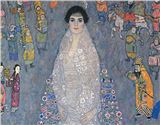
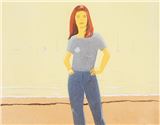
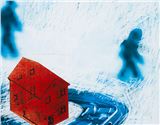
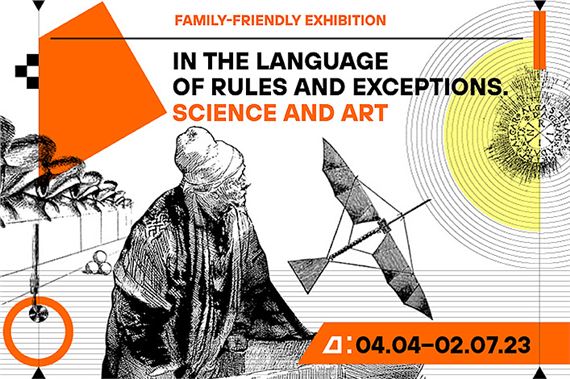
On April 4, 2023, the Jewish Museum and Tolerance Center will present the family-friendly exhibition In the Language of Rules and Exceptions. Science and Art, jointly organized with the Polytechnic Museum. The exhibition deals with the relationship between two of the most important spheres of human activity and the many forms of their interaction. The exhibition is held as part of the Decade of Science and Technology in Russia (2022–2031).
The exhibition features six interactive objects and more than 80 works produced over the past 500 years, from the Late Renaissance to our days, from the likes of Albrecht Dürer and Rembrandt to installations by contemporary artists such as ::VTOL:: and Andrey Bartenev. The list of artists on display at the show includes Rembrandt Harmenszoon van Rijn, Pieter Brueghel the Younger, Katsushika Hokusai, Georges Seurat, Fernand Léger, Joan Miró, Kazimir Malevich, Pavel Filonov, Ivan Leonidov, Konstantin Yuon, Yuri Pimenov, Dmitry Plavinsky, Vyacheslav Koleichuk, Francisco and Platon Infante-Arana, Bill Viola, and more.
The works by these and other artists are on loan from major Russian museums, including the State Hermitage, the State Tretyakov Gallery, the Pushkin State Museum of Fine Arts, the State Museum of Oriental Art, the Shchusev Museum of Architecture, as well as from the Stella Art Foundation and private art collections.
The Polytechnic Museum has contributed items for the many sections of the exhibition. These are rare and valuable devices that take as much effort and skill to create as works of art do. Masters of the past were also meticulous about the aesthetical qualities of the objects they made. Visitors to the exhibition will get to see an 18th-century telescope, a 19th-century solar microscope, a folding sundial, and the only surviving registrier, a device used to record vertical seismic oscillations. Also on display at the exhibition are items from the Polytechnic Museum that once helped scholars study and demonstrate the laws of optics. Among them are biconvex lenses, a total-internal-reflection prism, and Adolf Ferdinand Weinhold’s achromatic prism. The interplay between science and art is most vividly exemplified by a portable camera obscura and a camera lucida from the Polytechnic Museum’s collection. Visitors to the exhibition will find out how painters of the past used these devices, invented by scientists, to create their art.
Recommended for you


On April 4, 2023, the Jewish Museum and Tolerance Center will present the family-friendly exhibition In the Language of Rules and Exceptions. Science and Art, jointly organized with the Polytechnic Museum. The exhibition deals with the relationship between two of the most important spheres of human activity and the many forms of their interaction. The exhibition is held as part of the Decade of Science and Technology in Russia (2022–2031).
The exhibition features six interactive objects and more than 80 works produced over the past 500 years, from the Late Renaissance to our days, from the likes of Albrecht Dürer and Rembrandt to installations by contemporary artists such as ::VTOL:: and Andrey Bartenev. The list of artists on display at the show includes Rembrandt Harmenszoon van Rijn, Pieter Brueghel the Younger, Katsushika Hokusai, Georges Seurat, Fernand Léger, Joan Miró, Kazimir Malevich, Pavel Filonov, Ivan Leonidov, Konstantin Yuon, Yuri Pimenov, Dmitry Plavinsky, Vyacheslav Koleichuk, Francisco and Platon Infante-Arana, Bill Viola, and more.
The works by these and other artists are on loan from major Russian museums, including the State Hermitage, the State Tretyakov Gallery, the Pushkin State Museum of Fine Arts, the State Museum of Oriental Art, the Shchusev Museum of Architecture, as well as from the Stella Art Foundation and private art collections.
The Polytechnic Museum has contributed items for the many sections of the exhibition. These are rare and valuable devices that take as much effort and skill to create as works of art do. Masters of the past were also meticulous about the aesthetical qualities of the objects they made. Visitors to the exhibition will get to see an 18th-century telescope, a 19th-century solar microscope, a folding sundial, and the only surviving registrier, a device used to record vertical seismic oscillations. Also on display at the exhibition are items from the Polytechnic Museum that once helped scholars study and demonstrate the laws of optics. Among them are biconvex lenses, a total-internal-reflection prism, and Adolf Ferdinand Weinhold’s achromatic prism. The interplay between science and art is most vividly exemplified by a portable camera obscura and a camera lucida from the Polytechnic Museum’s collection. Visitors to the exhibition will find out how painters of the past used these devices, invented by scientists, to create their art.
Artists on show
- Albrecht Dürer
- Andrej Bartenev
- Bill Viola
- Boris Dmitrievich Grigoriev
- Dmitri Plavinsky
- Fernand Léger
- Georges Seurat
- Ivan Leonidov
- Joan Miró
- Katsushika Hokusai
- Kazimir Malevich
- Konstantin Yuon
- Kuz'ma Petrov-Vodkin
- Pavel Filonov
- Pieter Brueghel the Younger
- Platon Infante Arana
- Rembrandt van Rijn
- Rostan Tavasiev
- Vyacheslav Koleichuk
- Yuri Pimenov
Contact details

