
 ARTISTS

Invisible Art: Expanding the Boundaries of What Is Possible
On 13 November 2021, the inclusive exhibition “Invisible Art: Expanding the Boundaries of What Is Possible” will begin its run in the State Hermitage.
“As the Hermitage understands things, inclusion is the expansion of possibilities for all categories of visitor. In the present case, the restorers have come up with several new slants on the tactile appreciation of art. The relief outlines of the Penjikent murals and the woven reliefs of the Pazyryk carpets make the perception of them easier and more pleasurable for any visitor. It’s a dream coming true – being able to touch a museum exhibit,” Mikhail Piotrovsky, Director of the State Hermitage, commented.
Inclusivity is a rapidly developing sphere that, nonetheless, still remains something new for museums and demands a serious, many-sided approach. The State Hermitage has been involved in developing strategies for museum inclusivity for many years now. The present exhibition “Invisible Art: Expanding the Boundaries of What Is Possible” is one of the milestone projects in this area. It is aimed primarily at the blind and visually impaired. At the same time, it enables any visitor to interact with world cultural heritage in a fresh way.
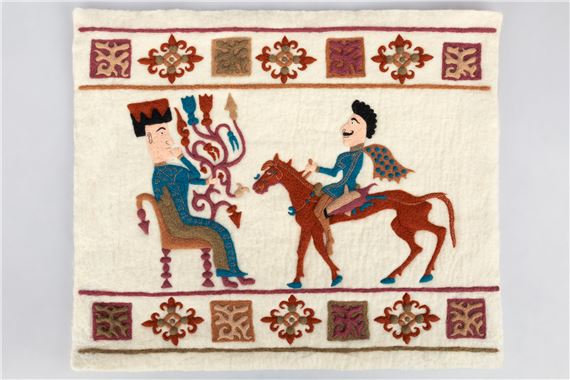
The exhibition presents the results of many years of experiments and explorations in the field of creating replicas of works of art for blind and visually impaired people. The display contains bas-reliefs reproducing the motifs of the famous Penjikent murals and their subjects “brought to life” through animation, tactile copies of parts of the Pazyryk carpet, a relief model of Rembrandt’s Self-Portrait with Shaded Eyes, and much more. The unique project that combines masterpieces of world culture, the achievements of museum science and state-of-the-art technologies is intended to attract the attention of both specialists and the wider public to the issue of providing inclusion for people with poor or no vision.
The Invisible Art project has been developing step by step for a number of years. The first object created was a relief model based on a Rembrandt painted self-portrait from the Leiden Collection (USA). It was presented to the public in the Hermitage in 2018 at the exhibition “The Age of Rembrandt and Vermeer. Masterpieces from the Leiden Collection”. Visitors to the present display in the General Staff building will be able to find out about the complex processes involved in translating a two-dimensional image into a three-dimensional one and about various techniques for producing tactile models.
Recommended for you


On 13 November 2021, the inclusive exhibition “Invisible Art: Expanding the Boundaries of What Is Possible” will begin its run in the State Hermitage.
“As the Hermitage understands things, inclusion is the expansion of possibilities for all categories of visitor. In the present case, the restorers have come up with several new slants on the tactile appreciation of art. The relief outlines of the Penjikent murals and the woven reliefs of the Pazyryk carpets make the perception of them easier and more pleasurable for any visitor. It’s a dream coming true – being able to touch a museum exhibit,” Mikhail Piotrovsky, Director of the State Hermitage, commented.
Inclusivity is a rapidly developing sphere that, nonetheless, still remains something new for museums and demands a serious, many-sided approach. The State Hermitage has been involved in developing strategies for museum inclusivity for many years now. The present exhibition “Invisible Art: Expanding the Boundaries of What Is Possible” is one of the milestone projects in this area. It is aimed primarily at the blind and visually impaired. At the same time, it enables any visitor to interact with world cultural heritage in a fresh way.
The exhibition presents the results of many years of experiments and explorations in the field of creating replicas of works of art for blind and visually impaired people. The display contains bas-reliefs reproducing the motifs of the famous Penjikent murals and their subjects “brought to life” through animation, tactile copies of parts of the Pazyryk carpet, a relief model of Rembrandt’s Self-Portrait with Shaded Eyes, and much more. The unique project that combines masterpieces of world culture, the achievements of museum science and state-of-the-art technologies is intended to attract the attention of both specialists and the wider public to the issue of providing inclusion for people with poor or no vision.
The Invisible Art project has been developing step by step for a number of years. The first object created was a relief model based on a Rembrandt painted self-portrait from the Leiden Collection (USA). It was presented to the public in the Hermitage in 2018 at the exhibition “The Age of Rembrandt and Vermeer. Masterpieces from the Leiden Collection”. Visitors to the present display in the General Staff building will be able to find out about the complex processes involved in translating a two-dimensional image into a three-dimensional one and about various techniques for producing tactile models.
Artists on show
Contact details

