ARTISTS
Jed Ochmanek: Sundials
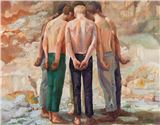
ltd los angeles is pleased to announce Los Angeles-based artist Jed Ochmanek’s Sundials. For his first solo exhibition with the gallery, Ochmanek will present new works from his on-going series of oil-based enamel paintings on metal sheets as well as new urethane and steel sculptures. To create the wall-based works on view in Sundials, Ochmanek moved his painting practice from Los Angeles to Joshua Tree, California. The site was chosen for its aridity and extreme heat - factors necessary to enable particular behavior and rapid drying cycles of the poured solvent and paint solutions across the works steel and aluminum supports. The plates are tilted to allow material to pour off, adjusted to catch or deflect the wind, and baked in full exposure sun. The rich, unrepeatable diversity of tonal and textural dispersions achieved through their successive layers synthetically registers not only the local atmospheric conditions where the paintings were produced, but the more universal forces of the earth’s gravitational pull and orbit around the sun. Beyond the paintings indexical relationship to their environment, Ochmanek’s work resonates deeply with the bareness of the desert’s features: as the paintings draw the viewer to experience the duration and conditions of their making, so too does the dimension of geological time make itself apparent throughout the sparse expanse of the Mojave. Ochmanek’s urethane sculptures are cast from a discontinued model of incandescent bulb previously used for theater spotlights. Like the paintings, the bulbs are a result of pouring color. Solid and tinted, the bulbs act as concentrated orbs of pigment, whereas the serial installation of the paintings posits the bulbs wall-based counterparts as dispersions of pigment across theoretical planes. The bulbs bend and emit light; the paintings absorb it. The bulb’s translucency fluctuates with the ambient lighting conditions, and they become optically active when circumnavigated, as they invert and magnify their environment, encouraging a fluid, time-based read. The planar geometry of their steel supports, however, suggests that one can conceptually reduce the bulbs to three views.
Recommended for you



ltd los angeles is pleased to announce Los Angeles-based artist Jed Ochmanek’s Sundials. For his first solo exhibition with the gallery, Ochmanek will present new works from his on-going series of oil-based enamel paintings on metal sheets as well as new urethane and steel sculptures. To create the wall-based works on view in Sundials, Ochmanek moved his painting practice from Los Angeles to Joshua Tree, California. The site was chosen for its aridity and extreme heat - factors necessary to enable particular behavior and rapid drying cycles of the poured solvent and paint solutions across the works steel and aluminum supports. The plates are tilted to allow material to pour off, adjusted to catch or deflect the wind, and baked in full exposure sun. The rich, unrepeatable diversity of tonal and textural dispersions achieved through their successive layers synthetically registers not only the local atmospheric conditions where the paintings were produced, but the more universal forces of the earth’s gravitational pull and orbit around the sun. Beyond the paintings indexical relationship to their environment, Ochmanek’s work resonates deeply with the bareness of the desert’s features: as the paintings draw the viewer to experience the duration and conditions of their making, so too does the dimension of geological time make itself apparent throughout the sparse expanse of the Mojave. Ochmanek’s urethane sculptures are cast from a discontinued model of incandescent bulb previously used for theater spotlights. Like the paintings, the bulbs are a result of pouring color. Solid and tinted, the bulbs act as concentrated orbs of pigment, whereas the serial installation of the paintings posits the bulbs wall-based counterparts as dispersions of pigment across theoretical planes. The bulbs bend and emit light; the paintings absorb it. The bulb’s translucency fluctuates with the ambient lighting conditions, and they become optically active when circumnavigated, as they invert and magnify their environment, encouraging a fluid, time-based read. The planar geometry of their steel supports, however, suggests that one can conceptually reduce the bulbs to three views.
Artists on show
What's on nearby