ARTISTS



Kyle Minors: Fishtail
Fishtail draws as much on emotion as it does the landscape it is inspired by. It is an attempt to capture the feeling of standing at the base of a mountain, and feeling the presence of what our guide told us were the spirits of the mountains. Standing beneath their cold, unyielding majesty, it is hard to disagree that the mountains are indeed alive.
As an artist, I wanted to capture the feeling of awe I felt when I first saw Machapuchare, or Fishtail, a mountain that is forbidden to climb and looms large over the Annapurna circuit. The sharp intake of breath, followed by my eyes scanning, focusing and readjusting repeatedly as I found more detail, more mystery and more inspiration is a feeling I will chase for the rest of my life.
To create these works, I’ve employed my entire skillset as a generative artist.
I created a photorealistic simulation of the Himalayas, including erosion, sediment and debris. Once I was satisfied with the base terrain, I scattered particles on the terrain and started to give them life and movement, being careful not to lose the integrity of the mountains I was inspired by, but also trying to reflect the feeling and spirit of what I saw, not just a literal representation.
If I manage to capture a fraction of the awe I felt myself in Nepal, then I’ve succeeded as an artist.
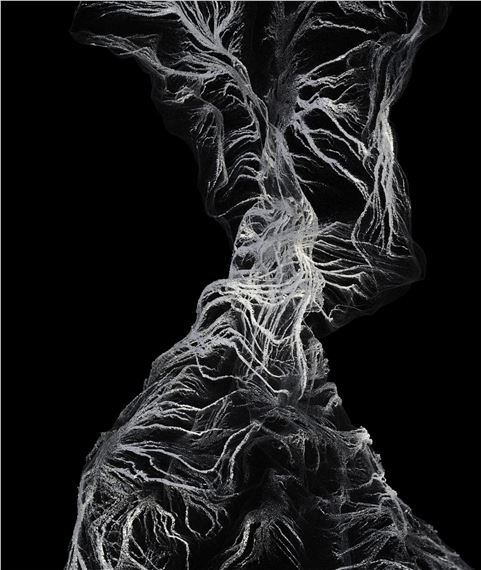
Fishtail draws as much on emotion as it does the landscape it is inspired by. It is an attempt to capture the feeling of standing at the base of a mountain, and feeling the presence of what our guide told us were the spirits of the mountains. Standing beneath their cold, unyielding majesty, it is hard to disagree that the mountains are indeed alive.
As an artist, I wanted to capture the feeling of awe I felt when I first saw Machapuchare, or Fishtail, a mountain that is forbidden to climb and looms large over the Annapurna circuit. The sharp intake of breath, followed by my eyes scanning, focusing and readjusting repeatedly as I found more detail, more mystery and more inspiration is a feeling I will chase for the rest of my life.
To create these works, I’ve employed my entire skillset as a generative artist.
I created a photorealistic simulation of the Himalayas, including erosion, sediment and debris. Once I was satisfied with the base terrain, I scattered particles on the terrain and started to give them life and movement, being careful not to lose the integrity of the mountains I was inspired by, but also trying to reflect the feeling and spirit of what I saw, not just a literal representation.
If I manage to capture a fraction of the awe I felt myself in Nepal, then I’ve succeeded as an artist.
Artists on show

What's on nearby