ARTISTS
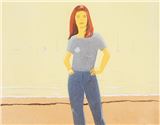
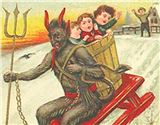
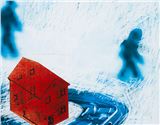
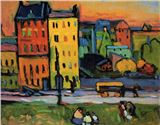
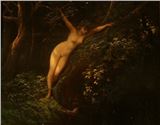
Lithography from Galerie Mourlot, New York
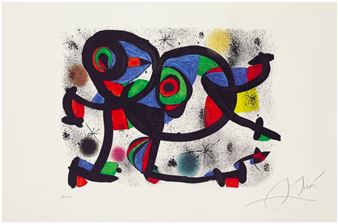
During the Twentieth Century, artists such as Alexander Calder, Marc Chagall, Raoul Dufy, Fernand Léger, Henri Matisse, Joan Miró, and Pablo Picasso, just to name a few, began to explore the art form of lithography. Their interest came through the encouragement of the Atelier Mourlot, a Parisian print shop founded in 1852 by the Mourlot family on rue Saint-Mar in East Paris.
Originally a producer of fine wallpaper, the Atelier Mourlot became involved in the printing of illustrated books as well as high quality posters for the French National Museums and major foreign institutions. By 1937, Mourlot had established its reputation as the largest printer of artistic posters.
The Atelier was transformed when Fernand Mourlot (1895-1988), a graduate of the famous École Nationale des Arts Decoratifs, invited a number of twentieth century artists to learn the complexities of fine-art printing. Here they worked directly on smooth lithographic stone tablets to create original artworks which would then be executed under the direction of master printers.
The combined genius of modern artist and master printer gave rise to unique and visually striking lithographs that appeared only as special limited editions. Reflecting energy and luminescence, the lithographs not only invoke the diligent technique and conscientiousness employed by the artists, but also the significance of the lithograph as a free-standing artistic form.
"Posters must have always existed," wrote Fernand Mourlot in his book "Twentieth Century Posters." "(They existed) in antiquity, in the form of inscriptions; laws engraved in Greek; painted announcements of theatrical performances in Rome; wood cuts in the Middle Ages; printed recruiting notices in the seventeenth and eighteenth centuries. Indeed, posters are to be found through history. They were rarely illustrated, however, before the invention of lithography. Then color lithography made it possible to give practical expression in color to the illustrated poster."
The complex lithograph process involves first drawing on a limestone or copper tablet in greasy crayon, adding a chemical called gum Arabic to preserve the forms, then adding the ink to print the colors using multiple pressings. In is book, Fernand Mourlot creates a documented history of the artists and the process he nurtured and witnessed.
"Leger was a regular visitor to our printing establishment where he made a great number of lithographs in the form of prints and illustrations," Fernand Mourlot recalled. "Beginning in October 1946, Picasso came to work at the Rue de Chabrol during a period of several months. During this period, he exhausted the possibilities of the process; he both learned and re-invented lithography." Picasso created, between 1945 and 1969, nearly four hundred lithographs at the Mourlot studio.
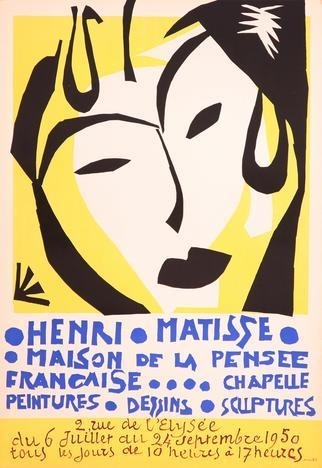
For the studio's one-hundred-year anniversary, Fernand Mourlot published a collection of original lithographs by Picasso, Léger, Matisse, Marino Marini, Derain, and Miró, among others. The results of Fernand Mourlot's collaboration with these artists were so successful that more and more galleries chose Mourlot to print posters for their exhibits, known as Affiches de Peintres Lithographiées. By the mid-twentieth century, the reputation of Mourlot Frères was so respected that the words "Imprimée par Mourlot" were enough to guarantee the finest quality lithographs and demand a premium collector or auction value, worldwide.
"Conceived, brought forth, watched over and supervised by the artist himself, in an atmosphere of creative excitement, all these posters are original, living works," wrote Fernand Mourlot. All of the gorgeous vintage lithographs in the Mourlot Posters archive were printed under the close supervision and control of the artist, a detail that adds to their allure.
New York City played a large part in Mourlot lithographic history. In 1967, the Atelier Mourlot opened a print shop at 115 Bank Street, and printed works by many celebrated American artists such as James Rosenquist, Roy Lichtenstein, Ellsworth Kelly, Robert Rauschenberg and others. Eric Mourlot, Fernand Mourlot's grandson, is the owner of Galerie Mourlot on New York City's Upper East Side. He is making Mourlot archives available to fine art dealers and to the public.
Recommended for you


During the Twentieth Century, artists such as Alexander Calder, Marc Chagall, Raoul Dufy, Fernand Léger, Henri Matisse, Joan Miró, and Pablo Picasso, just to name a few, began to explore the art form of lithography. Their interest came through the encouragement of the Atelier Mourlot, a Parisian print shop founded in 1852 by the Mourlot family on rue Saint-Mar in East Paris.
Originally a producer of fine wallpaper, the Atelier Mourlot became involved in the printing of illustrated books as well as high quality posters for the French National Museums and major foreign institutions. By 1937, Mourlot had established its reputation as the largest printer of artistic posters.
The Atelier was transformed when Fernand Mourlot (1895-1988), a graduate of the famous École Nationale des Arts Decoratifs, invited a number of twentieth century artists to learn the complexities of fine-art printing. Here they worked directly on smooth lithographic stone tablets to create original artworks which would then be executed under the direction of master printers.
The combined genius of modern artist and master printer gave rise to unique and visually striking lithographs that appeared only as special limited editions. Reflecting energy and luminescence, the lithographs not only invoke the diligent technique and conscientiousness employed by the artists, but also the significance of the lithograph as a free-standing artistic form.
"Posters must have always existed," wrote Fernand Mourlot in his book "Twentieth Century Posters." "(They existed) in antiquity, in the form of inscriptions; laws engraved in Greek; painted announcements of theatrical performances in Rome; wood cuts in the Middle Ages; printed recruiting notices in the seventeenth and eighteenth centuries. Indeed, posters are to be found through history. They were rarely illustrated, however, before the invention of lithography. Then color lithography made it possible to give practical expression in color to the illustrated poster."
The complex lithograph process involves first drawing on a limestone or copper tablet in greasy crayon, adding a chemical called gum Arabic to preserve the forms, then adding the ink to print the colors using multiple pressings. In is book, Fernand Mourlot creates a documented history of the artists and the process he nurtured and witnessed.
"Leger was a regular visitor to our printing establishment where he made a great number of lithographs in the form of prints and illustrations," Fernand Mourlot recalled. "Beginning in October 1946, Picasso came to work at the Rue de Chabrol during a period of several months. During this period, he exhausted the possibilities of the process; he both learned and re-invented lithography." Picasso created, between 1945 and 1969, nearly four hundred lithographs at the Mourlot studio.
For the studio's one-hundred-year anniversary, Fernand Mourlot published a collection of original lithographs by Picasso, Léger, Matisse, Marino Marini, Derain, and Miró, among others. The results of Fernand Mourlot's collaboration with these artists were so successful that more and more galleries chose Mourlot to print posters for their exhibits, known as Affiches de Peintres Lithographiées. By the mid-twentieth century, the reputation of Mourlot Frères was so respected that the words "Imprimée par Mourlot" were enough to guarantee the finest quality lithographs and demand a premium collector or auction value, worldwide.
"Conceived, brought forth, watched over and supervised by the artist himself, in an atmosphere of creative excitement, all these posters are original, living works," wrote Fernand Mourlot. All of the gorgeous vintage lithographs in the Mourlot Posters archive were printed under the close supervision and control of the artist, a detail that adds to their allure.
New York City played a large part in Mourlot lithographic history. In 1967, the Atelier Mourlot opened a print shop at 115 Bank Street, and printed works by many celebrated American artists such as James Rosenquist, Roy Lichtenstein, Ellsworth Kelly, Robert Rauschenberg and others. Eric Mourlot, Fernand Mourlot's grandson, is the owner of Galerie Mourlot on New York City's Upper East Side. He is making Mourlot archives available to fine art dealers and to the public.

What's on nearby