ARTISTS
Ludwig Goes Pop + The East Side Story
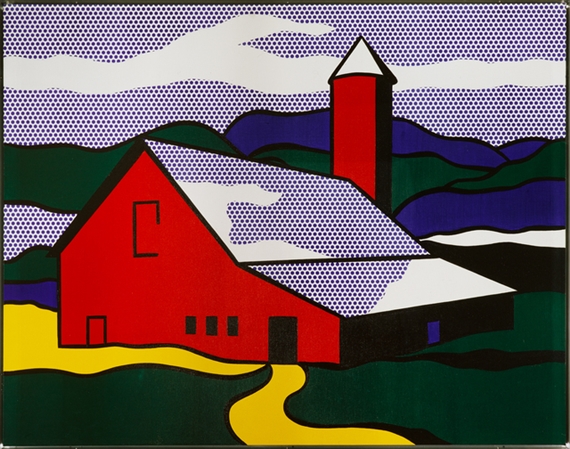
The art collection brought together by Peter and Irene Ludwig is the foundation of all Ludwig Museums. Perhaps the most well-known and famous part of this collection is the body of artworks that represents the period of Pop Art. It is unique in the sense that in addition to the iconic works of the most well-known Pop artists (Jasper Johns, Roy Lichtenstein, Claes Oldenburg, Robert Rauschenberg, Andy Warhol, Tom Wesselmann, etc.), it comprises pieces by less famous ones (Allan D’Arcangelo, Richard Lindner, etc.), along with artworks by the European representatives of this tendency (Peter Blake, Richard Hamilton, David Hockney, Mimmo Rotella). The collection of the Ludwig Museums alone is abundant for creating a survey exhibition of international Pop Art.
The allure of Pop Art lies in the fact – made evident by this exhibition – that succeeding the abstract tendencies, which had kept a considerable distance from the audience, it reintroduced a kind of figurative representation into the contemporary art of the time, which, owing to its everyday references, was familiar and seemingly easy to interpret for the public. At the same time, paradoxically, these works provide a critique of consumer society by translating the mechanism of daily consumption into art, offering the artworks (i.e. consumer products) to the spectators. This is also true of representations that already criticize a specific subject, such as the (Vietam) war, the representational modes in mass media.
The exhibition is partly realized as a collaboration of the Ludwig Museums; prior to the Budapest show, it was on display at the Ludwig Museums of Cologne and then Vienna. In the Budapest version, the exhibition is complemented with works by Hungarian and East-European artists (Ilona Keserü, Gyula Konkoly, László Lakner, Siskov Ludmil, Zsuzsa Szenes, Boris Bućan, Vera Fischer, Tomislav Gotovac, Dušan Otašević, Sanja Iveković, Běla Kolářová, Jana Želibská, Natalia LL, Stano Filko, Julius Koller, Marko Pogačnik, etc.). On the one hand, these pieces are based on the use of everyday objects in the period, and on the other hand, they provide a line-up of local cultural references. Indirectly, the exhibition also explores how the notions of “Western” art history can be interpreted in a context where the social and cultural conditions for the emergence of this tendency were fundamentally different from the original scenes where Pop Art had been created.
Recommended for you


The art collection brought together by Peter and Irene Ludwig is the foundation of all Ludwig Museums. Perhaps the most well-known and famous part of this collection is the body of artworks that represents the period of Pop Art. It is unique in the sense that in addition to the iconic works of the most well-known Pop artists (Jasper Johns, Roy Lichtenstein, Claes Oldenburg, Robert Rauschenberg, Andy Warhol, Tom Wesselmann, etc.), it comprises pieces by less famous ones (Allan D’Arcangelo, Richard Lindner, etc.), along with artworks by the European representatives of this tendency (Peter Blake, Richard Hamilton, David Hockney, Mimmo Rotella). The collection of the Ludwig Museums alone is abundant for creating a survey exhibition of international Pop Art.
The allure of Pop Art lies in the fact – made evident by this exhibition – that succeeding the abstract tendencies, which had kept a considerable distance from the audience, it reintroduced a kind of figurative representation into the contemporary art of the time, which, owing to its everyday references, was familiar and seemingly easy to interpret for the public. At the same time, paradoxically, these works provide a critique of consumer society by translating the mechanism of daily consumption into art, offering the artworks (i.e. consumer products) to the spectators. This is also true of representations that already criticize a specific subject, such as the (Vietam) war, the representational modes in mass media.
The exhibition is partly realized as a collaboration of the Ludwig Museums; prior to the Budapest show, it was on display at the Ludwig Museums of Cologne and then Vienna. In the Budapest version, the exhibition is complemented with works by Hungarian and East-European artists (Ilona Keserü, Gyula Konkoly, László Lakner, Siskov Ludmil, Zsuzsa Szenes, Boris Bućan, Vera Fischer, Tomislav Gotovac, Dušan Otašević, Sanja Iveković, Běla Kolářová, Jana Želibská, Natalia LL, Stano Filko, Julius Koller, Marko Pogačnik, etc.). On the one hand, these pieces are based on the use of everyday objects in the period, and on the other hand, they provide a line-up of local cultural references. Indirectly, the exhibition also explores how the notions of “Western” art history can be interpreted in a context where the social and cultural conditions for the emergence of this tendency were fundamentally different from the original scenes where Pop Art had been created.
Artists on show
- Akos Birkas
- Al Hansen
- Alex Mlynarcik
- Allan D'Arcangelo
- Andy Warhol
- Bela Kolárová
- Boris Bućan
- Boris Jesih
- Claes Oldenburg
- David Hockney
- Dezsõ Korniss
- Dragoš Kalajić
- Dušan Otašević
- Endre Tót
- Gábor Altorjay
- György Galántai
- Gyula Gulyás
- Gyula Konkoly
- Ilona Keserü
- Imre Bak
- Jana Želibská
- Janez Logar
- Jasper Johns
- Jean-Jacques Lebel
- Jim Dine
- Joe Tilson
- Július Koller
- Juraj Bartusz
- Juraj Meliš
- Jurry Zielinski
- Károly Halász
- Károly Kismányoki
- László Gyémánt
- László Lakner
- László Paizs
- Leonid Šejka
- Ludmill Siskov
- Marko Pogačnik
- Milena Usenik
- Mimmo Rotella
- Miša Pengov
- Natalia Lach-Lachowicz
- Nedeljko-Nesa Paripovic
- Nikola Koydl
- Peter Blake
- Radomir Damnjanovic-Damnjan
- Raymond Hains
- Richard Hamilton
- Richard Lindner
- Robert Indiana
- Robert Rauschenberg
- Roy Lichtenstein
- Rudolf Sikora
- Sándor Altorjai
- Sándor Csutoros
- Sándor Pinczehelyi
- Sanja Ivekovic
- Stano Filko
- Tamas Körösenyi
- Tamás Szentjóby
- Tibor Vilt
- Tom Wesselmann
- Tomislav Gotovac
- Vera Fischer
- Wolf Vostell
- Zmago Jeraj
- Zsuzsa Szenes
Contact details

What's on nearby