ARTISTS

Making Connections
In celebrating the creative legacy of the East End of Long Island, the Parrish Art Museum collection has grown especially rich in artists who have lived and worked here. It is this connection among artists, in their lives and in their art, which is brought to the fore in the thematic installations on view throughout the Permanent Collection galleries.
Over a half century ago, Stephen Antonakos was one of the first sculptors to use neon as a painter uses paint. Light and its variable and mystical properties were his abiding concerns, and Voyage shows a compelling marriage of solid geometric form and the transitory nature of light. By contrast, John Chamberlain’s Tambourinefrappe draws power from dense volumes, reflective material, and lush color.
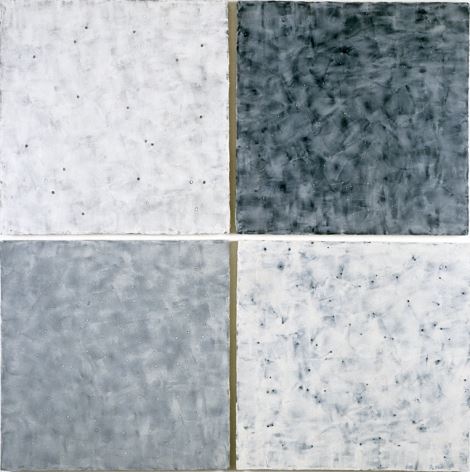
Light also informs the inventive and innovative approaches to landscape explored by Roy Lichtenstein and Michelle Stuart. Lichtenstein uses the motifs of historical Chinese landscapes, translated into his own language of variable-sized dots. Stuart’s Passage Bream Bay evokes the South Seas explorations of Captain Cook in its gridded panels of beeswax and pigment. The conversation with the grid is extended in Donald Sultan’s Lemon, Nov. 28, 1983, a vivid and forcefully graphic interpretation of the still-life tradition using unconventional materials. Caio Fonseca’s lyrical painting of interlocking abstract shapes suggests the intersection of natural forms and musical notation. Louise Nevelson’s composition of found wooden objects is rendered in a velvety black that, like Chamberlain’s reimagined crushed cars, transforms everyday materials into objects of beauty.
In the 1990s, Ross Bleckner began to paint aspects of the body, drawn to both the beauty and mutability of cells viewed at the microscopic level. In Mysticism for Beginners, jittery masses of circular shapes make explicit reference to human—even spiritual—concerns. Dorothea Rockburne’s Egyptian Painting: Sahura, suggests luminous light and archaic mysteries, inspired by her deep engagement with mathematics and astronomy.
Recommended for you


In celebrating the creative legacy of the East End of Long Island, the Parrish Art Museum collection has grown especially rich in artists who have lived and worked here. It is this connection among artists, in their lives and in their art, which is brought to the fore in the thematic installations on view throughout the Permanent Collection galleries.
Over a half century ago, Stephen Antonakos was one of the first sculptors to use neon as a painter uses paint. Light and its variable and mystical properties were his abiding concerns, and Voyage shows a compelling marriage of solid geometric form and the transitory nature of light. By contrast, John Chamberlain’s Tambourinefrappe draws power from dense volumes, reflective material, and lush color.
Light also informs the inventive and innovative approaches to landscape explored by Roy Lichtenstein and Michelle Stuart. Lichtenstein uses the motifs of historical Chinese landscapes, translated into his own language of variable-sized dots. Stuart’s Passage Bream Bay evokes the South Seas explorations of Captain Cook in its gridded panels of beeswax and pigment. The conversation with the grid is extended in Donald Sultan’s Lemon, Nov. 28, 1983, a vivid and forcefully graphic interpretation of the still-life tradition using unconventional materials. Caio Fonseca’s lyrical painting of interlocking abstract shapes suggests the intersection of natural forms and musical notation. Louise Nevelson’s composition of found wooden objects is rendered in a velvety black that, like Chamberlain’s reimagined crushed cars, transforms everyday materials into objects of beauty.
In the 1990s, Ross Bleckner began to paint aspects of the body, drawn to both the beauty and mutability of cells viewed at the microscopic level. In Mysticism for Beginners, jittery masses of circular shapes make explicit reference to human—even spiritual—concerns. Dorothea Rockburne’s Egyptian Painting: Sahura, suggests luminous light and archaic mysteries, inspired by her deep engagement with mathematics and astronomy.

What's on nearby