ARTISTS
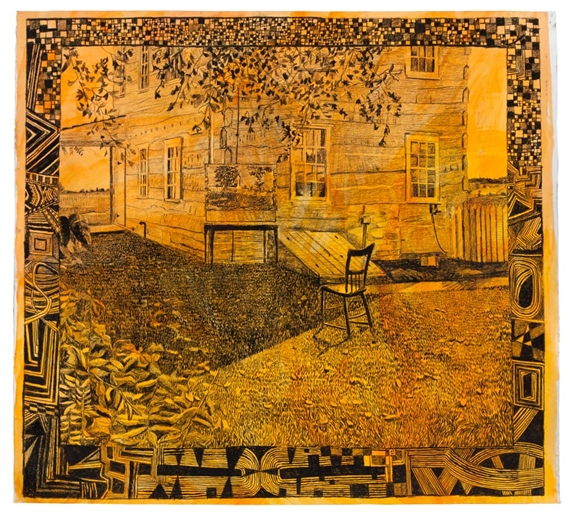
Mark Mahosky: The Yellow Drawings, 1986–2017
In The Yellow Drawings, Mark Mahosky explores the Gettysburg Civil War battlefield as a site of memory and memorialization through black ink and charcoal drawings on brightly painted grounds, using the palette of highway warning signs as if to grab our attention. On closer inspection, the viewer is rewarded with works of remarkable detail and poignant emptiness. No people, soldiers or civilians, inhabit these haunted landscapes where scores of Americans were maimed and killed. The battle of Gettysburg was the costliest of the entire war as well as the deadliest battle in U.S. history, with approximately fifty-thousand casualties suffered across both sides.
Almost immediately after the conclusion of the battle in 1863, the Gettysburg battlefield became a place of pilgrimage, attracting throngs of visitors. Images of the site, from photographs to paintings, and prints to postcards, have played a significant role in promoting Gettysburg's touristic appeal. Mahosky's drawings of the battlefield reflect this image economy—revealing how Americans have consumed images of the battlefield over time—as well as the artist's own subjectivity.
Mahosky's influences range from the historical to the mundane, from the art museum to the souvenir shop. The washy grounds of The Yellow Drawings reference the ambrotype emulsions of Civil War photography. Mahosky has been a diligent student of the various permutations of modernist abstraction, which filters into the Gettysburg drawings as well, especially in the drawn borders that frame the battlefield images. We can recognize a distillation of the history of abstraction, including Cubism and Constructivism, as well as the decorative flourishes of Secessionism. Paying homage to the Gettysburg battlefield's tacky, tourist trap shops and wax museums of his youth (now largely gone), The Yellow Drawings bring to mind the fake parchment paper of the countless facsimiles of Lincoln's Gettysburg Address which were sold at such establishments.
Recommended for you
In The Yellow Drawings, Mark Mahosky explores the Gettysburg Civil War battlefield as a site of memory and memorialization through black ink and charcoal drawings on brightly painted grounds, using the palette of highway warning signs as if to grab our attention. On closer inspection, the viewer is rewarded with works of remarkable detail and poignant emptiness. No people, soldiers or civilians, inhabit these haunted landscapes where scores of Americans were maimed and killed. The battle of Gettysburg was the costliest of the entire war as well as the deadliest battle in U.S. history, with approximately fifty-thousand casualties suffered across both sides.
Almost immediately after the conclusion of the battle in 1863, the Gettysburg battlefield became a place of pilgrimage, attracting throngs of visitors. Images of the site, from photographs to paintings, and prints to postcards, have played a significant role in promoting Gettysburg's touristic appeal. Mahosky's drawings of the battlefield reflect this image economy—revealing how Americans have consumed images of the battlefield over time—as well as the artist's own subjectivity.
Mahosky's influences range from the historical to the mundane, from the art museum to the souvenir shop. The washy grounds of The Yellow Drawings reference the ambrotype emulsions of Civil War photography. Mahosky has been a diligent student of the various permutations of modernist abstraction, which filters into the Gettysburg drawings as well, especially in the drawn borders that frame the battlefield images. We can recognize a distillation of the history of abstraction, including Cubism and Constructivism, as well as the decorative flourishes of Secessionism. Paying homage to the Gettysburg battlefield's tacky, tourist trap shops and wax museums of his youth (now largely gone), The Yellow Drawings bring to mind the fake parchment paper of the countless facsimiles of Lincoln's Gettysburg Address which were sold at such establishments.
Artists on show
Contact details
What's on nearby