Picasso: A Selection of Works on Paper

Mar 08, 2018 - May 31, 2018
The works on paper by Pablo Picasso (1881-1973) encompass many different media and techniques. He drew constantly, using pencil, pen and ink, pastel and watercolor. Some of these works are very complete studies, others are doodles sketched on café tables. Picasso’s works on paper also include a lifetime of creating intaglio prints. These etchings, drypoints and aquatints range from his Saltimbanques of 1904-1905 and his Suite Vollard of 1930-1937 to his 347 Series and 156 Series, respectively dating from 1968 and 1970-1972. Finally, lithography and linocut were used extensively by Picasso, particularly from 1945-1964. Picasso was responsible almost single-handedly for what was a fifth major period in the history of lithography since its invention at the end of the eighteenth century. In 1958-1964, with his new and revolutionary technique of the one-block, multicolored linocut, Picasso added still another dimension to his works on paper.


Within the panorama of works on paper over the centuries, Picasso’s achievements are impressive. To appreciate those achievements, one must view Picasso as essentially a Spanish artist, in his case, as a direct descendant of Velasquez and Goya. The works of his early career, those of the Cubist period and those produced immediately after Cubism have been  analyzed extensively by many art historians. Picasso’s works produced from 1945 onwards have been perhaps less well understood or appreciated.
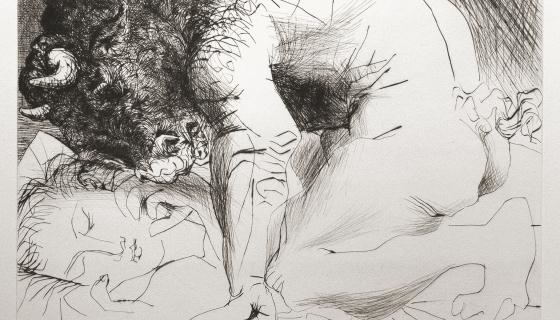

The works on paper by Pablo Picasso (1881-1973) encompass many different media and techniques. He drew constantly, using pencil, pen and ink, pastel and watercolor. Some of these works are very complete studies, others are doodles sketched on café tables. Picasso’s works on paper also include a lifetime of creating intaglio prints. These etchings, drypoints and aquatints range from his Saltimbanques of 1904-1905 and his Suite Vollard of 1930-1937 to his 347 Series and 156 Series, respectively dating from 1968 and 1970-1972. Finally, lithography and linocut were used extensively by Picasso, particularly from 1945-1964. Picasso was responsible almost single-handedly for what was a fifth major period in the history of lithography since its invention at the end of the eighteenth century. In 1958-1964, with his new and revolutionary technique of the one-block, multicolored linocut, Picasso added still another dimension to his works on paper.


Within the panorama of works on paper over the centuries, Picasso’s achievements are impressive. To appreciate those achievements, one must view Picasso as essentially a Spanish artist, in his case, as a direct descendant of Velasquez and Goya. The works of his early career, those of the Cubist period and those produced immediately after Cubism have been  analyzed extensively by many art historians. Picasso’s works produced from 1945 onwards have been perhaps less well understood or appreciated.


Artists on show

Contact details

645 North Michigan Avenue, Suite 990 River East - Chicago, IL, USA 60611
Sign in to MutualArt.com