
 ARTISTS
Picasso: Etchings of Love and Desire
Jan 26, 2008 - Apr 20, 2008
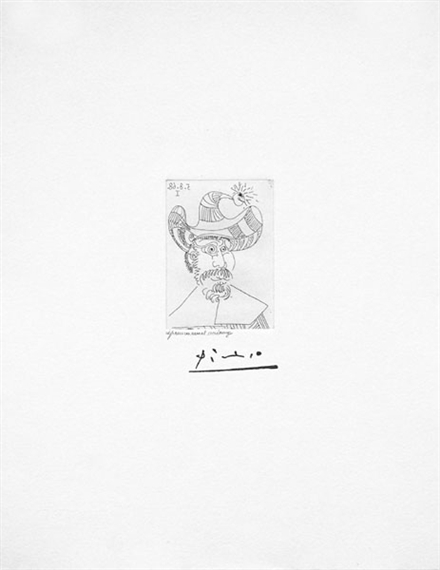
One of the most influential artists of the 20th century, Pablo Picasso employed disparate styles, media, and artistic sources to express the complexity of human experience. Born in Malaga, Spain, in 1881, he studied at the Academy of Fine Arts in Barcelona. Working with Georges Braque, he developed Cubism, an artistic movement that flattened and fragmented forms, and rejected traditional perspective. Throughout his career, Picasso formulated and adapted an unprecedented variety of styles, yielding works ranging from neo-classical figure paintings to expressive drawings. While painting was his primary medium, he was extremely prolific and produced sculpture, prints, theater designs, and ceramics that represented significant contributions to their respective disciplines. He died in Mougins, France, in 1973. Showcasing forty rare etchings from the artist’s final decades, this exhibition reveals the depth of Picasso’s expression. The themes of his late work can be tied to a decline in the artist’s health; at the age of 84 in 1965, he underwent an ulcer operation that left him homebound. Interacting with only a handful of people, he relied on his imagination and summoned characters from his past– the clown, the old man, the lover, and the gentleman. The works in this exhibition range from nudes to portraits, from sexual fantasies to autobiographical reflections, often addressing art historical and literary subject matter. Several of the etchings were inspired by the Old Masters such as Degas, Raphael, and Rembrandt. Works from the “347” series depict episodes from La Celestina, a tale of unrequited love written by Spaniard Fernando de Rojas in 1499. In addition to the “347” series, the exhibition also presents etchings from the “60” and “156” series. Drawn entirely from the collection of Leslie Sacks Fine Art (Los Angeles, CA), this exhibition was organized by Landau Traveling Exhibitions.
Recommended for you


Jul 07, 2017
- Jun 05, 2027


May 01, 2022
- Jun 01, 2050

Feb 09, 2024
- Feb 01, 2026
One of the most influential artists of the 20th century, Pablo Picasso employed disparate styles, media, and artistic sources to express the complexity of human experience. Born in Malaga, Spain, in 1881, he studied at the Academy of Fine Arts in Barcelona. Working with Georges Braque, he developed Cubism, an artistic movement that flattened and fragmented forms, and rejected traditional perspective. Throughout his career, Picasso formulated and adapted an unprecedented variety of styles, yielding works ranging from neo-classical figure paintings to expressive drawings. While painting was his primary medium, he was extremely prolific and produced sculpture, prints, theater designs, and ceramics that represented significant contributions to their respective disciplines. He died in Mougins, France, in 1973. Showcasing forty rare etchings from the artist’s final decades, this exhibition reveals the depth of Picasso’s expression. The themes of his late work can be tied to a decline in the artist’s health; at the age of 84 in 1965, he underwent an ulcer operation that left him homebound. Interacting with only a handful of people, he relied on his imagination and summoned characters from his past– the clown, the old man, the lover, and the gentleman. The works in this exhibition range from nudes to portraits, from sexual fantasies to autobiographical reflections, often addressing art historical and literary subject matter. Several of the etchings were inspired by the Old Masters such as Degas, Raphael, and Rembrandt. Works from the “347” series depict episodes from La Celestina, a tale of unrequited love written by Spaniard Fernando de Rojas in 1499. In addition to the “347” series, the exhibition also presents etchings from the “60” and “156” series. Drawn entirely from the collection of Leslie Sacks Fine Art (Los Angeles, CA), this exhibition was organized by Landau Traveling Exhibitions.
Artists on show
Contact details
Tuesday - Wednesday
10:00 - 5:00 AM
Thursday
10:00 AM - 8:00 PM
Friday
10:00 - 5:00 AM
Saturday
12:00 - 5:00 PM
560 South First Street San Jose, CA, USA 95113

What's on nearby

Jul 22, 2022
- Dec 31, 2025
Dec 05, 2025
- Mar 08, 2026
Jul 11, 2025
- Feb 22, 2026
