
 ARTISTS
Roy Lichtenstein: Girls
May 12, 2008 - Jun 28, 2008
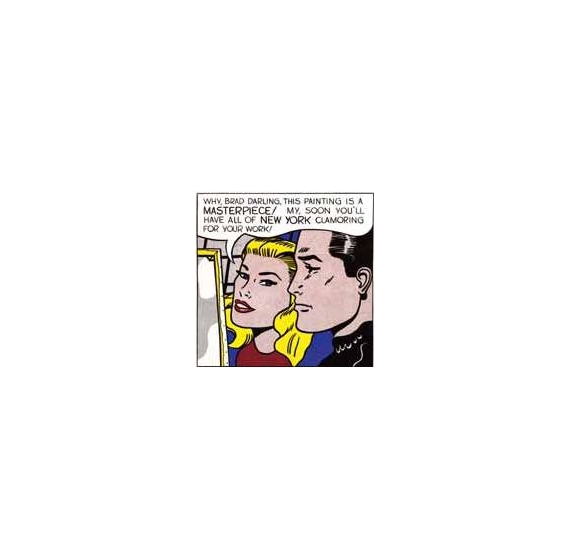
Gagosian Gallery is pleased to present “Girls,” a seminal group of paintings by Roy Lichtenstein. In the summer of 1961 Lichtenstein embarked on a series of iconic images of women, taken directly from newspaper clippings and the romance comic books so prevalent in post-war America. The anonymity of the mass-produced, cheap comic book helped him to capture specific impressions of real things, while maintaining the necessary degree of aesthetic distance afforded by what he understood to be the “high restrictive quality of art.” He scrutinized his female subjects, editing and re-presenting the crux of their trials and tribulations in paint on canvas on a greatly enlarged scale. The “Girl” paintings, together with the war images (or “Boy” paintings) established him as a major protagonist of the American Pop Art movement. In all of Lichtenstein’s art there remains a particular, unmistakably American quality: a knowing and laconic examination of the world that separated him from his Capitalist Realist contemporaries in Europe, who also borrowed from pop cultural sources. His mixing of text and image, and of high and low culture, as well as his strategies involving the appropriated image, continues to be a rich source of inspiration for subsequent generations of artists, from Richard Prince, Jeff Koons, and Raymond Pettibon to John Currin and Elizabeth Peyton. In 1962, Girl With Ball (1961), a painting of a girl holding a beach ball, taken directly from a New York Times advertisement for a Pocono resort, caught Leo Castelli’s eye. He showed it alongside works such as the prescient Masterpiece (1962). Lichtenstein went on to paint various comely women in conditions of distress, like Drowning Girl (1963) and Frightened Girl (1963). Hopeless (1963) shows a teary blonde beneath the caption: "That`s the way—it should have begun! But it`s hopeless!” and In the Car (1963) depicts a moment of chilly silence between a man and woman. In works such as Forget it! Forget Me (1962) and Kiss V (1964), sexual battles are fought and personal catastrophes played out, the elements of staged, melodramatic love scenes elevated to the realm of fine art. Such images accrue even greater historical importance in terms of contemporary gender stereotypes, the power of media images, and the social dichotomies endemic to modern life.
Recommended for you

Jul 07, 2017
- Jun 05, 2027

May 01, 2022
- Jun 01, 2050


Gagosian Gallery is pleased to present “Girls,” a seminal group of paintings by Roy Lichtenstein. In the summer of 1961 Lichtenstein embarked on a series of iconic images of women, taken directly from newspaper clippings and the romance comic books so prevalent in post-war America. The anonymity of the mass-produced, cheap comic book helped him to capture specific impressions of real things, while maintaining the necessary degree of aesthetic distance afforded by what he understood to be the “high restrictive quality of art.” He scrutinized his female subjects, editing and re-presenting the crux of their trials and tribulations in paint on canvas on a greatly enlarged scale. The “Girl” paintings, together with the war images (or “Boy” paintings) established him as a major protagonist of the American Pop Art movement. In all of Lichtenstein’s art there remains a particular, unmistakably American quality: a knowing and laconic examination of the world that separated him from his Capitalist Realist contemporaries in Europe, who also borrowed from pop cultural sources. His mixing of text and image, and of high and low culture, as well as his strategies involving the appropriated image, continues to be a rich source of inspiration for subsequent generations of artists, from Richard Prince, Jeff Koons, and Raymond Pettibon to John Currin and Elizabeth Peyton. In 1962, Girl With Ball (1961), a painting of a girl holding a beach ball, taken directly from a New York Times advertisement for a Pocono resort, caught Leo Castelli’s eye. He showed it alongside works such as the prescient Masterpiece (1962). Lichtenstein went on to paint various comely women in conditions of distress, like Drowning Girl (1963) and Frightened Girl (1963). Hopeless (1963) shows a teary blonde beneath the caption: "That`s the way—it should have begun! But it`s hopeless!” and In the Car (1963) depicts a moment of chilly silence between a man and woman. In works such as Forget it! Forget Me (1962) and Kiss V (1964), sexual battles are fought and personal catastrophes played out, the elements of staged, melodramatic love scenes elevated to the realm of fine art. Such images accrue even greater historical importance in terms of contemporary gender stereotypes, the power of media images, and the social dichotomies endemic to modern life.
Artists on show
Contact details
Tuesday - Saturday
10:00 AM - 6:00 PM
980 Madison Avenue Upper East Side - New York, NY, USA 10075

Related articles

Jun 11, 2008
What's on nearby
Dec 11, 2025
- May 12, 2026
Apr 18, 2025
- Jan 18, 2026
Oct 09, 2025
- Jan 12, 2026
