ARTISTS
Roy Lichtenstein
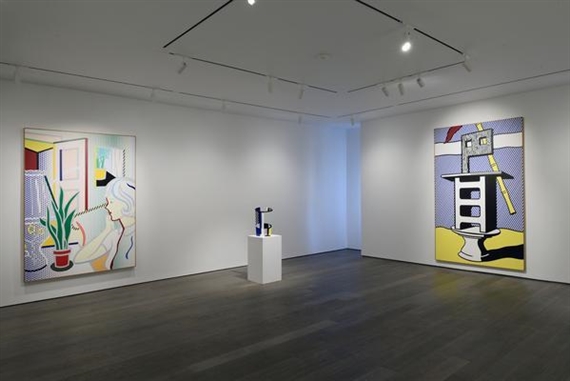
Van de Weghe Fine Art is pleased to present an exhibition of works by Roy Lichtenstein (1923 – 1997), one of the most renowned masters of the Pop Art movement. The show is comprised of paintings, drawings, and sculptures spanning four decades and is the first in the gallery’s newly renovated space.
Lichtenstein started drawing comic characters: Mickey Mouse, Bugs Bunny, Donald Duck, using Bazooka Bubble Gum wrappers as reference, to please his children in the late 1950s. He began inserting them in his paintings at the time and comics became a main source of inspiration, both as subject matter and as the means to a new way of painting. Beginning with his first one-man show at Leo Castelli Gallery in 1962, with a group of paintings that focused on solitary objects such as sneakers, hot dogs, golf balls, Lichtenstein’s was drawn to common objects that abstracted without relinquishing the features that make them recognizable. There is an equilibrium between his subjects and his translation of them.
While he retained the formal vocabulary of the comic - bold black line, brilliant color, and the Ben-Day dot - he largely abandoned it as a subject by 1965. His interests were wide-ranging, and grew to encompass not only everyday objects, but art-historical subjects and his own oeuvre. Pyramid III, 1969 depicts an icon of antiquity that is pared down and thoroughly modern, bound to an image of mechanized process. In Things on the Wall, 1973 Lichtenstein scatters objects around the picture plane without regard to the conventions of landscape or the force of gravity. The painting features a striking wood-grain motif, which he uses in non-illusionistic terms. The work references 19th century trompe l’oeil painting and Cubism, and includes a fragment of his own painting, Cape Cod Still Life, 1973 (a drawing for which is included in the exhibition). Lichtenstein’s exploration of art-historical movements expanded in the late 70s. He identified with the Surrealist works of Magritte, Ernst and Dalí. Figure with Banner, 1978 depicts a figural stack of detritus, starkly outlined in black and white, in a barren though brightly colored landscape. It is at once haunting and whimsical.
Recommended for you


Van de Weghe Fine Art is pleased to present an exhibition of works by Roy Lichtenstein (1923 – 1997), one of the most renowned masters of the Pop Art movement. The show is comprised of paintings, drawings, and sculptures spanning four decades and is the first in the gallery’s newly renovated space.
Lichtenstein started drawing comic characters: Mickey Mouse, Bugs Bunny, Donald Duck, using Bazooka Bubble Gum wrappers as reference, to please his children in the late 1950s. He began inserting them in his paintings at the time and comics became a main source of inspiration, both as subject matter and as the means to a new way of painting. Beginning with his first one-man show at Leo Castelli Gallery in 1962, with a group of paintings that focused on solitary objects such as sneakers, hot dogs, golf balls, Lichtenstein’s was drawn to common objects that abstracted without relinquishing the features that make them recognizable. There is an equilibrium between his subjects and his translation of them.
While he retained the formal vocabulary of the comic - bold black line, brilliant color, and the Ben-Day dot - he largely abandoned it as a subject by 1965. His interests were wide-ranging, and grew to encompass not only everyday objects, but art-historical subjects and his own oeuvre. Pyramid III, 1969 depicts an icon of antiquity that is pared down and thoroughly modern, bound to an image of mechanized process. In Things on the Wall, 1973 Lichtenstein scatters objects around the picture plane without regard to the conventions of landscape or the force of gravity. The painting features a striking wood-grain motif, which he uses in non-illusionistic terms. The work references 19th century trompe l’oeil painting and Cubism, and includes a fragment of his own painting, Cape Cod Still Life, 1973 (a drawing for which is included in the exhibition). Lichtenstein’s exploration of art-historical movements expanded in the late 70s. He identified with the Surrealist works of Magritte, Ernst and Dalí. Figure with Banner, 1978 depicts a figural stack of detritus, starkly outlined in black and white, in a barren though brightly colored landscape. It is at once haunting and whimsical.
Artists on show
Contact details

What's on nearby