
 ARTISTS
Scarecrow
Apr 06, 2010 - Jun 09, 2010
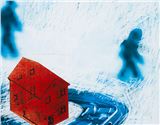
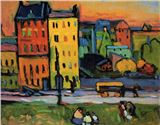
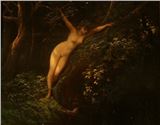
SCARECROW considers artists' explorations of the human body — and its functions — in visual narratives and performance situations that reorder and transgress physical and social conventions.
SCARECROW seeks to locate and consider the "ever unfinished, ever creating body" through works of art by a renowned group of seminal American and European artists that came of age in the 1950s and 60s, during periods of feverish artistic experimentation and upheaval. The exhibition presents recently acquired and rarely seen works from the Reed College Art Collection embracing ritualistic, theatrical, and exhibitionistic forms of art making that exceed and animate the representational body — through action, transformation, myth, and taboo.
SCARECROW is inspired, in part, by the writings of Russian philosopher, literary critic, and semiotician Mikhail Mikhailovich Bakhtin (1895-1975). Bakhtin's seminal work on the grotesque, theorized the body in relationship to internal and external stresses that penetrate and transform the self.
"Contrary to modern canons, the grotesque body is not separated from the rest of the world. It is not a closed, completed unit; it is unfinished, outgrows itself, transgresses its own limits. The stress is laid on those parts of the body that are open to the outside world, that is, the parts through the world enters the body or emerges from it, or through which the body itself goes out to meet the world. This means that the emphasis is on the apertures or convexities, or on various ramifications and offshoots: the open mouth, the genital organs, the breasts, the phallus, the potbelly, the nose. The body discloses its essence as a principle of growth which exceeds its own limits only in copulation, pregnancy, childbirth, the throes of death, eating, drinking, or defecation. This is the ever unfinished, ever creating body, the link in the chain of genetic development, or more correctly speaking, two links shown at the point where they enter into each other."
SCARECROW seeks to locate and consider the "ever unfinished, ever creating body" through works of art by a renowned group of seminal American and European artists that came of age in the 1950s and 60s, during periods of feverish artistic experimentation and upheaval. The exhibition presents recently acquired and rarely seen works from the Reed College Art Collection embracing ritualistic, theatrical, and exhibitionistic forms of art making that exceed and animate the representational body — through action, transformation, myth, and taboo.
SCARECROW is inspired, in part, by the writings of Russian philosopher, literary critic, and semiotician Mikhail Mikhailovich Bakhtin (1895-1975). Bakhtin's seminal work on the grotesque, theorized the body in relationship to internal and external stresses that penetrate and transform the self.
"Contrary to modern canons, the grotesque body is not separated from the rest of the world. It is not a closed, completed unit; it is unfinished, outgrows itself, transgresses its own limits. The stress is laid on those parts of the body that are open to the outside world, that is, the parts through the world enters the body or emerges from it, or through which the body itself goes out to meet the world. This means that the emphasis is on the apertures or convexities, or on various ramifications and offshoots: the open mouth, the genital organs, the breasts, the phallus, the potbelly, the nose. The body discloses its essence as a principle of growth which exceeds its own limits only in copulation, pregnancy, childbirth, the throes of death, eating, drinking, or defecation. This is the ever unfinished, ever creating body, the link in the chain of genetic development, or more correctly speaking, two links shown at the point where they enter into each other."
Recommended for you

Jul 07, 2017
- Jun 05, 2027


SCARECROW considers artists' explorations of the human body — and its functions — in visual narratives and performance situations that reorder and transgress physical and social conventions.
SCARECROW seeks to locate and consider the "ever unfinished, ever creating body" through works of art by a renowned group of seminal American and European artists that came of age in the 1950s and 60s, during periods of feverish artistic experimentation and upheaval. The exhibition presents recently acquired and rarely seen works from the Reed College Art Collection embracing ritualistic, theatrical, and exhibitionistic forms of art making that exceed and animate the representational body — through action, transformation, myth, and taboo.
SCARECROW is inspired, in part, by the writings of Russian philosopher, literary critic, and semiotician Mikhail Mikhailovich Bakhtin (1895-1975). Bakhtin's seminal work on the grotesque, theorized the body in relationship to internal and external stresses that penetrate and transform the self.
"Contrary to modern canons, the grotesque body is not separated from the rest of the world. It is not a closed, completed unit; it is unfinished, outgrows itself, transgresses its own limits. The stress is laid on those parts of the body that are open to the outside world, that is, the parts through the world enters the body or emerges from it, or through which the body itself goes out to meet the world. This means that the emphasis is on the apertures or convexities, or on various ramifications and offshoots: the open mouth, the genital organs, the breasts, the phallus, the potbelly, the nose. The body discloses its essence as a principle of growth which exceeds its own limits only in copulation, pregnancy, childbirth, the throes of death, eating, drinking, or defecation. This is the ever unfinished, ever creating body, the link in the chain of genetic development, or more correctly speaking, two links shown at the point where they enter into each other."
SCARECROW seeks to locate and consider the "ever unfinished, ever creating body" through works of art by a renowned group of seminal American and European artists that came of age in the 1950s and 60s, during periods of feverish artistic experimentation and upheaval. The exhibition presents recently acquired and rarely seen works from the Reed College Art Collection embracing ritualistic, theatrical, and exhibitionistic forms of art making that exceed and animate the representational body — through action, transformation, myth, and taboo.
SCARECROW is inspired, in part, by the writings of Russian philosopher, literary critic, and semiotician Mikhail Mikhailovich Bakhtin (1895-1975). Bakhtin's seminal work on the grotesque, theorized the body in relationship to internal and external stresses that penetrate and transform the self.
"Contrary to modern canons, the grotesque body is not separated from the rest of the world. It is not a closed, completed unit; it is unfinished, outgrows itself, transgresses its own limits. The stress is laid on those parts of the body that are open to the outside world, that is, the parts through the world enters the body or emerges from it, or through which the body itself goes out to meet the world. This means that the emphasis is on the apertures or convexities, or on various ramifications and offshoots: the open mouth, the genital organs, the breasts, the phallus, the potbelly, the nose. The body discloses its essence as a principle of growth which exceeds its own limits only in copulation, pregnancy, childbirth, the throes of death, eating, drinking, or defecation. This is the ever unfinished, ever creating body, the link in the chain of genetic development, or more correctly speaking, two links shown at the point where they enter into each other."
Artists on show
Contact details
Sunday
12:00 - 6:00 PM
Tuesday - Saturday
12:00 - 6:00 PM
3202 South East Woodstock Boulevard Portland, ME, USA 97202

What's on nearby
Oct 10, 2025
- Jan 11, 2026

Nov 07, 2025
- Jan 17, 2026
