
 ARTISTS

Under One Roof
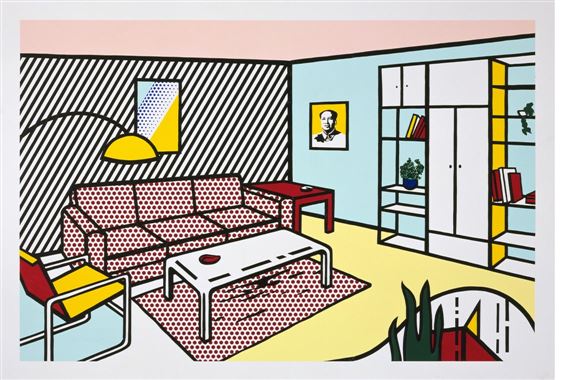
Gemini G.E.L. at Joni Moisant Weyl is pleased to present Under One Roof, an exhibition about commodification, domesticity, private and public selves, and the blurred boundary between furniture design and art. The artists in this show question the meaning of our relationship to interior environments as well as household objects, and investigating these relationships reveal the ‘house’ as both a lived experience and a vehicle for abstract thought. Roy Lichtenstein is well-known for his cool depictions of interiors. The artist collected images of the ‘ideal’ home, sourced from Yellow Pages’ phone books and advertisements, which were then re-worked into imagined, \ solitary settings for daily life, usually devoid of the human figure.
Lichtenstein exposes the irony that society accepts these interiors as the ideal – that one can own a home without truly living in it. Like Lichtenstein, many of Ken Price’s representations of interiors are stylized and boldly graphic in their rendering, and one of his ceramic sculptures often appears, with sly, biomorphic intent. In Mediterranean Lizard Cup, instead of blending in, his small cup, placed on the oversized table, becomes the focal point as opposed to merely being the decor. The works by Ann Hamilton directly bring the human element into this presentation of domesticity At first glance, Hamilton’s reach look like ancient rusted artifacts. Upon closer examination, the sculptures are spoons, but with elongated handles proportioned to fit the exact length of the human arm, and have holes in their centers, which thwart its standard functionality and give them a contradictory presence.
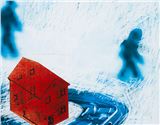
Analia Saban’s series, Spilled Interiors, is also inspired by domestic objects, being formed by the use of stencils in the shape of pitchers. These stencils, instead of holding water, hold etching ink that is allowed to partially dry, and once placed through the printing press, the ink smears beyond their shapes onto the paper in unpredictable ways. Also included in the exhibition are her trompe l’oeil series Wood Floor on Wood, photo-etchings of wood grain, printed on wood. By bringing the floor up to the wall, the art material or domestic object is taken apart and reconstituted into something else, thereby twisting their function and challenging the “material integrity of objects.”
A number of artists in this show engage with, and create, functional furniture. For Robert Rauschenberg, the chair was his way of making the viewer part of the art, and his Borealis Shares was created as exquisitelyrendered seating for two. Richard Tuttle’s Yellow Circle strives to bring the floor to the forefront, to raise the floor into our consciousness, and approaches the making of the ceramic tiles as he would printmaking, with pattern, composition and sequence playing an important role. Jonathan Borofsky takes his Berlin Dream, a drawing created while living in Berlin in the early 1980s, and creates a cylinder of light. Borofsky’s dream was a way for him to think about concepts of freedom, aggression, and division, and this lamp, illuminating the Berlin image printed on Mylar and sheathed in an acrylic tube, goes beyond the functional. For Ed and Nancy Kienholz, the found furniture in their assemblage sculptures is not necessarily functional. The Marriage Icon consists of an oak headboard embedded with Victorian-era postcards showing the different phases of courtship and married life.However, Kienholz adds a sexually explicit photo, and covers the entire artwork in dripping resin, thereby adding a countercultural, dark twist to the institution of marriage.
Recommended for you


Gemini G.E.L. at Joni Moisant Weyl is pleased to present Under One Roof, an exhibition about commodification, domesticity, private and public selves, and the blurred boundary between furniture design and art. The artists in this show question the meaning of our relationship to interior environments as well as household objects, and investigating these relationships reveal the ‘house’ as both a lived experience and a vehicle for abstract thought. Roy Lichtenstein is well-known for his cool depictions of interiors. The artist collected images of the ‘ideal’ home, sourced from Yellow Pages’ phone books and advertisements, which were then re-worked into imagined, \ solitary settings for daily life, usually devoid of the human figure.
Lichtenstein exposes the irony that society accepts these interiors as the ideal – that one can own a home without truly living in it. Like Lichtenstein, many of Ken Price’s representations of interiors are stylized and boldly graphic in their rendering, and one of his ceramic sculptures often appears, with sly, biomorphic intent. In Mediterranean Lizard Cup, instead of blending in, his small cup, placed on the oversized table, becomes the focal point as opposed to merely being the decor. The works by Ann Hamilton directly bring the human element into this presentation of domesticity At first glance, Hamilton’s reach look like ancient rusted artifacts. Upon closer examination, the sculptures are spoons, but with elongated handles proportioned to fit the exact length of the human arm, and have holes in their centers, which thwart its standard functionality and give them a contradictory presence.
Analia Saban’s series, Spilled Interiors, is also inspired by domestic objects, being formed by the use of stencils in the shape of pitchers. These stencils, instead of holding water, hold etching ink that is allowed to partially dry, and once placed through the printing press, the ink smears beyond their shapes onto the paper in unpredictable ways. Also included in the exhibition are her trompe l’oeil series Wood Floor on Wood, photo-etchings of wood grain, printed on wood. By bringing the floor up to the wall, the art material or domestic object is taken apart and reconstituted into something else, thereby twisting their function and challenging the “material integrity of objects.”
A number of artists in this show engage with, and create, functional furniture. For Robert Rauschenberg, the chair was his way of making the viewer part of the art, and his Borealis Shares was created as exquisitelyrendered seating for two. Richard Tuttle’s Yellow Circle strives to bring the floor to the forefront, to raise the floor into our consciousness, and approaches the making of the ceramic tiles as he would printmaking, with pattern, composition and sequence playing an important role. Jonathan Borofsky takes his Berlin Dream, a drawing created while living in Berlin in the early 1980s, and creates a cylinder of light. Borofsky’s dream was a way for him to think about concepts of freedom, aggression, and division, and this lamp, illuminating the Berlin image printed on Mylar and sheathed in an acrylic tube, goes beyond the functional. For Ed and Nancy Kienholz, the found furniture in their assemblage sculptures is not necessarily functional. The Marriage Icon consists of an oak headboard embedded with Victorian-era postcards showing the different phases of courtship and married life.However, Kienholz adds a sexually explicit photo, and covers the entire artwork in dripping resin, thereby adding a countercultural, dark twist to the institution of marriage.
Contact details

