
 ARTISTS
Victor Vasarely: Einstein in the Sky with Diamonds
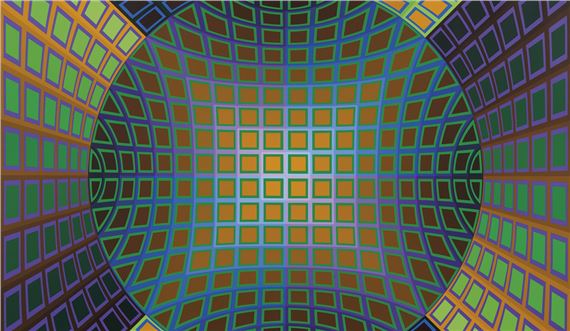
Mazzoleni presents VICTOR Vasarely. Einstein in the Sky with Diamonds, a selection of ten major works by the master of optical and kinetic art, covering almost his entire career from the 1950s to the 1980s.
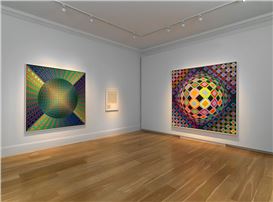
The exhibition presents some of the first compositions in which Vasarely experimented with the activation of the surface by the use of small, repeated geometric units and the vibrant alternation of black and white patterns. Dating from the 1950s, these works invented the language of Op Art. In the following decade, the painter rationalized the use of those “plastic units” by distributing them inside grids where the variations of tones and shades were rigorously modulated, as it is evident in the sculptural shapes and contrasting colours of Arc Tur (1968). When planning his works, Vasarely used to prepare preliminary scale drawings and models – or “programmations ” in his own terms – of which an example will be also presented. The patterns generate light waves that modulate the surface and radiate towards the viewer. The grids themselves deform and produce depressions or protuberances that move the surface towards a higher dimension.
The exhibition is dominated by Einstein-Ker (1976), a large canvas whose title refers to the founder of the theory of relativity, Albert Einstein. Fascinated by the scientific discoveries of his time, Vasarely sought to translate them into “plastic equivalents”. The treatment of formal elements is not limited to simple formalism, as they produce visual phenomena connecting with the invisible manifestations of matter or the “supra-dimensions” of the universe. According to his approach, the alternation of positive and negative in the 1950s compositions would visually express the hypothesis of anti-matter and the existence of mirror universes.
Recommended for you


Mazzoleni presents VICTOR Vasarely. Einstein in the Sky with Diamonds, a selection of ten major works by the master of optical and kinetic art, covering almost his entire career from the 1950s to the 1980s.
The exhibition presents some of the first compositions in which Vasarely experimented with the activation of the surface by the use of small, repeated geometric units and the vibrant alternation of black and white patterns. Dating from the 1950s, these works invented the language of Op Art. In the following decade, the painter rationalized the use of those “plastic units” by distributing them inside grids where the variations of tones and shades were rigorously modulated, as it is evident in the sculptural shapes and contrasting colours of Arc Tur (1968). When planning his works, Vasarely used to prepare preliminary scale drawings and models – or “programmations ” in his own terms – of which an example will be also presented. The patterns generate light waves that modulate the surface and radiate towards the viewer. The grids themselves deform and produce depressions or protuberances that move the surface towards a higher dimension.
The exhibition is dominated by Einstein-Ker (1976), a large canvas whose title refers to the founder of the theory of relativity, Albert Einstein. Fascinated by the scientific discoveries of his time, Vasarely sought to translate them into “plastic equivalents”. The treatment of formal elements is not limited to simple formalism, as they produce visual phenomena connecting with the invisible manifestations of matter or the “supra-dimensions” of the universe. According to his approach, the alternation of positive and negative in the 1950s compositions would visually express the hypothesis of anti-matter and the existence of mirror universes.
Artists on show

Related articles
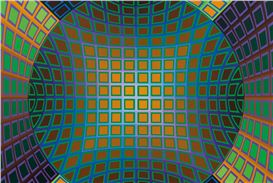
Mazzoleni recently opened an exhibition by Victor Vasarely on October 12th.
For the greater part of his life, Hungarian painter Victor Vasarely sought to represent the building blocks of the universe.
