
 ARTISTS

Will Calver: Of Earth and Light
Simple objects, small enough to fit the hand, are painted life-size. A porcelain dish, long- stemmed and low-lipped, is arranged with leafy lemons. A high-walled bowl, in blue-on-white, is crowded with chubby Williams pears. A single stem of white hellebore stands upright in a thick glass vessel.
Guided by the principles of classical painting – an intricate process of layering oils of varying saturation and viscosity - for Will Calver the subject at hand is his only variable; each item a collection of qualities to be captured.
The artist assembles his selection: fruits and flowers picked from the garden; ceramics gathered from around the house; a cloth-bound book plucked from the shelf. Assemblages of texture and tone, colour and hue – their meaning is neither prescriptive nor allegorical, instead - much like a sculptor - the meaning is located in the forms themselves, in the contours, surfaces and shadows.
Calver’s sense of placement, his treatment of light, his manner and methods all remain true to the genre of still life, which reached opulent heights in the work of Jan Davidsz. De Heem (b.1606) - whose mastery of paint is as palpably delicious as the subjects he chose: great tumbles of fruits ripe-to-bursting, oysters that glisten in their shells, and long tendrils of fragrant lemon peel that hang, languorously, from the edge of a table, or the lip of a silver cup.
Others offer a more modest scene, and it is these quieter, more quotidian arrangements - presented with less bombast, less high-octane - that ring most true for Calver. Preferring a single clementine over a glut, the individual stem over a riot of blooms, Calver’s compositions have an ease, a lightness-of-touch, that brings to mind the work of Chardin and Coorte, Morandi and William Nicholson.
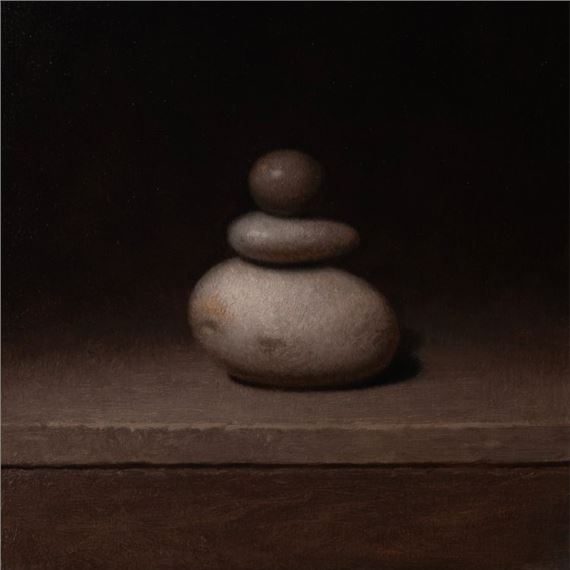
Simple objects, small enough to fit the hand, are painted life-size. A porcelain dish, long- stemmed and low-lipped, is arranged with leafy lemons. A high-walled bowl, in blue-on-white, is crowded with chubby Williams pears. A single stem of white hellebore stands upright in a thick glass vessel.
Guided by the principles of classical painting – an intricate process of layering oils of varying saturation and viscosity - for Will Calver the subject at hand is his only variable; each item a collection of qualities to be captured.
The artist assembles his selection: fruits and flowers picked from the garden; ceramics gathered from around the house; a cloth-bound book plucked from the shelf. Assemblages of texture and tone, colour and hue – their meaning is neither prescriptive nor allegorical, instead - much like a sculptor - the meaning is located in the forms themselves, in the contours, surfaces and shadows.
Calver’s sense of placement, his treatment of light, his manner and methods all remain true to the genre of still life, which reached opulent heights in the work of Jan Davidsz. De Heem (b.1606) - whose mastery of paint is as palpably delicious as the subjects he chose: great tumbles of fruits ripe-to-bursting, oysters that glisten in their shells, and long tendrils of fragrant lemon peel that hang, languorously, from the edge of a table, or the lip of a silver cup.
Others offer a more modest scene, and it is these quieter, more quotidian arrangements - presented with less bombast, less high-octane - that ring most true for Calver. Preferring a single clementine over a glut, the individual stem over a riot of blooms, Calver’s compositions have an ease, a lightness-of-touch, that brings to mind the work of Chardin and Coorte, Morandi and William Nicholson.
Artists on show
Contact details

