
 ARTISTS



EAA Gallery
ONLINE: Joseph Christian Ekom-Obong: What We Carry, What Remains
Joseph Christian Ekeomobong’s paintings dwell in the quiet spaces between uncertainty and endurance. Across intimate portraits of children and young people, moments of solitude, cultural memory and guarded hope become sites of reflection. His figures do not offer easy resolutions; they hold their ground, listening, remembering and carrying forward what pain, heritage and experience have placed within them.
Hope does not always announce itself. Sometimes it survives as a smile, a moment of listening, a remembered rhythm, or the decision to carry something precious forward.
"What We Carry, What Remains" brings together four paintings by Joseph Christian Ekeomobong that consider endurance as a quiet human condition. Rather than presenting hope as triumph or certainty, Ekeomobong locates it in overlooked gestures: a child listening closely, a boy smiling despite what has come before, a figure pausing at an uncertain threshold, and a young person surrounded by objects connecting the present to a cultural past.
In Junction of Hope, a solitary figure occupies a psychological crossroads. The work is less concerned with arrival than with the courage required to remain open when the way forward is unclear. Its stillness becomes active: a pause where caution, vulnerability and possibility coexist. Hope appears not as an answer, but as the small movement that keeps one facing the unknown.
The Smile That Remains approaches endurance through expression. The child’s smile is modest, almost restrained, yet it becomes the painting's emotional centre. It suggests that joy can persist without denying difficulty. Ekeomobong’s careful modelling of the face and luminous halo give this quiet expression dignity, transforming a seemingly ordinary moment into an image of persistence.
Quiet Time turns inward. A boy holds a device to his ear, creating an image of listening as refuge. Against the richly worked surface, the act of listening suggests memory, connection, and escape. Silence here is not absence; it is a space in which the self can gather itself, hear what matters, and remain present amid a noisy world.
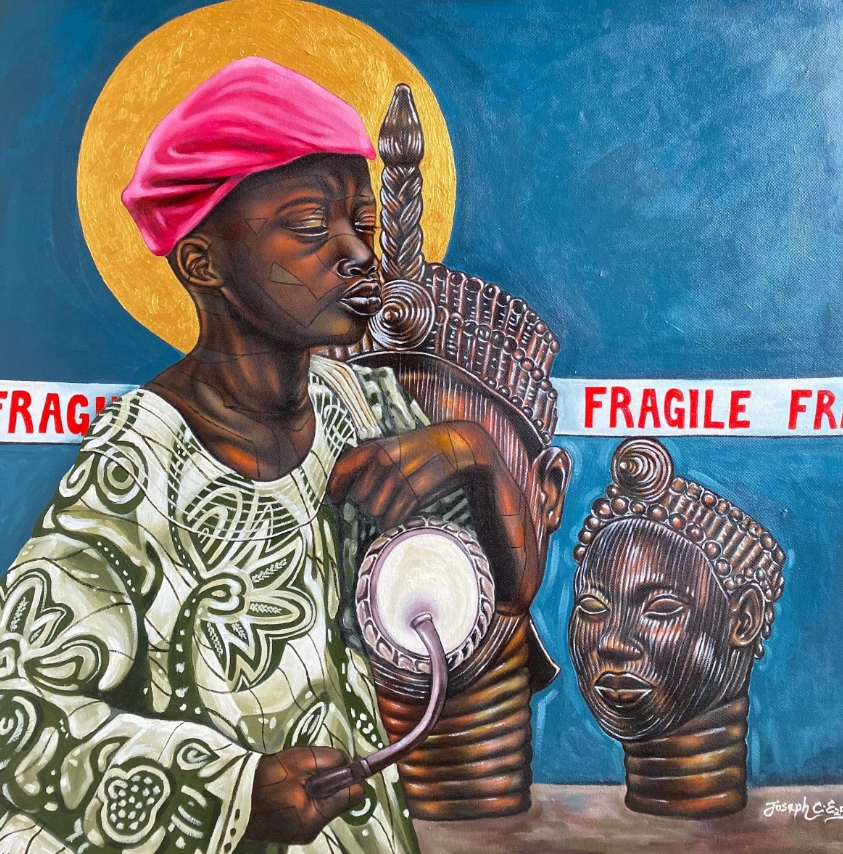
Fragile Heritage expands this inward reflection into a meditation on cultural inheritance. The patterned clothing, traditional objects, carved forms, and drum evoke continuity between generations. The repeated word “FRAGILE” crosses the composition like a warning, suggesting that heritage can be weakened when knowledge is neglected, or transmission is interrupted. Yet the painting is not simply elegiac. By placing the young figure beside these cultural forms, Ekeomobong imagines inheritance as something that can still be encountered, protected and carried forward.
Across the four works, Ekeomobong treats the human figure as a vessel for memory and possibility. His rich surfaces, symbolic objects and attentive portraiture create images in which vulnerability does not cancel strength. What remains is not certainty, but the capacity to listen, remember, endure and continue.
Artist on show: