ARTISTS

Meet the Artist Who Transformed His Bedroom into a Studio
Rising star Yoshihiro Kikuchi spoke to us about experimental music, eroticism and how making art helped heal his depression
MutualArt
Jan 12, 2018
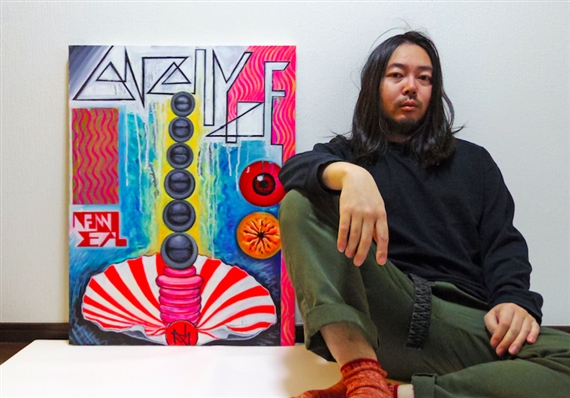
Artist Yoshihiro Kikuchi spoke to us about experimental music, eroticism and how art helped heal his depression
The scope of Yoshihiro Kikuchi's work is dizzying. Based in Miyagi and Tokyo, the artist's subjects including automation, the elimination of self, and the eroticism and violence he believes lies at the heart of man's innate being. He spoke to us from his bedroom studio, discussing his varied practice and why he's excited to be part of a unique collection to benefit artists.
MutualArt: What type of art do you create?
Yoshihiro Kikuchi: I mainly make 2D works like drawing, collage, printing, painting, and video. I’m also starting to make sculptures. I’ve been trying to broaden the range of my creativity and make it more expansive. I want to keep myself open to all possibilities, but my interests are always the same. I also make experimental music, but it’s a very separate from my visual works.
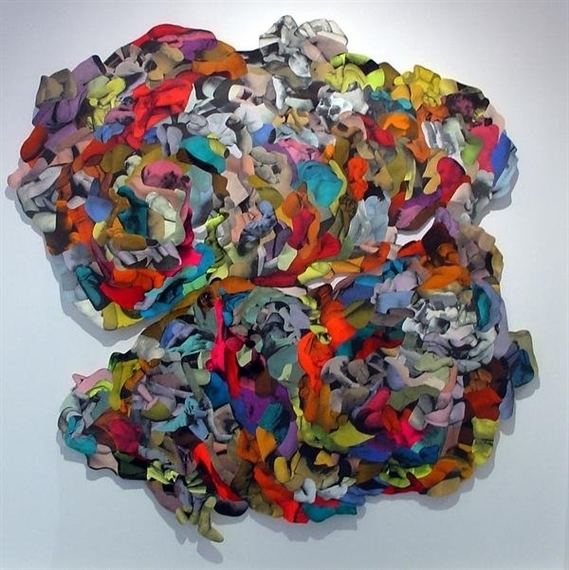
Yoshihiro Kikuchi, Text_0. Inkjet print on paper (scanned and processed pictures of pro-wrestlers/sumo-wrestlers from Japanese old magazines), collage, 32.874 x 0.393 x 32.874 in. (83.5 x 1 x 83.5 cm.), 2008.
Where do you work?
Unlike most artists, I don’t have a studio. I work in two rooms in my house; my bedroom and another room. I can do everything here. I use everyday tools such as computers, scanners, printers and paints. At home I can read books, listen to music and drink alcohol. I have a collection of over 650 books and around 3,000 CDs, records, and cassette tapes. Home is a very comfortable space for me, although it’s very messy. One of the reasons I don’t need a large studio is that I don’t make physically large works. I try not to emphasize physicality, rather I aim to be an observer of my own work, which means working beyond physicality to gain a meta-view of myself. But I guess that will change sooner or later. Let’s see.
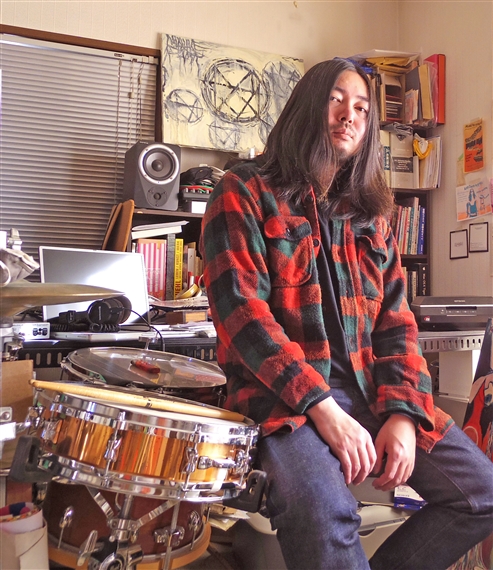
Yoshihiro Kikuchi,pictured in his bedroom studio.
What's your typical process when working?
Starting this year, I made a weekly schedule to produce works according to two different styles. Tuesday and Friday are for digital works; making materials on a computer, materials for printing, animations, or designing programming for pieces that employ computer programmes. The remaining days are used to produce analog works; drawing, painting and collage. As long as I follow the schedules, I don’t have a typical daily process. As for ideas; they often develop logically from my previous works. I write down and organize my thoughts, and the core ideas come only from myself, always. I read books to make my thoughts deeper.
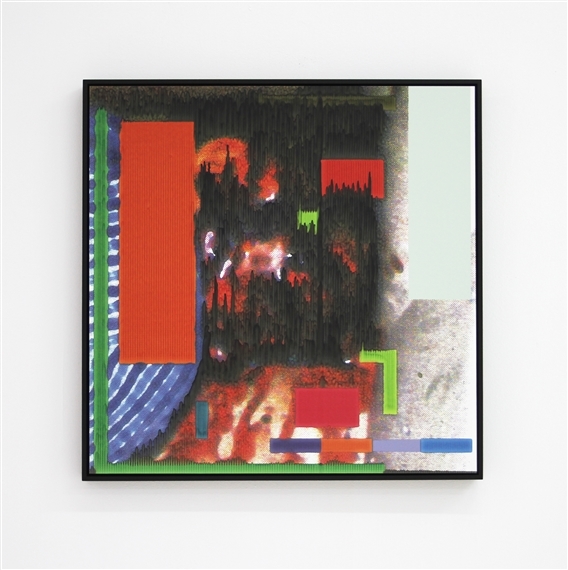
Yoshihiro Kikuchi, Optic Scissure 13. Inkjet print on paper (with unique bleeding of the ink), 20.472 x 20.472 x 1.181 in. (52 x 52 x 3 cm.), 2015.
When did you first begin to make art?
In the winter of 2006. At first, I practiced art simply for a kind of personal amusement. Before that, I only made music. I composed rhythmically and conceptually very complicated music with my friend. But it was too much. I found it depressing. During my depression I went to buy pens, just to relax. I started drawing and making collages with scanned and printed materials.
Only later did I come to think that these works were worth being shown to an audience. I displayed them online in 2007, where my current gallery, Aisho Miura Arts, discovered them and asked me to present an exhibition. That was the starting point, and it’s the greatest turning point in my life. I was selected as an APT artist in 2013, which gave me a much higher profile as an international artist.
What influences your practice?
Music continues to be an influence. My ideas about music led to some strict artistic processes, enabling me to bring indeterminacy and contingency to my works. I’m influenced especially by 20th Century avant-garde music, particularly Schoenberg’s 12-tone music, and Boulez’s Total Serialism. What they have in common is a very automatic and artificial way of composing. Schoenberg was a teacher of John Cage, and Cage is a big figure within experimental music. He used indeterminacy, which he named Music of Chance Operation. I employ a similar method, using logical approaches to arrive at indeterminacy without personal aesthetic decision. I think it’s a Modernistic attitude.
Other influences come from linguistics, philosophy of language, and philosophy of eroticism. Language is one of the most innate phenomena, something that only human beings possess; it thus defines humanity. It was my interest in language that inspired me to produce the drawing series Grammatical Luxation that is made from a broken and reconstructed old Japanese porn novel. I made seven sets, two of which have been in The APT Collection since 2014.
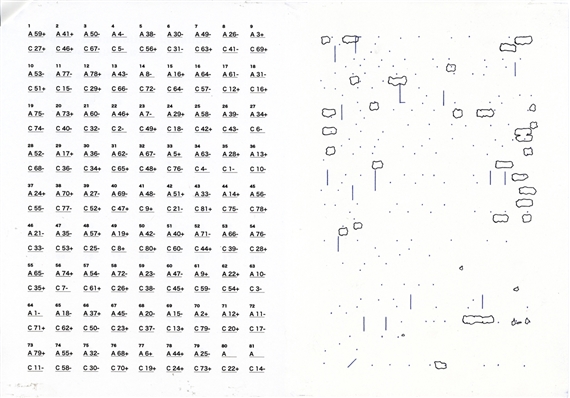
Yoshihiro Kikuchi, Grammatical Luxation - A Porn 5. Hand-copied carbon (black and blue) on paper, wooden box, 8.267 x 11.692 in. (21 x 29.7 cm.), 2014.
As an APT artist, you have a chance to use your work to support your peers and rising talent. How important is it to you to support a community of artists?
APT allows me to create works that support other artists, which is a really great thing; that mutual cooperation within the artistic community is so important. By actively investing our works in the collection, we're helping to reshape the industry and make it democratic.
To me, however, the most important thing about APT is that its artists share both risk and return. That gives young and emerging artists time to grow and develop more experimental approaches, and the money distributed within the community ensures talented artists have the budget to make high-costs works.
As emerging artists in The APT Collection go up in value, including me, I think it will emerge as a new brand, which could come to function like super famous galleries, but with more return for artists. It’s a very exciting idea and something that we have not yet seen.
What are you working on at the moment? Are there any exciting projects you're keen to tell us about?
This year I’ve started working in oil painting with figurative motifs. I make with them with my own dominant hand. The motifs are very vulgar things that represent my subconscious, which has been suppressed by my rational consciousness. It may be the negation of my rationality, and the affirmation of my intuition, which consists of popular culture influences, including the underground music I have enjoyed.
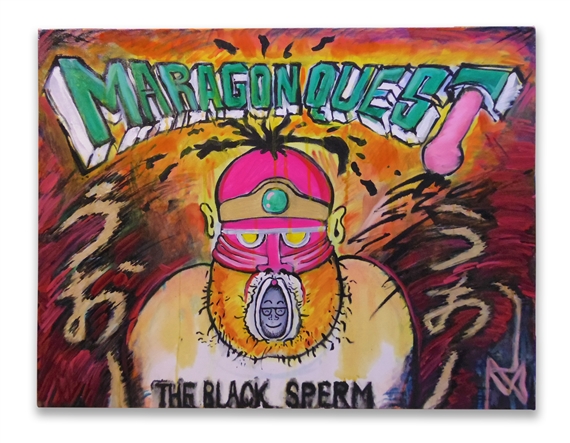
Yoshihiro Kikuchi, Black Correction (with cultural suicides, social scatology, educational feces, expressionistic ejaculation, and you), 2017. Oil on canvas.
The paintings contain humorous references to the history of contemporary art. The series is titled Black Correction (with cultural suicides, social scatology, educational feces, expressionistic ejaculation, and you). It’s a long title. It refers to two things: firstly, that indecently releasing personal suppression equates to social suicide. Secondly, it highlights the mistake that many Japanese artists tend to make, by trying to assimilate into Western culture and Western art history. I think it’s too short-sighted. We don’t really share that history, so it is not real for Japan. To randomly combine fragments in a post-modernist way seems wrong to me. We Japanese have to live out our Modernist society first. The prelude to this new series is the collage series Self-denial Practice (physical), which is held in the APT collection.