ARTISTS



Negative Space in Ukiyo-e: How to Look at Nothing
Discover the essential role of negative space in ukiyo-e through the works of Hokusai and Hiroshige
Abigail Leali / MutualArt
Feb 27, 2026
Among those learning to appreciate artwork for the first time, negative space is one of the more baffling aspects of composition. As Western audiences, we are primed to view the artistic process as one of physical creation, where the artist’s lines and brushstrokes slowly and almost miraculously manufacture form and meaning out of nothing. Traditional Western painting techniques, particularly after the Renaissance, also tend to associate emptiness with incompleteness. While our tradition does allow for some large areas of uniform color – Giotto’s Lamentation from c. 1305 comes to mind – they are usually subjugated to the major figures and elements of the scene. Rarely before modernity did Western artists allow the absence of visible craft to speak as poignantly as its presence. And as a result, many viewers initially struggle to understand it when it does appear.
I am being very particular here in referring to Western art, because the situation in other artistic traditions is not always the same. In East Asia and especially in Japan, the artistic process often highlights overall composition more overtly than its Western counterpart, with an artist’s technical skill placed in service of his (for, as with most cultures, it was very often his) ability to design a pleasing overall form. We see this more abstract approach not only in visual arts like ukiyo-e but also in other areas like ikebana, a highly structured and minimalist school of floral arrangement that relies on the practitioner’s meditative observations of the natural lines and shapes of the flowers, or haiku, which limits the poet to seventeen syllables and a single image to evoke meaning. In ikebana and haiku, as in ukiyo-e or traditional artworks, what isn’t pictured is often as essential to the composition – and as charged with meaning – as what is.
To understand Japanese artwork, or any style that relies heavily on its composition, it is essential to understand negative space. Thankfully, daunting as it may appear in theory, in practice it is not nearly as complicated. In fact, our minds are instinctively wired to recognize it.
Defining Ma
Do you remember the first time you encountered that famous, clever image of two faces whose contours form a vase (often called a Rubin vase)? If so, then as you let your eyes focus back and forth between the two illusions, you were experiencing a very concrete example of negative space: the white vase didn’t really “exist” on the page, but our minds filled it in via its surrounding contours.
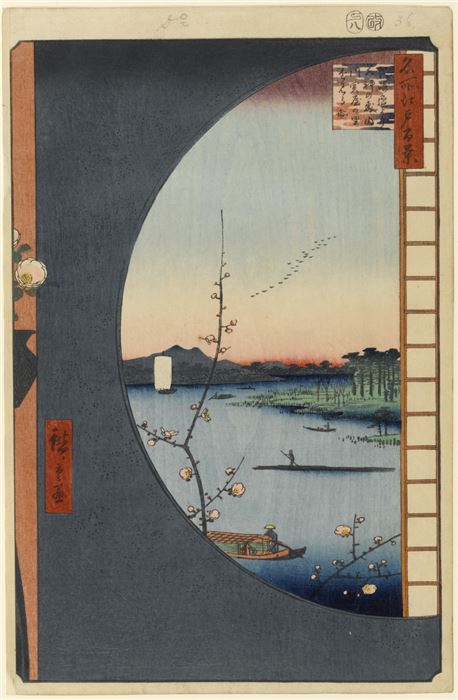
Utagawa Hiroshige, View From Massaki of Suijin Shrine, Uchigawa Inlet, and Sekiya, from from One Hundred Famous Views of Edo, 1857
While the technique is rarely so blatant in fine art, this example does suggest something important: Our brains interpret negative space in terms of its size and its shape. If the faces were too far apart, our minds would cease to see the vase as a distinct entity and instead view the two faces in isolation. If the faces were instead flat rectangles, we would perceive nothing but a uniform, black-and-white striped pattern. Negative space, in other words, derives its effect precisely from its relationship with the elements it surrounds – or that surround it.
Maybe this explanation sounds a little obvious. But like all apparently simple techniques, it can take exceptional skill to wield negative space effectively. To prove it, one need look no further than the masters of ukiyo-e. Broadly speaking, these woodblock designs require their creators to balance a wide range of considerations beyond simple beauty. They need to include enough visual information for an educated viewer to recognize the scene or story. They need to ensure there is a strong visual hierarchy, so the image reads clearly at a glance. They need to consider how lines and shapes and colors will interact with each other to create unique, possibly unintended effects. They need to calibrate the composition, including negative space, to signal the message they want to convey – for instance, a sweeping landscape versus a close-up portrait. The list goes on.
With all these decisions to balance, ukiyo-e is often at its most breathtaking when it is most restrained. An artist demonstrates the height of his skill not only in astounding technical brilliance but in an ability to depict objects by their very absence. In many of the most masterful compositions, negative space (which in Japan is understood as a manifestation of the aesthetic principle, ma) transcends its compositional boundaries and becomes essential to the meaning of the piece.
To see how this looks in practice, we could look to the work of great ukiyo-e artists like Katsushika Hokusai, Utagawa Hiroshige, Tsukioka Yoshitoshi, and Hiroshi Yoshida.
Hokusai and Hiroshige
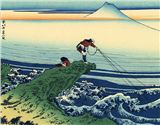
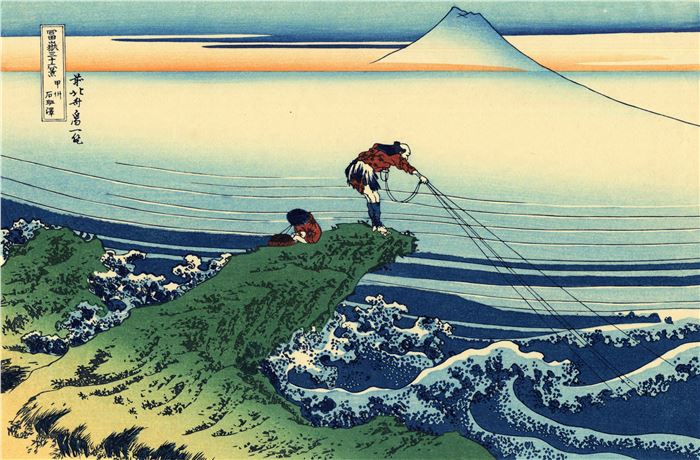 Katsushika Hokusai, Kajikazawa in Kai Province, from Thirty-Six Views of Mount Fuji, c. 1830
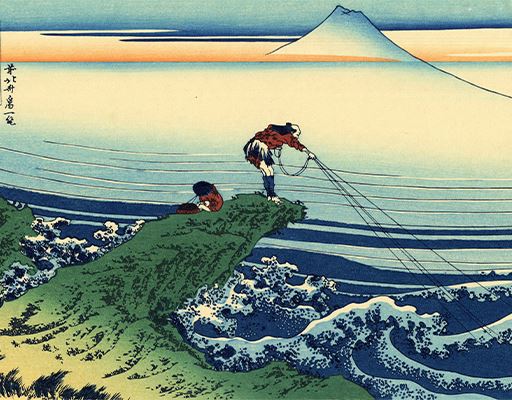
While Hokusai is best known for his Great Wave off Kanagawa, which is an incredible composition in its own right, a more surprising use of ma may be his Kajikazawa in Kai Province. Another installment in the Thirty-Six Views of Mount Fuji series, it features a fisherman whose cliff perch, stooped posture, and fishing lines mimic the slope of the mountain. Where Fuji peaks above the cloud cover, however, the fisherman’s head crests over a swath of empty space, which blurs the transition from mountain to sea, like an atmospheric haze. The negative space also obscures the perspective, highlighting the resonance between humanity and nature – and, perhaps, the greater scale of nature over human effort.
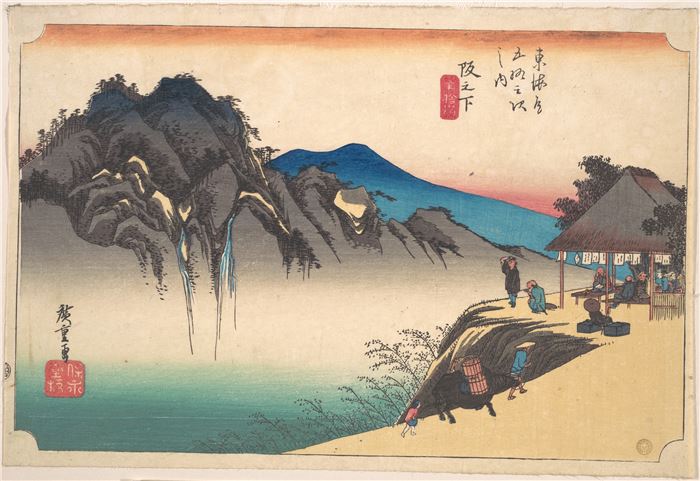 Utagawa Hiroshige, Sakanoshita, from The Fifty-Three Stages of Tokaido, 1833-34
When it comes to Hiroshige, there are nearly endless examples of his stunning grasp of ma. The dramatic, crashing waterfall in Sakanoshita, from The Fifty-Three Stages of Tokaido, struck me so vividly that it became one of the first ukiyo-e prints I ever bought (more on that another time). But I am also fond of View From Massaki of Suijin Shrine, Uchigawa Inlet, and Sekiya, from One Hundred Famous Views of Edo. The viewer looks out through a circular window over the water. The soft, dark contours of the room’s empty space, paired with the close-cropped composition, brilliantly suggest the comfortable, daily isolation that can accompany city life – both echoed by and contrasted with the lone boaters in their long ships. Still, the blossoms peeking out of the left edge indicate the beauty to be found even in this solitude – a beauty mirrored in the outside, natural world via the blooming trees.
Yoshitoshi and Yoshida
In Yoshitoshi’s The Ghost, from his series One Hundred Aspects of the Moon, the graduated, gently sloped ma at the bottom of the composition amplifies the color scheme’s limited tonal range to make the ghost – who is Yugao, a murdered lover of Prince Genji’s from The Tale of Genji – appear weightless. Only the surrounding morning glory vines, from which she derives her name, seem to have substance. In framing her figure, they frame her memory, as well.
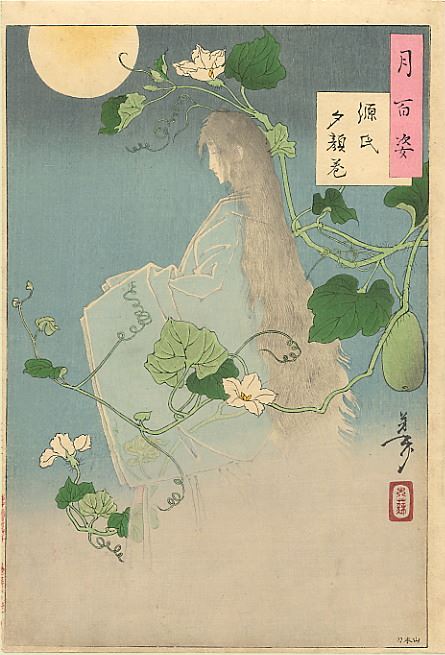
Tsukioka Yoshitoshi, The Ghost, from One Hundred Aspects of the Moon, 1886
Finally, for a slightly more modern example, we have Yoshida’s Sailing Boats, Morning. In addition to its striking combination of Western and Eastern compositional techniques – which was becoming more common as the Taisho period in Japan saw rapid westernization and industrialization during the early years of the twentieth century – it is also one of the most effective depictions of light I’ve encountered. Unlike the other artists’ more traditional uses of ma, much of Yoshida’s work gestures towards the European practice of filling the entire canvas. That said, despite the subtle, warm gradient evoking a hazy morning sky, the area still functions as ma, with the waves and the faintest outline of another boat just barely entering into view. At this early hour, the shadow of the boat on the water feels almost more substantial than the boat itself – as if it were only now coming into being. The piece, like the others we’ve discussed, is one of a set. In it, Yoshida depicts the same boat at different times of day, reflecting on the passage of time. With Morning, we see the simultaneous glory, ambiguity, and transience of our own beginnings.
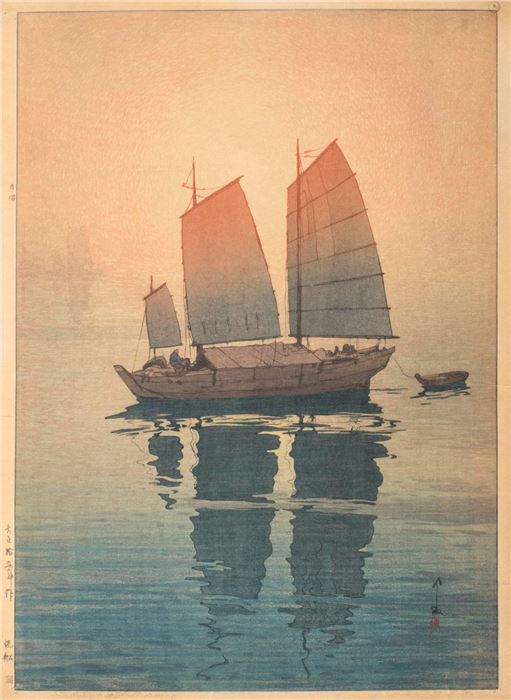
Hiroshi Yoshida, Sailing Boats, Morning, 1926
These are only a few examples; there are infinitely more. While you can certainly begin to grasp ma from studying these works online, I strongly recommend you take the opportunity to view them in-person when they are exhibited near you. (One of the best parts of ukiyo-e is that, as woodblock prints, there are plenty of instances of each piece to go around.) As well as I thought I understood negative space, nothing could have prepared me for its true boldness. It takes a particular kind of courage as an artist to leave so much space unclaimed – and sometimes they use no ink at all! The more you understand the depth of thought and care that goes into it, the more you can appreciate the genius of this apparently humble medium.
And once you’ve learned from the best, you will also begin to see negative space wherever you go and in all styles of art. You will no longer take the artist’s choice to fill the canvas for granted; if anything, you’ll be all the more impressed when an artist undertakes the effort to do so. Fair warning, though: If you’re anything like me, this knowledge may be as much a curse as a blessing. It may change the way you look at works by artists who approach their craft from angles that don’t emphasize composition. But that is where the debates get started – and where the fun comes in.
For more on auctions, exhibitions, and current trends, visit our Magazine Page