ARTISTS

Venice’s must-see collateral shows
Heading to Venice this summer? The national pavilions aren’t the only thing worth seeing. We looked beyond the Biennale to select 10 key collateral exhibitions across the city
Laura Preece / MutualArt
Aug 10, 2017
The national pavilions aren’t the only thing worth seeing in Venice. We looked beyond the Biennale to select 10 key collateral exhibitions across the city
1. Mark Tobey, Threading Light
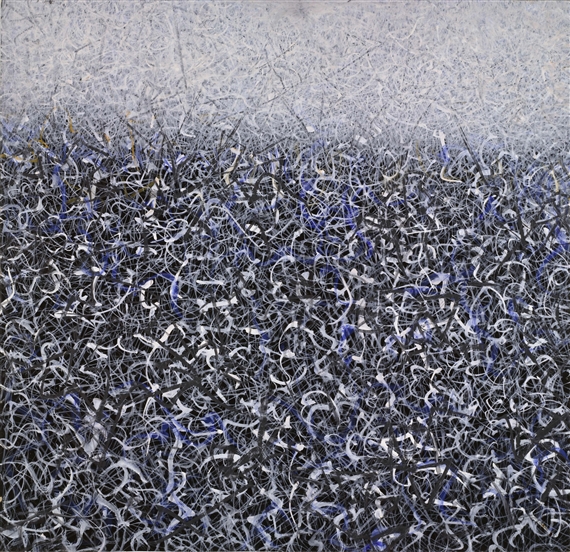
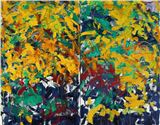
Mark Tobey, Wild Field, 1959. Tempera on board. The Museum of Modern Art, New York, The Sydney and Harriet Janis Collection, 1967 © 2017 Mark Tobey / Seattle Art Museum, Artists Rights Society (ARS) New York.
The Guggenheim’s Mark Tobey retrospective is the first of its kind in more than 40 years, tracing the evolution of an artist whose contribution to American abstraction was both significant and under-recognised. The show features paintings from the beginning of Tobey’s career in the late 1920s until the early 1970s, when he made his last works. Frequently mentioned in the same breath as Jackson Pollock, the artist paved the way for an ‘all-over’ style of painting, creating abstract fields of ‘white writing’. The Peggy Guggenheim Museum, until 10 September 2017
2. Thomas Demand, Alexander Kluge and Anna Viebrock. The Boat is Leaking. The Captain Lied
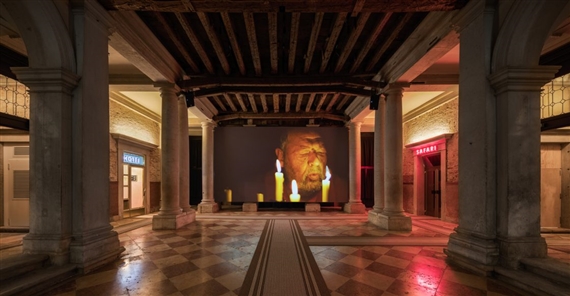
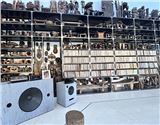
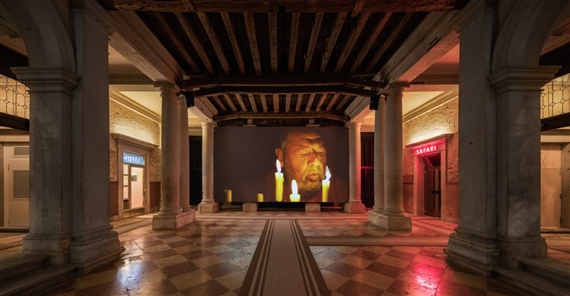
Thomas Demand, Alexander Kluge and Anna Viebrock, The Boat is Leaking. The Captain Lied, Installation view, Fondazione Prada.
Spread across three storeys of an 18th-century palazzo, The Boat is Leaking. The Captain Lied. is a multimedia extravaganza. Combining the work of writer and filmmaker Alexander Kluge, artist Thomas Demand and costume designer Anna Viebrock, the exhibition reflects on the world as a site of hope, and as one subject to catastrophe and extreme distress. Curator Udo Kittelman, Director of Berlin’s NationalGalerie, describes a show that expresses a ‘shared awareness, both on an emotional and theoretical level, of the critical aspects of present times and the complexity of the world we live in.’ Fondazione Prada, until 26 November
3. Douglas Gordon, Gente di Palermo!
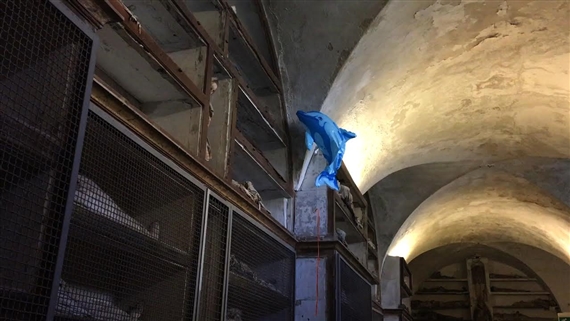
Douglas Gordon, Gente di Palermo!, Installation shot, Palazzo Ducale.
In the prisons of the Doge’s Palace, Scottish artist Douglas Gordon has created an installation that sets macabre visions of death against playful frivolity. Excerpts from a home movie, shot in the Cupuchin Catacombs in Palermo, show mummified corpses arranged by gender, age and social categories. Nearby, a hovering inflatable dolphin replicates an object the artist found in the catacomb’s children’s wing. More suited to an amusement park than a mass grave, the addition turns the exhibition into both a celebration of life, and a warning of its brevity. Doge’s Palace, Prisons. Until 24 November.
4. Jheronimus Bosch, Jheronimus Bosch and Venice
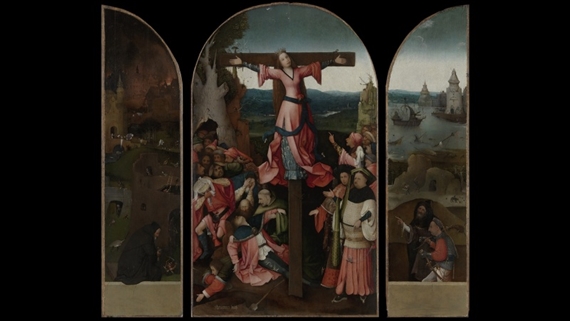
Anonymous follower of Jheronimus Bosch, Apocalyptic vision, third quarter of the XVI century oil on the table, National Museum of Galleries at the Academy of Venice.
Some of the most fantastical works on display during this year’s Biennale come, not from contemporary artists, but from the 15th century Dutch painter Jheronimus Bosch. Renowned for his paintings of hallucinatory landscapes, the artist is the subject of an exhibition at the Doge’s Palace — held a year after the 500th anniversary of his death, which prompted major shows across Europe. Scholars have been particularly excited by the inclusion of two triptychs and four panels, newly restored following an extensive campaign. Palazzo Ducale, Doge’s Apartment. Until 4 June.
5. Michelangelo Pistoletto, One and One Makes Three
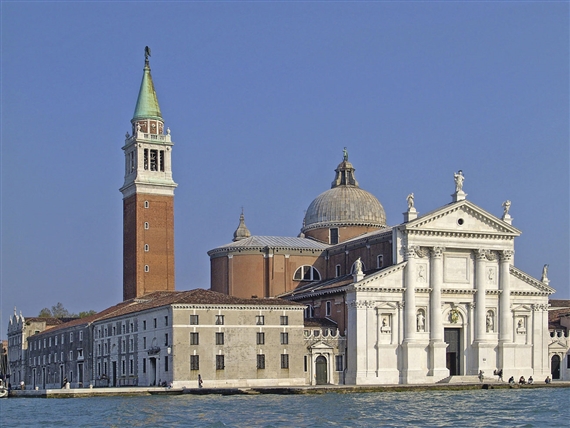
The 16th-century Basilica di San Giorgio Maggiore, home to Michelangelo Pistoletto’sOne and One Makes Three
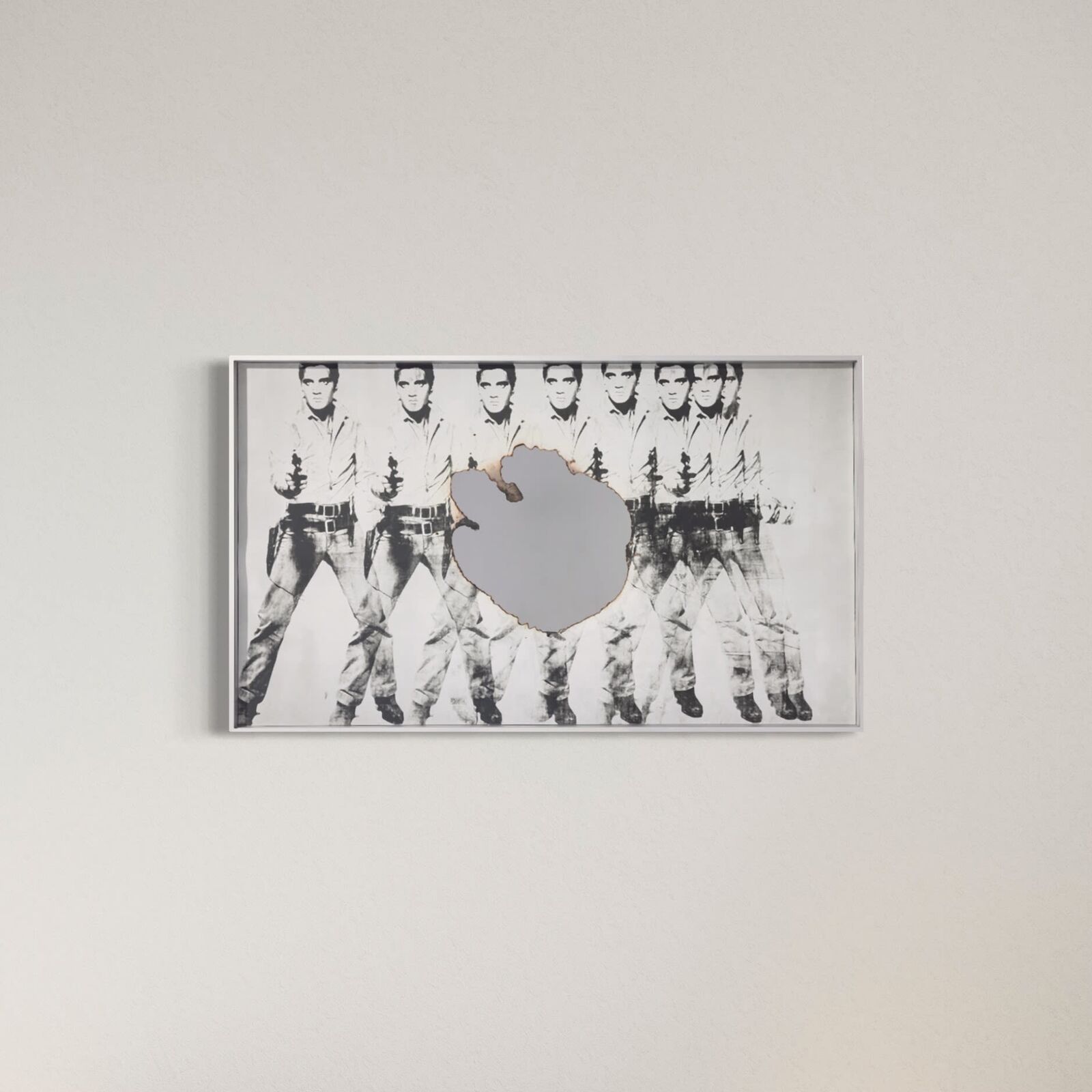
In the 16th-century Basilica di San Giorgio Maggiore, Arte Povera master Michelangelo Pistoletto has create a site-specific installation using the mirrors that have become his trademark: Suspended Perimeter – Love Difference forms part of an exhibition that extends into the Basilica’s chapter room, where a work entitled The Time of Judgement represents the four largest religions in the world. Throughout, Pistoletto’s theme is one of acceptance, highlighting the richness of multiculturalism, and the importance of tolerance. Basilica di San Giorgio Maggiore, Isola di San Giorgio. Until 26 November.
6. James Lee Byars, The Golden Tower
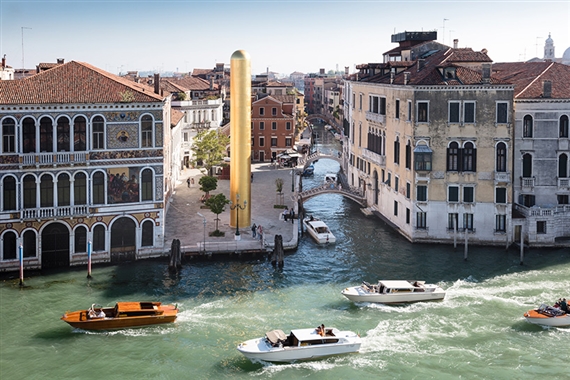
James Lee Byars, The Golden Tower. Image by Richard Ivey. Courtesy Michael Werner Gallery New York and London
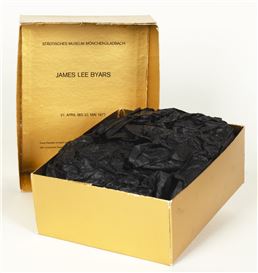
Visitors to Venice will struggle to miss The Golden Tower — a 20-meter high golden beacon overlooking the Grand Canal, which was conceived by the late artist James Lee Byars. Designed to rival the grandeur of the Lighthouse of Alexandria, the work was intended to stand as a contemporary monument that could ‘bridge heaven and earth and unify humanity’. First exhibited in Berlin in 1990, its new setting is fitting: Byars exhibited in Venice often, calling the city home off and on from 1982. Dorsoduro, Camp San Vio
7. Loris Gréaud, The Unplayed Notes Factory
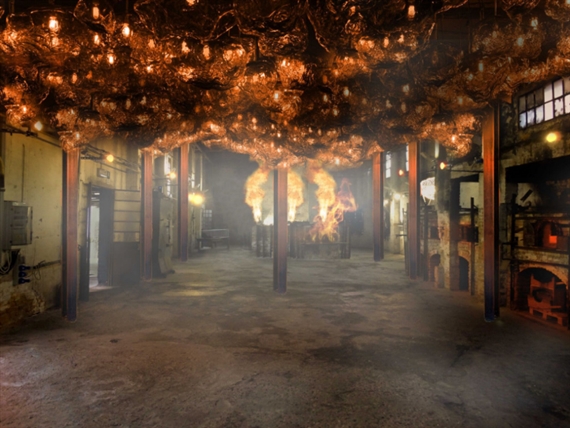
Loris Gréaud The Unplayed Notes Factory, installation view.
Though Venice’s status as a centre for glassmaking may have dwindled over the centuries, a new work by French artist Loris Gréaud is bringing life to the abandoned workshops of Murano. Unused for 60 years, the furnace at Campiello della Pescheria has been transformed into a production line, with glass maestri working around the clock to create up to 1,000 pieces that will hang from the building’s roof. The exhibition, entitled The Unplayed Notes Factory, will generate a hive of repetitious activity intended to resemble a living tableau vivant.
8. Damien Hirst, Treasures from the Wreck of the Unbelievable
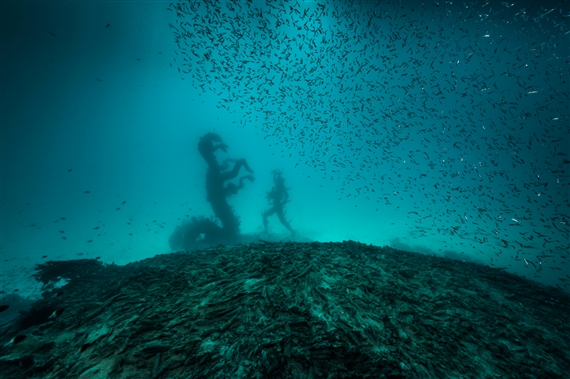
Damien Hirst, Treasures from the Wreck of the Unbelievable, 2017. Photographed by Christoph Gerigk. © Damien Hirst and Science Ltd.
Damien Hirst’s sprawling one-man show became one of the most-talked about exhibitions in the run up to the Biennale, covering 5,000 square meters of exhibition space across both the Punta Della Dogana and Palazzo Grassi. The show presents visitors with the wreckage of an ancient ship (the Unbelievable) which, according the legend, sunk under the weight of its extravagant cargo. The scale and lavishness of works is extraordinary: from marble sculptures inlaid with emeralds, to an 18-meter high status that fills the Palazzo’s central courtyard. Punta Della Dogana and Palazzo Grassi, until 3 December.
9. Pierre Huyghe at Espace Louis Vuitton Venezia
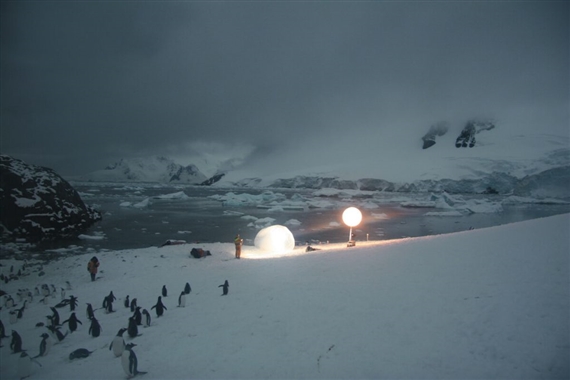
Pierre Huyghe, A Journey, 2015. Courtesy of the artist and Espace Louis Vuitton Venice.
In the heat of the Venice sun, one exhibition takes considerably snowier climes as its source of inspiration. Pierre Huyghe’s solo show at the Espace Louis Vuitton Venice centers around the 2005 film A journey that wasn’t, which records a research trip Huyghe took with artists and scientists in the Antarctic. The group boarded an ancient sailing ship in search of a new island created by thawing, on which an albino penguin might live. The project inspired a composition, which was performed by a symphony orchestra on the ice rink of Central Park in New York — contrasting the wilds of nature with an urbanized and spectacularized society. Espace Louis Vuitton Venice. Until 26 November.
10. Pae White at Le Stanze Del Vetro
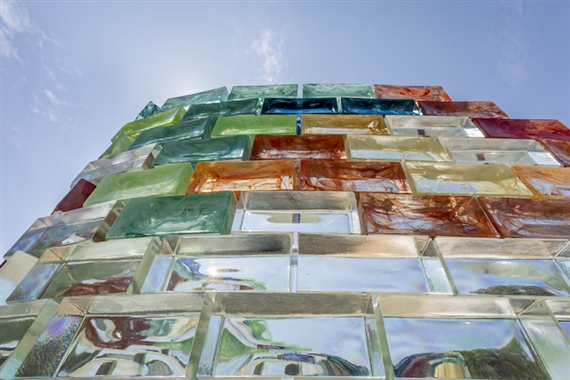
Pae White, Qwalala, View of the work in progress at Le Stanze Del Vetro, San Maggiore.
On the island of San Giorgio Maggiore, American artist Pae White has created a curving wall made of thousands of solid glass bricks, each hand-cast in the Veneto region. At 75 meters long and 2.4 meters high, the work echoes the meandering flow of the Gualala river in Northern California, taking its name from the Native American Pomo word Qwalala, which describes its form. Made in a palette of 26 colours, the bricks are arranged according to computer-generated sequences — a reflection of White’s interest in new technologies. Le Stanze Del Vetro, San Giorgio Maggiore. Until 30 November.