
 ARTISTS
Biography
Jump to section >
Early Life and Education
Born in Dube, Soweto, in September 1959, South African artist Velaphi George Mzimba discovered his affinity for drawing at the age of nine, nurtured by his father's encouragement amid the cultural ferment of township life. Largely self-taught, he honed his skills at sixteen by joining the Mofolo Arts Centre, studying drawing, oil painting, and pastels under mentor Dan Rakgoathe. The centre's closure during the 1976 Soweto uprising interrupted his training, yet a bursary soon enabled study at Johannesburg's Art Foundation with Bill Ainslie, forging a foundation in expressive figuration attuned to social realities.
Key Life Events and Historical Context
As South Africa navigated the turbulent 1980s—intensified state repression, economic sanctions, and underground liberation struggles—his practice evolved in Johannesburg's townships, capturing resilience without overt militancy. The 1990s transition to democracy, with Nelson Mandela's 1994 election, infused his oeuvre with post-apartheid optimism, reflecting urban renewal and social flux. Professional stability marked these years, sustaining his output through evolving social conditions.
Influencers
Dan Rakgoathe introduced Mzimba to technical proficiency in oils and pastels, instilling a command of bold figuration that anchored his early portraits. Bill Ainslie expanded his conceptual scope, emphasizing narrative depth and social commentary, which propelled Mzimba toward professional independence. These mentors redirected his self-taught instincts into a structured yet personal style, pivotal for his debut and sustained career.
Artistic Career
Mzimba established himself with a debut solo exhibition in 1981 at Johannesburg's Carlton Hotel Gallery, under the South African Association of Arts, launching a trajectory of consistent output as a Johannesburg-based professional. Subsequent solos proliferated, including ventures into sculpture, graphics, and found-object paintings, alongside commissions for posters like the 1993 Toronto showcase. International forays—from Swaziland in 1985 to Hong Kong in 1995—broadened his reach, culminating in steady gallery affiliations that sustained his evolution into multifaceted media until 2021.
Artistic Style and Themes
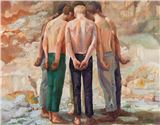
Mzimba's hallmark lay in large-scale canvases on textured grounds, rendered in vibrant hues that convey expressiveness and immediacy, with subjects' direct gazes fostering intimate encounters. Recurring motifs—Zama Zama illegal miners amid stark landscapes, township vignettes, children's portraits, and still lifes—blend optimism with socio-political undercurrents, extending to eclectic compositions merging figures and objects. Pivotal works include the etching *Free at Last* (1994), evoking liberation, and poignant depictions like *Miners Underground* (1984), embodying labor's grit.
Exhibitions and Representation
Mzimba's institutional profile shone through solos at Everard Read's Johannesburg and Cape Town spaces, notably the 1999 Johannesburg outing and 2006 London presentation at Rebecca Hossack Gallery, affirming his cross-continental draw. Long represented by Everard Read galleries, his oeuvre resides in South African public collections, including the Constitutional Court and SABC.
Little-known fact
Mzimba passed away in the arms of his wife Boitumelo outside a Johannesburg hospital in June 2021, emblematic of the COVID-19 crisis's strain on public health access despite South Africa's democratic gains.
Influences & Legacy
Mzimba's textured, humanistic figuration resonated in Johannesburg's post-apartheid studio scene, shaping younger township painters toward optimistic social realism unbound by protest aesthetics. His depictions of informal economies informed narratives in emerging South African art discourses. Velaphi Mzimba endures as a vital chronicler of township vitality, his canvases affirming the unyielding humanity that bridged apartheid's shadows to democracy's promise.
Selected Group Exhibitions
2020
George Velaphi Mzimba Record Prices
The 2026 record price for George Velaphi Mzimba was for Green Pear I
The 2025 record price for George Velaphi Mzimba was for Apple
The 2024 record price for George Velaphi Mzimba was for Nomvula
The 2023 record price for George Velaphi Mzimba was for Pear
The 2022 record price for George Velaphi Mzimba was for Book II (Brown)
The 2021 record price for George Velaphi Mzimba was for Portrait of Woman Wearing a Head Scarf
The 2020 record price for George Velaphi Mzimba was for Short Prayer
The 2019 record price for George Velaphi Mzimba was for Township Scene
The 2018 record price for George Velaphi Mzimba was for 2 Works: Untitled
The 2017 record price for George Velaphi Mzimba was for New Dawn
The 2016 record price for George Velaphi Mzimba was for Man Smoking a Pipe
The 2015 record price for George Velaphi Mzimba was for Maria Mahlangu
The 2014 record price for George Velaphi Mzimba was for TLHALEFANG (BE WISE)
The 2013 record price for George Velaphi Mzimba was for Zinhle
The 2012 record price for George Velaphi Mzimba was for A Miner with a Machine Drill
The 2011 record price for George Velaphi Mzimba was for THE CROWDED TRAIN
The 2010 record price for George Velaphi Mzimba was for Street sweeper
The 2009 record price for George Velaphi Mzimba was for Tsonga
The 2008 record price for George Velaphi Mzimba was for PRETTY WOMAN
The 2007 record price for George Velaphi Mzimba was for SINDISWA (BLESSED)
Jump to section
×