
 ARTISTS
Biography
Jump to section >
Early Life & Education
Born in Los Angeles in 1936 to Hazel Stuart Burr and Charles Reynolds Burr, Lee Reynolds Burr developed an early passion for art that led him to the University of Southern California, where he earned a Bachelor of Fine Arts. After completing his studies, he served in the U.S. Army before returning to Los Angeles to engage with the city’s burgeoning postwar art culture, laying the foundation for his future ventures in contemporary art production.
Key Life Events & Historical Context
The late 1960s marked a turning point in Burr’s career with the founding of Vanguard Studios in Beverly Hills, an enterprise dedicated to expanding public access to original art through limited-edition works. Under his direction, a team of artists produced compositions bearing the “Lee Reynolds” signature, blending collaborative practice with commercial innovation. Following the 1974 sale of Vanguard Studios to the Kirsch Company, Burr remained associated with the brand’s output. In 1981, he launched East Park Gallery in Sylmar, California, a space committed to showcasing contemporary aesthetics, which he directed until his retirement in 1998.
Influences
Though direct accounts of Burr’s artistic mentors are sparse, his work aligns with the ethos of mid-20th-century modernism, particularly in its embrace of abstraction and expressive form. His approach suggests an engagement with broader currents in American abstraction and the California modernist sensibility, shaped more by cultural momentum than by individual tutelage.
Artistic Career
Burr redefined the role of the artist as both creator and curator through his leadership at Vanguard Studios, where he oversaw the production of a significant body of work under a unified artistic identity. While he personally executed only a select number of original paintings and sculptures, his vision guided the studio’s aesthetic direction. This model of artistic entrepreneurship continued with the establishment of East Park Gallery, where he promoted contemporary art until stepping away from the public eye in 1998.
Artistic Style & Themes
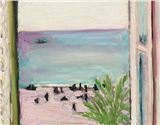
Burr’s visual language combined vibrant color palettes with dynamic compositions, often exploring natural motifs such as seascapes, floral arrangements, and abstracted landscapes. His works balance decorative appeal with modernist structure, reflecting the tastes of his era. Representative pieces include *Abstract Landscape* (circa 1980), *Blue and White Wildflowers* (circa 1985), and *Lighthouse with Seagulls* (1985), each exemplifying his synthesis of spontaneity and design.
Exhibitions & Representation
His works have been presented by RoGallery, a platform specializing in 20th-century modern and contemporary prints, and have appeared in the catalogues of auction houses including those tracked by MutualArt, where pieces such as *Sailing Boats* have entered private collections. These venues have played a key role in maintaining the visibility of his studio’s output in the secondary market.
Awards & Accolades
No major awards or formal honors have been documented in relation to Burr’s career, though his influence is measured more through reach and accessibility than institutional recognition.
Little Known Facts
Despite the widespread circulation of artworks signed “Lee Reynolds,” Burr’s personal hand appears on only a small fraction of them. The majority were collaboratively produced under his supervision at Vanguard Studios, making his practice a pioneering example of artistic authorship in a commercial context.
Legacy
Burr’s model of studio-based art production anticipated later discussions about authorship, authenticity, and the democratization of art, echoing precedents set by figures like Warhol while operating within the distinct realm of accessible contemporary art. By bridging artistic vision with scalable production, he expanded the market for original works among middle-class audiences. His later stewardship of East Park Gallery furthered a commitment to modern aesthetics in Southern California. Though few direct artistic descendants are recorded, his legacy endures in the intersection of art, commerce, and public engagement—a quiet architect of art’s broader cultural reach.
Lee Reynolds Record Prices
The 2026 record price for Lee Reynolds was for Abstract Airplane Scene
The 2025 record price for Lee Reynolds was for Still Life
The 2024 record price for Lee Reynolds was for Sailing Boats
The 2023 record price for Lee Reynolds was for Waterlilies
The 2022 record price for Lee Reynolds was for Horse Race
The 2021 record price for Lee Reynolds was for Santa Barbara
The 2020 record price for Lee Reynolds was for LARGE Lee Reynolds Oil on Canvas
The 2019 record price for Lee Reynolds was for Untitled
The 2018 record price for Lee Reynolds was for SHIP AT SEA
The 2017 record price for Lee Reynolds was for AMERICAN ABSTRACT
The 2016 record price for Lee Reynolds was for Snow Scene with House
The 2015 record price for Lee Reynolds was for CITY VIEW
The 2013 record price for Lee Reynolds was for Cubist Composition with Abstracted Bird
The 2012 record price for Lee Reynolds was for A pier scene with boats and city skyline in distance
The 2005 record price for Lee Reynolds was for Aquaduct
Jump to section
×