ARTISTS

Lessons in Geometry
Artists have obsessed over the relationship between mathematics and art for millennia. As artists turned toward abstraction in the early twentieth century, Europeans like Piet Mondrian used geometry to create a set of rules and parameters that guided their creative process. Meanwhile, American artists began developing their own styles and movements—particularly Abstract Expressionism, which was typified by bold, quickly executed brushwork, drips, and splashes. In the mid-twentieth century in the United States, artists laid the groundwork for Geometric Abstraction as a more cerebral alternative to the often macho flamboyance of Abstract Expressionism. Over the ensuing decades, artists used geometry to produce abstract works that ranged from the dazzling Op Art of Victor Vasarely to the restrained Minimalism of Sol LeWitt.
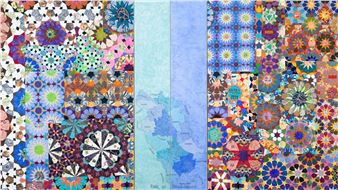
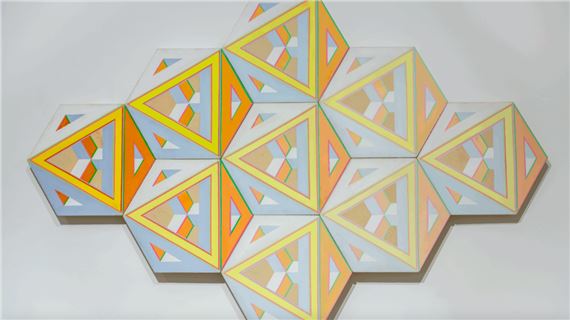
Lessons in Geometry traces the evolution of hard-edged abstraction in the United States as artists sought to use pure geometric forms to create works with balance, harmony, and order. For these artists, shape, line, and color took precedence over representational compositions. The Everson’s collection reflects the wildly varied ways that artists have used geometry to serve their personal expression, from the analytical formulations of Robert Swain to the shaped canvases of Harmony Hammond and the spatial illusions of Tony King.
Recommended for you


Artists have obsessed over the relationship between mathematics and art for millennia. As artists turned toward abstraction in the early twentieth century, Europeans like Piet Mondrian used geometry to create a set of rules and parameters that guided their creative process. Meanwhile, American artists began developing their own styles and movements—particularly Abstract Expressionism, which was typified by bold, quickly executed brushwork, drips, and splashes. In the mid-twentieth century in the United States, artists laid the groundwork for Geometric Abstraction as a more cerebral alternative to the often macho flamboyance of Abstract Expressionism. Over the ensuing decades, artists used geometry to produce abstract works that ranged from the dazzling Op Art of Victor Vasarely to the restrained Minimalism of Sol LeWitt.
Lessons in Geometry traces the evolution of hard-edged abstraction in the United States as artists sought to use pure geometric forms to create works with balance, harmony, and order. For these artists, shape, line, and color took precedence over representational compositions. The Everson’s collection reflects the wildly varied ways that artists have used geometry to serve their personal expression, from the analytical formulations of Robert Swain to the shaped canvases of Harmony Hammond and the spatial illusions of Tony King.
Artists on show
Contact details

What's on nearby