
 ARTISTS
Radenko Milak and Roman Uranjek: Dates 2
Dec 05, 2015 - Feb 14, 2016
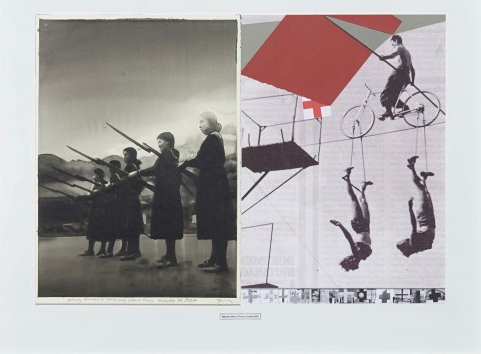
Dates [as in a calendar] is only one of many possible meanings of the word dates, which artists Radenko Milak and Roman Uranjek used as the title for their joint exhibition format. According to the artists themselves, other meanings are also correct: diaries, procedures of measuring time, which in their case, due to an arbitrary procedure that was used to make the work integral, becomes a diachronic, relativized time, devoid of continuum. Dates could be understood also as a form of social engagement that includes al least two interested parties. Both meaning are correct here. Namely, since 2013, Milak and Uranjek have been publishing their art works on the social network, Facebook, which enabled them to meet in the first place. Milak then started publishing his diary cycle of black-and-white watercolors, 365 Image of Time, dating from 1 Jan 2013 to 31 Dec 2013, while Uranjek was publishing his collages from the At Least One Cross a Day series, which he initiated on 1 Jan 2002. Both of them chose the diary principle of subjective and obsessive time recording as their daily strategy; Milak was applying it for a year, and Uranjek has been doing this for 13 years already. Their interest for the other’s work, their mutual recognition of their artistic closeness in understanding objective time and historical time, as well as in distinguishing phenomena of social and cultural past (history) from those of personal/obsessive documenting,[1] and from the process of memory, developed into a concrete collaboration, creating and exhibiting their joint and composite works. And, what was that the artists recognized as their joint platform? As an answer, or at least as a trigger for possible explanations, I will cite the Facebook status by Radenko Milak from 7 Nov 2010: “Images of the past are threatened by extinction if the present is not recognized in them…” Therefore, the question is how to not forget the past, how to make it visible here and now, but also, how to rise above it, in the processes of transforming reality as a whole.[2]
Today, when it is obvious that the world has been for many decades exposed to recurring wars, terrorism, brutal violence, mass migration, resurgence of cold war trends, xenophobia, fear and paranoia, this question becomes the mother of all questions. Both artists approached it very early, already in their formative period – Uranjek did it as a founding member of the Slovenian group IRWIN in mid-eighties, and Milak, being younger of the two, appeared about a decade ago on the artistic scene of Bosnia and Herzegovina. Both of them tied their artistic work to the domain of cultural and political activism using artistic means. Uranjek did it through the well-known activities of the IRWIN group and the Neue Slovenische Kunst (NSK) that caused a big disruption in the social and cultural currents in ex-Yugoslavia, and significantly contributed to the processes of democratization; later, it enhanced the polarization and weakening of the totalitarian consciousness of the political elites. On the other hand, Milak, at the beginning of the new millennium, making a generational leap over the war-time nineties, as the founder of the art association Protok and the SpaPort Biennial of Contemporary Art in Banja Luka, questions his personal and social perception; he is interested in how the media influence our memory of the events of the (war) time that, as the consequence of the process of dissolving totalitarianism and statist unitarism, caused the tragic and appalling conflicts between the newly formed national states. The generational differences between Milak and Uranjek did not reduce their similarities in understanding the past as an aggressive and exhausting “parasite” on our everyday life, a “parasite” that social and national communities in the region of ex-Yugoslavia cannot get rid of.
Today, when it is obvious that the world has been for many decades exposed to recurring wars, terrorism, brutal violence, mass migration, resurgence of cold war trends, xenophobia, fear and paranoia, this question becomes the mother of all questions. Both artists approached it very early, already in their formative period – Uranjek did it as a founding member of the Slovenian group IRWIN in mid-eighties, and Milak, being younger of the two, appeared about a decade ago on the artistic scene of Bosnia and Herzegovina. Both of them tied their artistic work to the domain of cultural and political activism using artistic means. Uranjek did it through the well-known activities of the IRWIN group and the Neue Slovenische Kunst (NSK) that caused a big disruption in the social and cultural currents in ex-Yugoslavia, and significantly contributed to the processes of democratization; later, it enhanced the polarization and weakening of the totalitarian consciousness of the political elites. On the other hand, Milak, at the beginning of the new millennium, making a generational leap over the war-time nineties, as the founder of the art association Protok and the SpaPort Biennial of Contemporary Art in Banja Luka, questions his personal and social perception; he is interested in how the media influence our memory of the events of the (war) time that, as the consequence of the process of dissolving totalitarianism and statist unitarism, caused the tragic and appalling conflicts between the newly formed national states. The generational differences between Milak and Uranjek did not reduce their similarities in understanding the past as an aggressive and exhausting “parasite” on our everyday life, a “parasite” that social and national communities in the region of ex-Yugoslavia cannot get rid of.
Recommended for you
Mar 07, 2026
- Aug 16, 2026

Mar 19, 2026
- Jun 14, 2026
May 15, 2026
- Jun 20, 2026
Dates [as in a calendar] is only one of many possible meanings of the word dates, which artists Radenko Milak and Roman Uranjek used as the title for their joint exhibition format. According to the artists themselves, other meanings are also correct: diaries, procedures of measuring time, which in their case, due to an arbitrary procedure that was used to make the work integral, becomes a diachronic, relativized time, devoid of continuum. Dates could be understood also as a form of social engagement that includes al least two interested parties. Both meaning are correct here. Namely, since 2013, Milak and Uranjek have been publishing their art works on the social network, Facebook, which enabled them to meet in the first place. Milak then started publishing his diary cycle of black-and-white watercolors, 365 Image of Time, dating from 1 Jan 2013 to 31 Dec 2013, while Uranjek was publishing his collages from the At Least One Cross a Day series, which he initiated on 1 Jan 2002. Both of them chose the diary principle of subjective and obsessive time recording as their daily strategy; Milak was applying it for a year, and Uranjek has been doing this for 13 years already. Their interest for the other’s work, their mutual recognition of their artistic closeness in understanding objective time and historical time, as well as in distinguishing phenomena of social and cultural past (history) from those of personal/obsessive documenting,[1] and from the process of memory, developed into a concrete collaboration, creating and exhibiting their joint and composite works. And, what was that the artists recognized as their joint platform? As an answer, or at least as a trigger for possible explanations, I will cite the Facebook status by Radenko Milak from 7 Nov 2010: “Images of the past are threatened by extinction if the present is not recognized in them…” Therefore, the question is how to not forget the past, how to make it visible here and now, but also, how to rise above it, in the processes of transforming reality as a whole.[2]
Today, when it is obvious that the world has been for many decades exposed to recurring wars, terrorism, brutal violence, mass migration, resurgence of cold war trends, xenophobia, fear and paranoia, this question becomes the mother of all questions. Both artists approached it very early, already in their formative period – Uranjek did it as a founding member of the Slovenian group IRWIN in mid-eighties, and Milak, being younger of the two, appeared about a decade ago on the artistic scene of Bosnia and Herzegovina. Both of them tied their artistic work to the domain of cultural and political activism using artistic means. Uranjek did it through the well-known activities of the IRWIN group and the Neue Slovenische Kunst (NSK) that caused a big disruption in the social and cultural currents in ex-Yugoslavia, and significantly contributed to the processes of democratization; later, it enhanced the polarization and weakening of the totalitarian consciousness of the political elites. On the other hand, Milak, at the beginning of the new millennium, making a generational leap over the war-time nineties, as the founder of the art association Protok and the SpaPort Biennial of Contemporary Art in Banja Luka, questions his personal and social perception; he is interested in how the media influence our memory of the events of the (war) time that, as the consequence of the process of dissolving totalitarianism and statist unitarism, caused the tragic and appalling conflicts between the newly formed national states. The generational differences between Milak and Uranjek did not reduce their similarities in understanding the past as an aggressive and exhausting “parasite” on our everyday life, a “parasite” that social and national communities in the region of ex-Yugoslavia cannot get rid of.
Today, when it is obvious that the world has been for many decades exposed to recurring wars, terrorism, brutal violence, mass migration, resurgence of cold war trends, xenophobia, fear and paranoia, this question becomes the mother of all questions. Both artists approached it very early, already in their formative period – Uranjek did it as a founding member of the Slovenian group IRWIN in mid-eighties, and Milak, being younger of the two, appeared about a decade ago on the artistic scene of Bosnia and Herzegovina. Both of them tied their artistic work to the domain of cultural and political activism using artistic means. Uranjek did it through the well-known activities of the IRWIN group and the Neue Slovenische Kunst (NSK) that caused a big disruption in the social and cultural currents in ex-Yugoslavia, and significantly contributed to the processes of democratization; later, it enhanced the polarization and weakening of the totalitarian consciousness of the political elites. On the other hand, Milak, at the beginning of the new millennium, making a generational leap over the war-time nineties, as the founder of the art association Protok and the SpaPort Biennial of Contemporary Art in Banja Luka, questions his personal and social perception; he is interested in how the media influence our memory of the events of the (war) time that, as the consequence of the process of dissolving totalitarianism and statist unitarism, caused the tragic and appalling conflicts between the newly formed national states. The generational differences between Milak and Uranjek did not reduce their similarities in understanding the past as an aggressive and exhausting “parasite” on our everyday life, a “parasite” that social and national communities in the region of ex-Yugoslavia cannot get rid of.
Artists on show

What's on nearby
Mar 24, 2026
- Jun 21, 2026
Feb 24, 2026
- May 24, 2026
