ARTISTS

The Anatomy Lesson
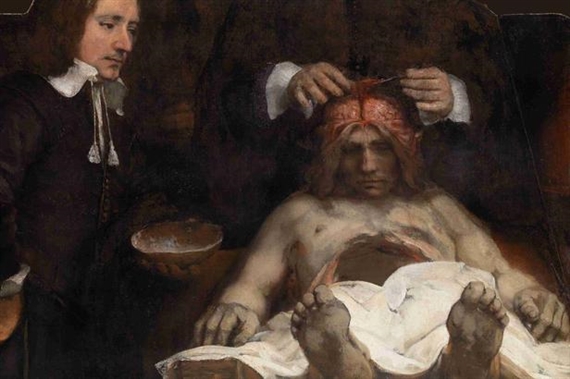
The anatomical practice of the seventeenth-century Surgeon’s Guild of Amsterdam symbolises the innovative spirit of the Dutch Golden Age. Dissections of human corpses in the Theater Anatomicum were open not only to medical men; wealthy laymen could also pay to attend. Science, art and commercial acumen went hand in hand to produce an era of unprecedented social and cultural development. But, perhaps most importantly of all, the paintings mark the birth of empirical science. For the first time, people in Europe abandoned the all-encompassing concept of God. The Bible was no longer the sole explanation for everything. People went in search of the tangible reality and, as part of that quest, turned the body inside out.
The exhibition will also feature items drawn from the history of medical science. In addition to surgical instruments, these will include Utrecht University Medical Centre’s world-famous anatomical preparation ‘Child’s head with Turkish cap’. This important preparation is thought to have been made by Frederik Ruysch in around 1700. Ruysch’s collection of anatomical specimens was bought by Tsar Peter the Great of Russia and is now in the State Hermitage Museum in Saint Petersburg, where access to it is difficult.
The imperfections or failures of the human body, the relationship between body and mind, the power of the medical world and the magic of dissection are topics that feature in the classic modern and contemporary sections of the exhibition. The impressive line-up of artists includes great names like Atelier van Lieshout, Francis Bacon, Berlinde De Bruyckere, Matthew Day Jackson, Lucio Fontana, Mona Hatoum, Paul Thek, Marc Quinn and – of course –Damien Hirst. Their work reveals with particular clarity the friction between the divine and the earthly. It includes, for example, Hirst’s installation Sometimes I Avoid People. Consisting of two glass display cases and gas cylinders, the work give visual expression to the modern way of death: a mysterious activity that takes place behind the closed doors of hospital rooms, with results that are disposed of quickly and efficiently.
Specifically for this exhibition, internationally renowned Dutch sculptor Folkert de Jong has created a large installation based on the idea of the Anatomical Theatre. The Primacy of Matter over Thought will form the very heart of the exhibition and will place visitors in the centre of a space in which they will become keenly aware of the fragility of their own existence. Folkert de Jong takes the anatomical theatre as the starting point for an examination of the balance of power between the artwork, the artist and the viewer. Or, in other words, the deed, the perpetrator and the witnesses.
Recommended for you


The anatomical practice of the seventeenth-century Surgeon’s Guild of Amsterdam symbolises the innovative spirit of the Dutch Golden Age. Dissections of human corpses in the Theater Anatomicum were open not only to medical men; wealthy laymen could also pay to attend. Science, art and commercial acumen went hand in hand to produce an era of unprecedented social and cultural development. But, perhaps most importantly of all, the paintings mark the birth of empirical science. For the first time, people in Europe abandoned the all-encompassing concept of God. The Bible was no longer the sole explanation for everything. People went in search of the tangible reality and, as part of that quest, turned the body inside out.
The exhibition will also feature items drawn from the history of medical science. In addition to surgical instruments, these will include Utrecht University Medical Centre’s world-famous anatomical preparation ‘Child’s head with Turkish cap’. This important preparation is thought to have been made by Frederik Ruysch in around 1700. Ruysch’s collection of anatomical specimens was bought by Tsar Peter the Great of Russia and is now in the State Hermitage Museum in Saint Petersburg, where access to it is difficult.
The imperfections or failures of the human body, the relationship between body and mind, the power of the medical world and the magic of dissection are topics that feature in the classic modern and contemporary sections of the exhibition. The impressive line-up of artists includes great names like Atelier van Lieshout, Francis Bacon, Berlinde De Bruyckere, Matthew Day Jackson, Lucio Fontana, Mona Hatoum, Paul Thek, Marc Quinn and – of course –Damien Hirst. Their work reveals with particular clarity the friction between the divine and the earthly. It includes, for example, Hirst’s installation Sometimes I Avoid People. Consisting of two glass display cases and gas cylinders, the work give visual expression to the modern way of death: a mysterious activity that takes place behind the closed doors of hospital rooms, with results that are disposed of quickly and efficiently.
Specifically for this exhibition, internationally renowned Dutch sculptor Folkert de Jong has created a large installation based on the idea of the Anatomical Theatre. The Primacy of Matter over Thought will form the very heart of the exhibition and will place visitors in the centre of a space in which they will become keenly aware of the fragility of their own existence. Folkert de Jong takes the anatomical theatre as the starting point for an examination of the balance of power between the artwork, the artist and the viewer. Or, in other words, the deed, the perpetrator and the witnesses.
Contact details

What's on nearby