 BUY ART

Esther Mahlangu and Ndebele Culture: Beyond the Wall
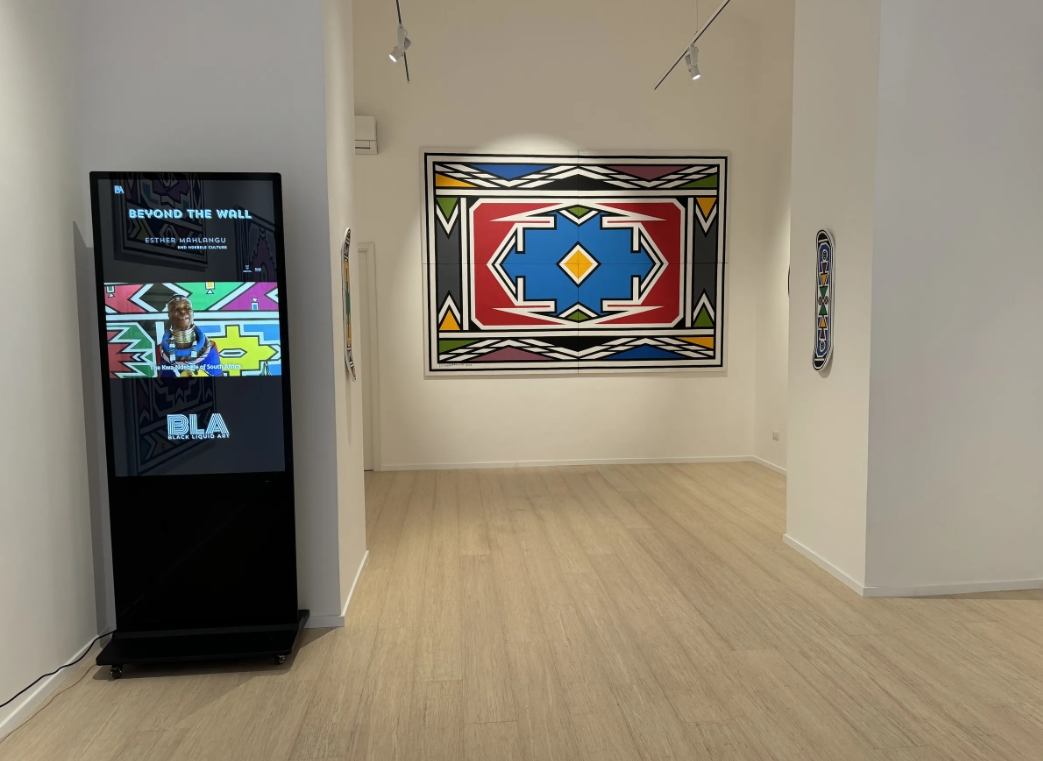
Black Liquid Art is inaugurating its Rome venue with an exhibition dedicated to Esther Mahlangu, one of the most iconic figures in contemporary African art. This event offers the opportunity to connect with the work of one of the most powerful voices in South African art, capable of blending Ndebele tradition with modernity, taking her cultural message beyond the confines of time and space.
Esther Mahlangu, an internationally renowned painter, has participated in some of the most significant global art exhibitions, from Magiciens de la Terre to Africa Remix, and her works are included in major institutions, museums, and private collections around the world. Her art is deeply appreciated not only internationally but also in her homeland, South Africa, where she is a prominent figure. Starting from her hometown, Mabhoko, Esther has traveled extensively to share the Ndebele painting tradition, bringing her culture to the world.
Following tradition, Esther Mahlangu began painting at a young age under the guidance of her grandmother and mother. Originally, Ndebele paintings were intended to decorate houses and were renewed during male rites of passage. This painting tradition was exclusively entrusted to women, symbolizing the profound link between art and culture in the Ndebele community.
Today, Esther Mahlangu has expanded this practice by teaching Ndebele art to young boys in her tribe. As she mentioned in an interview with Antonella Pisilli, her goal is to preserve and spread her community's culture, creating a small army of artists capable of decorating places worldwide with the Ndebele style.
Ndebele paintings are characterized by formal geometric modules, with a predominant use of triangular shapes, strict symmetry, vivid colors, and bold black lines on a white background. This visual language, which may seem spontaneous and intuitive, actually represents an elaborate phenomenology of form. In Mahlangu’s art, abstraction takes precedence over the figurative, leading her work toward a universal dimension akin to the pure concepts of abstraction, similar to those valued by Suprematists. In this context, the sensitivity of forms becomes the essence of art itself.
Artist on show: