 BUY ART

Misheck Masamvu: Naked
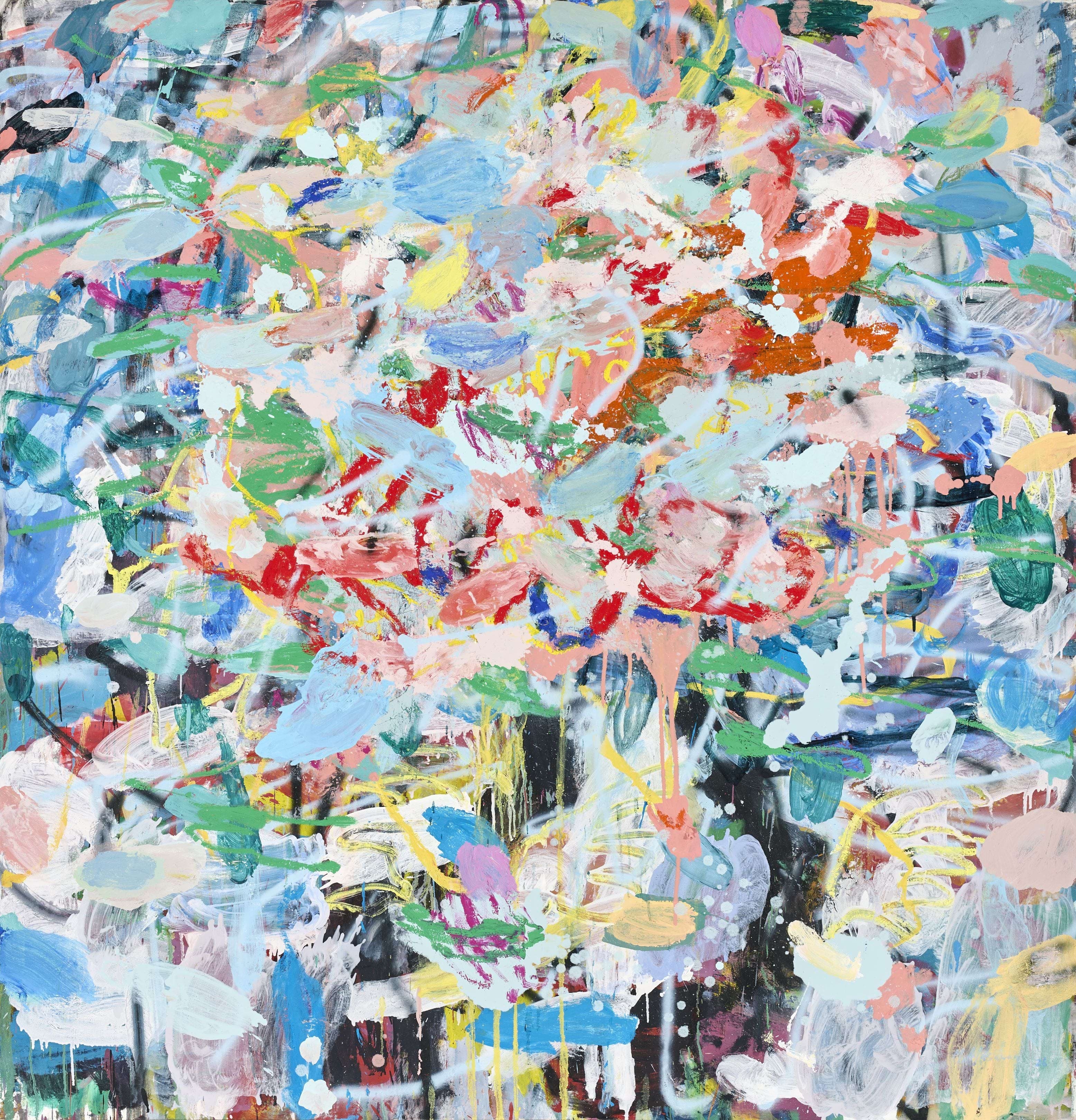
Goodman Gallery Cape Town is pleased to present Naked, acclaimed painter Misheck Masamvu’s ninth solo exhibition with the gallery. Comprising a dozen paintings, many executed in his characteristically vibrant palette, the exhibition brings together recent works on Belgian linen made over the last two years alongside earlier canvas paintings from 2016–19, reworked during a 2026 residency in Johannesburg.
Offering an informal survey of Masamvu’s evolving compositional strategies and studio techniques, 'Naked' foregrounds his sustained pursuit of innovation within painterly abstraction. His densely layered compositions feature assertive blocks and bands of colour, notably vivid reds, variegated greens and a spectrum of blues, often overlaid with expressive lines and chromatic trails.
The exhibition includes a group of new works incorporating black, ranging from the dense matte blacks achieved with oil stick to muted areas realised with spray-paint. This exploration of blackness marks a notable shift for an artist widely recognised as a colourist. Goodman Gallery will present a new large-scale composition in this mode at Art Basel in June. The dual presentation in Cape Town and Basel honours Masamvu’s position as both an influential painter and a catalyst for artistic community.
In 2009, Masamvu and his partner, Georgina Maxim, founded Village Unhu, an artist-run space in Harare. Since its inception, Village Unhu has served as an incubator for numerous artists who have subsequently achieved international prominence. Masamvu likens the initiative to the wooden frame supporting a painting: the structure that sustains collective life, with its people, aspirations and shared experiences functioning as the canvas.
This idea of an energised artistic community, which Masamvu extends to his newer operations in Mutare, is central to his biography and to the conceptual framework of Naked. The exhibition title recalls two formative early exhibitions in Zimbabwe: Naked Mind I, presented in 2002 at the National Gallery of Zimbabwe in Bulawayo, and Naked Mind II, held at Delta Gallery in 2003.
Presented in the aftermath of Zimbabwe’s contentious 2000 constitutional referendum, Naked Mind I emerged during a period of intensifying political and economic instability, a situation that persists. Masamvu remembers the exhibition as a rare and trusted space in which young people could gather and articulate divergent viewpoints outside institutional constraint.
Naked Mind II marked a return to Delta Gallery, where Masamvu had first attended Saturday workshops as a teenager. Born shortly after Zimbabwean independence in 1980, he came of age within the orbit of the pioneering Harare space established in 1975 by painters Helen Lieros and Derek Huggins. In 1999, he participated in a Delta workshop led by Jerry Zeniuk, the German-American abstract painter under whom he later studied at Munich’s Academy of Fine Arts.
Writing in a 2000 issue of Zimbabwe’s now-defunct Gallery magazine, Zeniuk remarked on the “colours being revealed in combinations unfamiliar to my own experience” in the abstract backgrounds of the figural allegories being produced by Zimbabwean painters. Masamvu’s existentially charged figure paintings, which echoed Zeniuk’s observation, were a highlight of the inaugural Zimbabwe Pavilion at the 54th Venice Biennale in 2011. The presentation introduced international audiences to Zimbabwe’s rich expressionist tradition, of which Masamvu remains a leading exponent.
In the years following Venice, Masamvu’s practice became increasingly abstract. Figures gradually dissolved into the background, resulting in compositions that opened onto a more fluid and hopeful imaginative space. The figure persists in his new work, if not always visibly, then socially and psychologically. These works draw strongly on the visual grammar of the street, with Masamvu favouring direct observation over invention. He likens his layered compositions to weathered billboards: surfaces carrying traces of earlier messages that persist beneath peeling paint and fading colour, inviting viewers to reconstruct meaning rather than receive a fixed statement.
Masamvu’s recent work is elliptical and poetic rather than didactic, yet retains the urgency that characterised his earliest paintings. Zimbabwe’s political and social realities continue to shape his thinking, though he avoids direct illustration or overt political narration. Instead, he leaves space for ambiguity and personal reflection. This sensibility informs his understanding of his materials and process.
Masamvu likens Belgian linen, with its weathered appearance, to a faded tent, battlefield, ruin or drying leaves. For the artist, it offers a resonant ground through which to “illuminate or draw attention to what might have happened in that space”. He describes painting as an attempt to “drum out” an image from the canvas and values oil sticks for their immediacy and flexibility, allowing for rapid, provisional mark-making that nevertheless becomes permanent. Despite the implied violence of the word “stick”, he is drawn to the medium’s directness, its capacity to function as an extension of the hand rather than as the mediated gesture of a brush.
Artist on show: