 BUY ART
HOS Gallery
Roma Hałat & Andrzej Szewczyk: Repeat/Recal
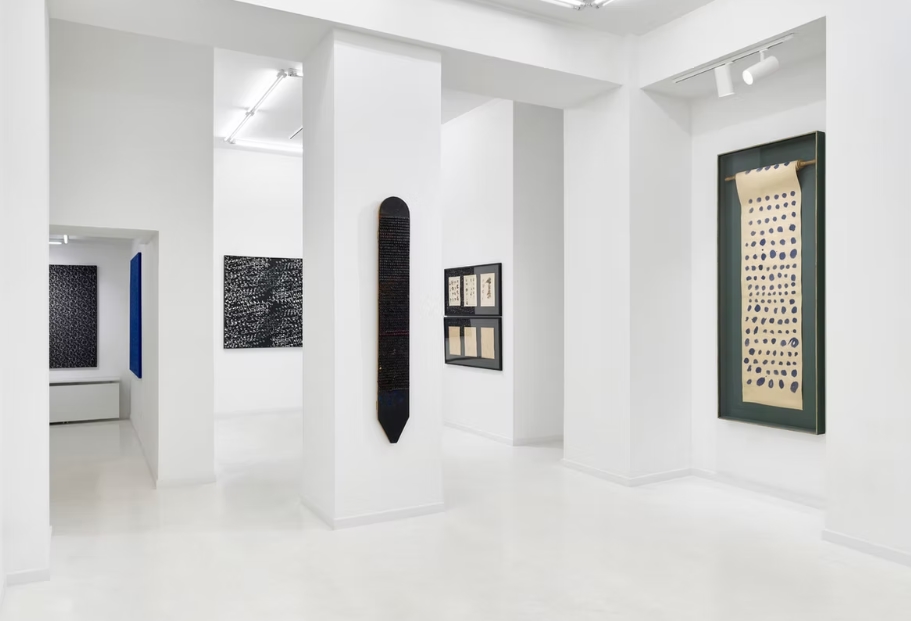
The exhibition ‘Repeat/Recall’ creates a space for dialogue between selected works by Roma Hałat and works by Andrzej Szewczyk from dela.art collection.
The exhibition focuses on the points of contact between paradoxically different and similar realisations, and the fascinations associated with them. These aspects certainly include the search for the limits of painting through conceptual activities, inspiration by writing, alphabets as sets of graphic signs, sensitivity towards everyday life and, finally, the repetition of the artistic gesture in extended series.
At the same time, in the early 1970s, Hałat and Szewczyk painted using the house painter’s roller with cut-out patterns. In both cases they were a way of exploring the limits of painting, treated as an ‘activity in itself’, and an experimental rejection of the individual gesture and classical aesthetics. They both reduced painting to a physical activity. In the history of Polish art, it was Szewczyk who pioneered this solution. However, before he initiated, together with Tomasz Wawak, the series of picture painting unified with wall painting’ in 1974, Roma Hałat used this tool for a week in 1971 in the rooms of the Art Propaganda Centre in Łódź, creating large-scale compositions in front of the public. The sheer size of the works made it impossible to remove them from the exhibition venues, which is why none of the original works from this period have survived. The artist reproduced two of the paintings on a smaller scale three decades later.
In 1977 Roma Hałat had transferred the image of a fleshless leaf blade onto canvas, initiating the series ‘Landscapes’, which begins with an analysis of the surrounding world, synthesising what is available to the eye and capturing it in simple forms. She continued this series until the mid-1980s. During this time Szewczyk turned to new methods and materials such as coloured pencils, molten lead and, since the 1990s, pistachio shells, semen and human and animal blood.
Hałat and Szewczyk also revisit themes related to literature and calligraphy.
The titles of their works are inspired by epics, poetry and epistolography.
Their paintings and objects are written with tiny rows of holes, pencil shavings, pistachio shells, lead fused into wood and less rhythmic patches of paint on canvas and paper. By using the conventions of the written word, they invoked artistic forms that carried content and emotion, and the apparent illegibility of their verses invited alternative readings beyond the purely linguistic.
Szewczyk’s creations are sometimes compared to the Orthodox tradition of icon writing and the Russian etymology of the word ‘painting’ – żywopis (Russian: живопись), which refers to painting as a living record of life. In the context of Szewczyk’s works, the term palimpsest is used, i.e. a manuscript made on material that has already been used. Szewczyk’s interventions added another layer, most often on the pages of books, old invitations or envelopes. In 1985, Roma Hałat initiated the series ‘Triads’, in which each work consists of three layers, which are treated more painterly or graphically. In the top layer, the artist cut small holes and, by tilting them away, revealed what was hidden on the inner sheets. Personal notes by the artist and fragments of her favourite literary works became an integral part of the work. Their content, however, was in a sense encoded, enchanted in the characteristic handwriting, written backwards with the left hand.
Artists on show: