
 ARTISTS
HOS Gallery
Ryszard Grzyb & Marcin Osiowski: I pop a beautiful sentence into my mouth and suck it like a fruit drop
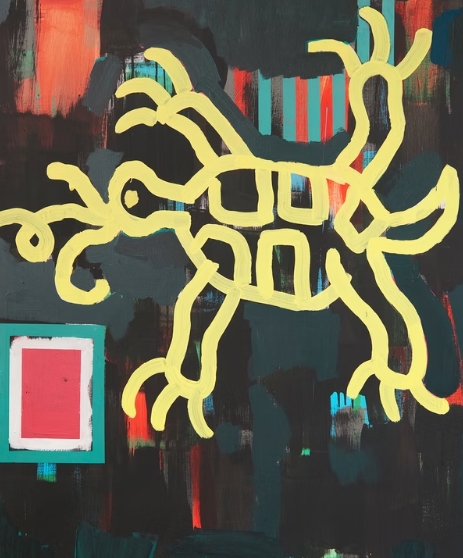
The exhibition’s title was taken from one of the opening sentences of Bohumil Hrabal’s novel “Too loud a solitude”. In the year of the book’s publication (1976), the Czech writer was Grzyb’s and Osiowski’s contemporary. What the artists also had in common manifested both in their characteristic sense of humour, sensitivity combining wit and melancholy, and the experience of creating in the shadow of the communist system. The associations of the narrator of “Too loud a solitude” with Grzyb and Osiowski are also manifested in their love of books, undiscovered worlds created by literature and philosophy. The written word plays a considerable role in the work of each of the painters; it inspires them to paint, stimulates their imagination, and encourages philosophical reflection as well as a more careful observation of how language is used in everyday life. The works presented at the exhibition reflect these inspirations. Both individual and these created as part of the OBA project, the paintings are inspired by the artists’ readings and employ the written word as a compositional element. That is why their paintings reveal direct references to the work and biography of such figures as Georg Trakl, George Orwell, Ludwig Wittgenstein, and Plato.
Characterizing the work of the OBA duo, one can think of the concept of “carnivalization” by Mikhail Bakhtin, who draws attention to the “culture of laughter” depreciated by researchers. Homo Sapiens owes the sense of humour to the relatively high capacity of the brain cavity and the ability to think in an abstract way, or the qualities that constitute us as a species. That is why, sensitivity to absurdity and laughter should be considered an inseparable part of human existence. But not every era expressed humour in the same way. Bakhtin’s laughter, and its expression in the form of a folk carnival, is characterized by ambivalence; it can be both a form of approval and criticism. It inherently includes elements of eccentricity, clownery, or even obscenity and blasphemy that defy authority. Grzyb and Osiowski’s paintings remind us of this carnival aspect of everyday life, where the apparent logic and universal acceptance of rules and order are suspended, putting aside behaviours and social situations that are often considered obvious and unquestionable.
Grzyb has been writing poetry since highschool. The artist considers it a medium of expression equivalent to painting. At the beginning of the 2000s, Grzyb created paintings that he provisionally called “written”; they combine painting and texts taken from various sources. In turn, Osiowski since his student times has penned his thoughts on culture, art, social relations, own experiences in the form of loose notes, which last year were the basis of his artistic action “Milking van Gogh”. . Both individual and these created as part of the OBA project, the paintings are inspired by the artists’ readings and employ the written word as a compositional element. The content and emotions alike are carried not only by the message of the linguistic layer of painted words, but also by their typographical form. Both in their final formal shape and in their meaning, these paintings are made of the word and the paint. Words appear in different configurations, criss-crossing and intersecting.Words appearing on the canvas evade literalness, enriched with colour and texture, and entangled in new contexts and content.
From the very beginning painting together has had the character of friendly meetings, which is why the OBA’s paintings reveal the artists’ pleasure in cooperation, and enjoying the very act of painting. Already before the meeting, one of the painters usually prepares a photo, a travel postcard, an illustration from a book, a forgotten sketch, or a recently read thought or a sentence once written down. The concept of a canvas is agreed upon together, it mainly deals with formal issues and is created in the process of translating words into visual language. They divide their roles spontaneously – the one who paints has the confidence and knows what gesture should be made at a given moment. Their joint sessions look like jam sessions, improvisations, where one theme is interpreted and processed by the other person. Joint painting also resembles relay race, where the track is divided into legs and the baton – here the brush – is transferred to complete the next leg with new energy and fresh look, approaching the goal together. Overcoming the artist’s loneliness, which remains the artist’s natural state, is an important aspect of taking decisions together and supporting each other for both of them. The painter usually works alone, looking for all solutions on his or her own responsibility. During their joint sessions, each of the artist knows that the other is watching his achievements and is ready to take the initiative.
The relationship between the graphic form of signs and the patterns of meanings is sometimes revealed through the titles that play an important role linking the artists and the audience. Often the titles are quotes taken from other literary works or song lyrics. In this context, they are elements of the painting structure. Even though hidden on the reverse of the canvas, they help to reveal new meanings of the visual layer; they are catalysts of ambiguity, associations, and unlimited peregrinations of imagination. sometimes disappointment, fatigue, or a certain mood of catastrophism.
Both Hrabal’s book, from which the exhibition’s title was taken, and the paintings displayed at the exhibition, combine humour with seriousness, realism with magic and surrealism. Hrabal’s book is said to be poetry written in prose, whereas in the case of Grzyb and Osiowski it is poetry written in painting.
Artists on show: