 BUY ART



HOS Gallery
Memory Palace
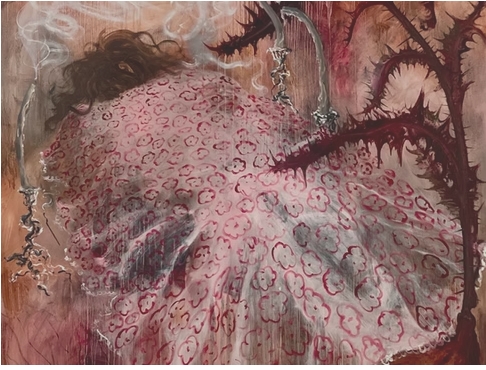
Walking through the chambers of the imaginary Memory Palace is a mnemonic known since antiquity. Each object encountered evokes specific memories. Crossing its threshold, one discovers not only images of the past, but also the complex emotions that shape identity — ambivalence, where beauty meets decay and shame intertwines with fascination.
In the course of growing up, we face boundaries and ambiguities. We place, separate and define our place. This experience can lead to fear and disgust, but also sublimation — the transformation of chaos into art or mystical experiences. A common thread in the practice of Guenther, Sakowska, Szczerbowska and Wojcik is tension — between aesthetics and control, between structure and subjectivity, between beauty and its decay. The artists do not create clear-cut diagnoses. Rather, they test boundaries, decompose mechanisms. They trace what remains hidden. Their works build maps of contemporary emotions: shame, need, loneliness, anger and the desire for control — but also the desire for freedom.
Abject — a psychoanalytic term introduced by Julia Kristeva in Powers of Horror (1982) — is all about ambiguity. It separates from that which threatens, but does not protect from it completely. On the contrary, it recognizes the threat as something eternally present. It is a mixture of judgment and emotion, condemnation and longing. It is inscribed in the duality of the experience of socialization into the female role, planted on guilt and the constant shifting of boundaries between norm and taboo. It unseals them, exposes the repressed, the unwanted, the hidden. Pink is easily soiled.
Artists face the abject in two ways — they highlight ugliness, fear, anxiety or construct aesthetic armor. They encase, subdue, tame. They organize the narrative fabric of identity with symbols, scores, architectural circuits, dream map journeys. Nevertheless, the peace is disturbed, the sleeper is entangled in dreams by smoke from phallic candles, the clustered marks on the scores swell. Eroticism becomes entangled with violence and the subconscious realm. And beauty, fragile and delicate, can crumble any moment. Although the Palace is built from memories, it is first and foremost a map of emotions and a trace of what has passed but never disappeared. The objects activate memory that is not logical, but sensory, related to texture, muscle tension, the smell of smoke, traces on the skin. The artists do not reconstruct the past, but perform it, as a ritual of growing up, a spectacle of sublimation.
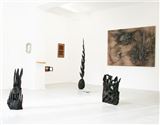
The detailed character of the works presented in the exhibition is not accidental. It is the detail that sets the rhythm of looking and introduces the world of the hidden, whether in filigree drawings or large-format paintings. Exploring, the viewer becomes a voyeur who discovers more elements. Intimate proximity activates the unconscious. It is necessary to evoke feelings of revulsion, to activate defense mechanisms, to confront one's inner self. So take a closer look, peering inside.
Curator and author of the text: Marianna Łomża
Artists on show: